Wednesday, March 30, 2011

Cleveland's Long Road To Rebuilding

A central theme of Miami and Cleveland's fourth and final match-up of the season Tuesday night was "showing up." Most observers, including myself, felt all Miami had to do was show up in order to win. They'd won the previous three match-ups by an average of 20 points, more than tripled the Cavs win total this season, and flat out possess more talent on their roster.

LeBron James also failed to show up for the pregame introductions, launching a thousand speculations as to why. The least likely among them is that James was scared to face the chorus of boos waiting for him. Unlikely because James has been serenaded with boos from every city this season and took part in the introductions on December 2nd, the last time the Heat played in Cleveland.

James claimed he was in the restroom during the introductions. Obviously, an eight-year veteran who hasn't missed a pregame introduction in his career shouldn't be granted the benefit of the doubt in this case. James most likely skipped the introductions in protest of some of his friends and associates being denied access to an underground parking garage at Quicken Loans Arena. The privilege, routinely granted to James' entourage when he was a member of the team, isn't typically granted to visiting players.

James hogged the pre-game and much of the in-game conversation, posting the 36th triple-double of his career. But Tuesday night was undoubtedly about the Cavaliers and their 102-90 win.

In their first meeting in Cleveland, the Cavs were rightly accused of cowering to LeBron. They joked with him as he approached their bench during free throw attempts and offered very little resistance on the defensive end. The Cavs went on to lose 35 of their next 36 games. Followers of the team pointed to the Miami game as the one that rocked the Cavs' confidence.

Heading into Tuesday's game the future of both teams was already decided. The 14-58 Cavs were headed for the draft lottery and the 51-22 Heat were gunning for the 2nd seed in the Eastern Conference playoffs. A win figured to mean more to the Heat, but no one bothered to mention that to the new look Cavs.

Ryan Hollins shut Bosh down, holding him to 10 points on 5-14 shooting. He provided the defensive intensity that was sorely lacking during their December match up. Anthony Parker hit four three-pointers, all of which either prolonged a Cleveland run, or killed one of Miami's. Luke Harangody came off the bench looking to score and poured in seven 2nd quarter points. He was the biggest reason the Cavs held an 11-point lead at halftime. All unlikely heroes indeed, which seems only fitting for Cleveland's Herculean toppling of the supposed Miami super team.

I'm reminded of a quote from 1994 children's movie classic Little Giants, which coincidentally took place in Urbana, Ohio, about 200 miles southwest of Cleveland. Giants coach and perpetual loser Danny O'Shea addresses his depleted team at halftime of a blowout at the hands of the Cowboys, coached by his older brother Kevin. 

Danny O'Shea: ...you guys belong out there with those Cowboys. You know how I know that? Because I belong out there with my brother.


Rudy Zolteck: Give us a break, coach. You could never beat Kevin O'Shea at *anything*!

Danny O'Shea: That's not true. I did beat him once.

Jake Berman: When?

Danny O'Shea: When we were kids. We used to race our bikes down Cherry Hill every day after school. We raced every day and he always beat me, but one time, one time... I beat him.

Jake Berman: You beat Kevin down Cherry Hill?

Danny O'Shea: Yes, I did. He ate my dust.

This was the Cavs' one time.
 
It is now important for the Cavaliers and the city of Cleveland to move on. Even the Packers had to get over the hump and beat Brett Favre before they won the Super Bowl. The LeBron James chapter is now closed. Continuing to curse his name and sell out only the games he plays in just shows how dependent they are on the idea of LeBron.
Tuesday night was about the Cleveland Cavaliers and no one else. They showed up and beat a team they didn't deserve to be on the floor with. The city of Cleveland can be proud, if only for one night. This feeling, even more important than the upcoming 2011 Draft, is the first step towards the rebuilding process.

Monday, March 28, 2011

Jet Lag And Chest Passes

Back-to-back games are a constant source of contention every NBA season. Players hate them and fans use them as an excuse for poor play from their favorite team. Bulls fans and some players have openly questioned the amount of back-to-back games the team has played this season. It has certainly seemed like a lot, but how to the Bulls stack up compared to other teams?

The Bulls will play 22 back-to-back games this season, tied for second most with the 76ers, Clippers, Bobcats, Cavaliers, and Nets. Only the Bucks, with 23 back-to-back games on their schedule, will play more than these six teams.

Below is a table of all 30 NBA teams. The first column shows how many back-to-backs each team had played through Sunday, March 27th. The second column details the record of each team in the second leg of their back-to-back. And the third column points to the remaining number of back-to-backs for each team, and the total number of back-to-back games they will play this season in parentheses.

Click To Enlarge.


Of course, simply looking at the wins versus losses in the second game of a back-to-back isn't the best indicator of how back-to-backs affect a team. Differences in shooting percentage, points scored, points surrendered, and minutes played from the first game to the second game would be a better determinant of a team's performance. Unfortunately, I didn't have the time to calculate all of those stats. We also have to keep in mind other factors such as home versus away games, travel distance, quality of opponent, if the opponent also played a game the day before, and a team's average age/depth in assessing just how impressive these records are. Those are questions for another day.

This table does however, prove valuable for a few reasons. Firstly, it appears that the schedule makes have been very kind to the preseason favorites. The Lakers play two less back-to-backs than the next closest team, and a staggering nine less than the Bucks. The Heat, Spurs, Thunder, Magic, and Celtics all play a low number of backs-to-backs. However, so do the Suns, Warriors, and Hornets; three teams that weren't expected to contend, so take that observation with a grain of salt. 

Then there's the teams that seemed to get the short end of the stick. The Bulls, Hawks, Grizzlies, Knicks, Pacers, Rockets, 76ers, Clippers, Bucks, Bobcats, Cavs, Nets, and Wizards all will play 21 or more back-to-backs. How many of these teams were considered preseason playoff locks? The Bulls, Hawks, and Bucks to my knowledge, and the Bucks probably won't make the playoffs this year. It seems like the preseason NBA heavyweights received the benefit of the doubt concerning back-to-back games this season.

Probably the most telling detail this table is that it reads like the NBA Power Rankings. Besides the 6-7 Celtics dwelling in the middle, the good teams are at the top, and bad teams at the bottom. Regardless of the circumstances listed above, the best teams take care of business in the second game of back-to-backs. The number is somewhat tainted because they play more back-to-backs than other elite teams, but the Bulls are in position to win more than any other team this year. Reaching for positives, maybe; but add this to the list of unexpected Bulls accomplishments this year.

Saturday, March 26, 2011

We Will Be Back, We Have To Be

"Let's Go Red. Let's Go Red. Let's Go Red."

The whispered chants of the Badger faithful scattered faintly across New Orleans Arena. Down 20 with just over 10 minutes left, Wisconsin had scored just three points in the second half. I felt sorry for those chanting. Were they looking for something to do? Did they feel obligated to cheer, knowing they had spent all of their parent's Spring Break money on a trip to Louisiana? Or did they actually believe the Badgers would come back and win?

Fandom is funny like that. Rooting for the same team, through thick and thin, by nature is extremely irrational. We wouldn't continue to support an artist who has consistently put out shitty albums the past decade. We wouldn't clamor to see a director's next movie if his first one was a dud. Hell, we might even divorce our spouse or disown our child if having them around continued to depress us year after year.

Any rational, die-hard Badger fan, not content with mediocrity has surely been tested the last decade. On one hand, it's easy to be pleased with Wisconsin's new found success. The Badgers have notched ten straight NCAA tournament appearances, four Sweet 16s, one Elite 8, and advanced to the round of 32 nine of ten times since Bo Ryan took over. Ryan's predecessors, on average, took Wisconsin to the tournament about once every ten years. Progress, yes. But progression is a relative term. Wisconsin basketball is in fact progressing, but doing so at a snail's pace.

Speaking of snail's pace, Wisconsin's offense has been known to stall to almost unbearable levels. Their historic 33-point effort, historic for all the wrong reasons, against Penn State in the second round of this year's Big Ten tournament provided a collective chuckle for college basketball fans across the nation. That game also showcased how dependent the Badgers are on their outside shooting. They have a very difficult time winning, particularly when they're not hitting threes.

First-team All-Big Ten center Jon Leuer is the Badgers' only consistent low-post threat. He posted up early in both the first and second half but couldn't get anything going. He seemed to abandon the block all together after missing some shots he would normally make. Leuer finished the game 1-12, hitting a lone three-pointer at the 16:32 mark in the first half. Those would be his only three points in the game. Wisconsin can't win with only three points from Jon Leuer.

It's easy to single out Leuer, Wisconsin's leading scorer during the regular season, but the entire team struggled offensively. Beginning in the end of the first and half and extending into the second half, the Badgers had a 9-minute stretch where they didn't score a single point. Think about that. Nine minutes! Leuer missed three shots during that stretch, and his teammates missed ten.

Then the chants came. The Badgers had scored three points in the last 12 minutes. It's hard to say how much a crowd inspires a team. I'm sure those cheering would like to think they could make a difference. Otherwise, what's the point? Whatever their thought process was, a small Wisconsin contingent, existing within a Butler scattering and the abandoned seats of Florida and BYU fans may have inspired a run.

Jordan Taylor promptly dropped five points, cutting the seemingly insurmountable lead to fifteen. The Badgers would dwindle the lead to four after a Taylor three-pointer with 37 seconds remaining. That is as close as they would come. Wisconsin scored 30 points in the second half, 14 of them came in the final 3:23. The Badgers didn't deserve to win. They are the better team, but weren't on Thursday.    

Their nine-minute scoreless stretch is probably the most memorable portion of the game, that is, if you're a bitter individual. The more optimistic fans will look towards the final three minutes and point towards the resilience of this Wisconsin team. The proper recollection, I would say, is somewhere in between.

I honestly didn't believe this team would beat Belmont. Now I feel like they should be in the Final Four. Irrational thought processes at their finest. Such is the life of a fan rooting for a team drenched in mediocrity. Woulda, coulda, shoulda....But I, those watching on TV, and the brave, hopeful throng in attendance on Thursday will keep coming back. We have to, there's no other way.

LET'S GO RED. LET'S GO RED. LET'S GO RED.

Tuesday, March 22, 2011

Wisconsin In Need Of A Statement Tournament Win


Below are the overall records and number of Top 3 conference finishes in the last ten years of some of the high-profile coaches in college basketball. Their overall record is listed first, and number of Top 3 conference finishes in parentheses. Again, these numbers encompass the last ten years of each coach's career.

1) 294-64 (8)
2) 287-61 (10)
3) 287-73 (8)
4) 256-93 (6)
5) 242-90 (7)
6) 235-108 (5)

Now think about which coach matches which number. Surely, you guessed Coach K and Roy Williams at some point. Probably Bill Self, Tom Izzo, and maybe Jim Boeheim as well. Congratulations, you'd be correct. Chances are though, unless you're a college basketball savant, or follow the Big Ten closely, you didn't correctly guess number 5 on the list. That would be Wisconsin coach Bo Ryan, one of the most successful coaches of the last decade, but rarely mentioned in the same breathe as the other five.
It's easy to see why. Here's the same list, replaced by number of Sweet 16, Elite 8, Final Four, and Championship game appearances in the last ten years (2011 Sweet 16 appearances for Krzyzewski, Self, Williams, and Ryan were included).

1) Mike Krzyzewski - 6 Sweet 16s, 1 Final Four, 1 National Championship
2) Bill Self - 3 Sweet 16s, 2 Elite 8s, 1 National Championship
3) Roy Williams - 1 Sweet 16, 1 Elite 8, 2 Final Fours, 1 Runner-Up, 1 National Championship
4) Jim Boeheim - 3 Sweet 16s, 1 National Championship
5) Bo Ryan - 4 Sweet 16s, 1 Elite 8
6) Tom Izzo - 1 Sweet 16, 1 Elite 8, 2 Final Fours, 1 Runner-Up

Bo Ryan is as good of a regular season coach as there is in college basketball but his tournament resume pales in comparison to the above list of heavy hitters, which doesn't even include Thad Matta or Billy Donovan. My point is not to disparage Ryan, but to beg for a statement win.
Bo Ryan is the best thing to ever happen to Wisconsin hoops. Sure, Wisconsin won a National Championship (1941), and added a Final Four appearance (2000) before him, but those are two diamonds in a 78-year rough.
Ryan has been the model of consistency at Wisconsin, honing his system that won four Division III Championships at UW-Platteville. The Badgers qualified for the NCAA Tournament seven times in a 62-year period before Ryan's inaugural 2001-02 season. He has taken his team to the tournament in all ten years as Wisconsin head coach. The Badgers were never seeded higher than fifth before Ryan took over. They've been a four-seed or higher four times under him. Ryan's teams have also advanced to the Round of 32 in nine of their ten appearances.
Basically, pencil the Wisconsin Badgers into the second round of the tournament every year. 2011 is the year they have to take the next step.
I'm as realistic of a fan as any. Wisconsin never will be a Duke or North Carolina. They've successfully recruited one McDonald's All-American in school history and probably won't earn a commitment from another for the next ten years. Their roster is routinely composed of the best players from Wisconsin, Minnesota, Iowa, and three-star recruits from Illinois. They don't have the name recognition, facilities, history, or market to compete with the schools that hang banners every year.
With that in mind, Bo Ryan has done a wonderful job of developing and recruiting players for his swing offense. Every player needs to be able to pass, handle the ball, and hit outside shots -- including big men. Ryan has shown a knack for finding skilled bigs and hard-nosed defenders, most of which were passed over or neglected all together by bigger name programs.
Realistically, Wisconsin's ceiling is the Elite 8 with an experienced and talented Bo Ryan team. It's time to escape from reality. Ryan needs desperately to validate his program. The best coaches and teams carry over their regular season success to the NCAA tournament. Wisconsin has yet to do that.
Their 2005 Elite 8 run was a bit of a fluke. They earned a 6-seed and defeated 11th seeded Northern Iowa in the first round. Then due to a couple of upsets, drew 14-seed Bucknell in the 2nd round, and 10-seed North Carolina State in the Sweet 16. The two teams they avoided? The 23-8 UConn Huskies and the 23-7 Kansas Jayhawks.
A 2011 advancement to the Elite 8 will be much more impressive. Belmont finished the regular season with 30 wins and was probably one of the three or four best mid-majors in the tournament. Kansas St. was a Top 5 preseason pick that dismissed some key players early in the year but still finished the season with the core of their team together. Butler is a veteran team with five contributing players from last year's runner-up team.
There is no clear-cut favorite between Wisconsin, Butler, Florida, or BYU. If there was ever a chance for Bo Ryan to lead his team to a Final Four this is it. Wisconsin basketball needs this. But more importantly, Ryan's legacy needs this.
Deep tournament runs are the only thing that separates him from the other great coaches of this era. Well that, and I don't see Coach K cranking dat Soulja Boy anytime soon.

Tuesday, March 15, 2011

A Blank Canvas

ESPN's Fab Five documentary, which chronicled Michigan's basketball team during the 1992 and 1993 seasons aired on Sunday, with one glaring omission: Chris Webber. Envision a Jackson 5 documentary without Michael's input and that is essentially what the Fab Five documentary was. Yet, it still seemed to work.
In my estimation, the most powerful image of the documentary was a hunched over Webber walking off the floor after Michigan lost the 1993 title game in which Webber called the infamous timeout his team didn't have (watch the entire sequence here, starting around the 18:11 mark).
The overall mood, extending into the tunnel and postgame press conference was reminiscent of a funeral. Seems fitting, considering it would be the last time the Fab Five would play a game together. Webber promptly entered the NBA Draft, and the Fab Four lost in next year's Elite 8. Juwan Howard and Jalen Rose declared for the 1994 Draft, officially spelling the end of the youthful excitement surrounding the program for the last three years.
The story of the Fab Five starts and ends with Webber. He was Michigan's prized hometown recruit and the top player in his class. He was an elite scorer, rebounder, passer, and could also handle the ball like a guard, despite being a 6'9 power forward.
Webber's time at Michigan is now shrouded in controversy due to the aforementioned timeout and subsequent 2002 indictment for lying to a grand jury about his relationship with booster Ed Martin. Martin reportedly gave Webber 280 thousand dollars during his time at Michigan with the expectation that Webber would pay him back when he signed his NBA contract. As a result of Webber's actions, Michigan vacated the Fab Five's entire sophomore season, as well as their two Final Four games in 1992. The banners commemorating the 1992 and 1993 Final Four runs were also taken down from Crisler Arena.
Webber made two high-profile mistakes and ending up costing himself and his team a Championship, official acknowledgement in the history books, and possibly millions of dollars in endorsements.
The Fab Five's influence spread well beyond those things. As Jalen Rose stated in the documentary, "We were bigger than the final score." The Fab Five ushered in a hip-hop influenced sense of style, bravado, and self-awareness that college basketball had never seen before. These kids, at 18 and 19 years old were well aware of the hypocrisy surrounding college hoops. They grew tired of the university and various retailers profiting off them, so they began wearing plain blue shirts during warm-ups so their innate style could not be co-opted and sold. You'd be hard-pressed to find another group of underclassmen as adept at understanding the business side of college athletics as the Xs and Os of the game.
I was too young to remember the Fab Five. By all accounts, they were an inescapable force. You may not have liked them, you may not have watched college basketball, but you had an opinion about the Fab Five. They mattered, just as much off the court as on it.
People watched because of their superior athleticism, and then to see them rub it in the faces of their opponent. People watched because they dressed like the Fab Five, or the Fab Five dressed how they always wanted to. People watched because they had the foresight to recognize the hip-hop movement, and how basketball and hip-hop would surely play off each other in the coming years. The Fab Five provided an alternative to ol' boring white-bred Duke. They were a team that was equally as cool to black inner-city teens as their white suburban counterparts.
That is the legacy the Fab Five left on the previous generation, but not to mine. I was 15 years old when Chris Webber was indicted. Growing up, I read more about Michigan's undoing than their glory days. Chris Webber's timeout showed up at the top of every "Biggest Sports Blunder" list on TV. While acknowledging their undoing, this documentary attempted to connect the younger generation with the swash-buckling, hip, and influential side of the Fab Five, as teenagers growing up in the mid-90s remember them.
It's easy to theorize why Webber wouldn't want to be a part of it. He's the focal point of Michigan's fall from grace. People forget Webber poured in 23 points on 11 of 18 shooting, grabbed 11 boards and blocked three shots in the 1993 Championship game. Not to mention he snatched an extremely difficult rebound and scored on the putback to cut North Carolina's lead to one. Then he grabbed the missed free throw on the other end to give Michigan a chance to tie. But all anyone remembers is Webber bringing the ball up the court, trending towards the sideline and calling a timeout. Webber was an active big who covered the entire floor, and his activity ultimately cost Michigan.
Webber's timeout play is an interesting sequence to analyze. The above video clearly shows a member of his team on the sideline calling for a timeout. After grabbing the rebound, Webber turns to the official and appears to almost call a timeout there. He holds off and instinctively turns to fire the ball to Jalen Rose. But Rose was covered, and Webber didn't notice the defender until he was mid-stride, ready to pass. He ends up traveling rather than throwing an errant pass.
I have no doubt in my mind that had Webber not traveled, the timeout talked about to this day never would have happened. He simply panicked after traveling. Anyone who has traveled in a game before knows the feeling. Every player knows when he travels because it feels unnatural. Your brain is telling you the play is dead, but the play hasn't actually been blown dead. Confusion sets in, and every play set, basketball move, or game situation is forgotten. You're a chicken with your head cut off, existing in a zone you know is off limits.
This happened to Webber. He stopped thinking and dribbled straight up the court, because that is what his basketball instinct told him to do when in trouble. He found himself caught in a trap and called time out. I think the image of his teammate signalling timeout from the bench was the last picture in his head. He called timeout, even though I think he was aware his team had none. It was a moment of panic, a brain fart if you will, that we've all experienced, just not on that large of a stage.
Webber reacted how anyone would. First with anger towards his bench, then with disbelief. He knew what he was supposed to do, but did the exact opposite. Just my theory, of course. But had Webber turned around with the ball and not trended forward, he could have calmly dribbled up the floor or waited for Rose to get open. He wouldn't have panicked and we're not talking about a timeout.
In his postgame interview, Webber was asked what was going through his mind when he the last play happened. His answer was very telling.
Webber proceeded to describe the play, and ended with, "Whatever I did, that what was going through my head." His language speaks to a disconnect from the moment. He lost himself in that final play.
Webber went on to have a fantastic NBA career. He was drafted first overall by the Magic and traded to the Warriors on draft night. He played in four All-Star Games and was selected to five All-NBA teams, including First Team in 2001. He also got paid, legally. Webber was one of the highest paid players of his generation. Only Jordan, Shaq, and Garnett were paid more to play basketball during Webber's career.
But he could never shake the memory of his timeout. Webber always seemed to wilt during crunch time of big games. Whether that was due to his gaff in 1993 we'll never know. But it was an easy explanation for his late game struggles, and used against him often.
Jalen Rose and Juwan Howard also went on to have solid NBA careers, proving to be competent second and third options for many years. Jimmy King played briefly in the NBA, but enjoyed more success in the CBA, along with Ray Jackson. The height of their star power was the Fab Five, they needed it more than Webber.
Webber's refusal to take part in the documentary is understandable. He was the Fab Five's best player, yet received most of the blame for the program's downfall. It's possible Webber just wants to move on with his life, but then again, we'll never know.
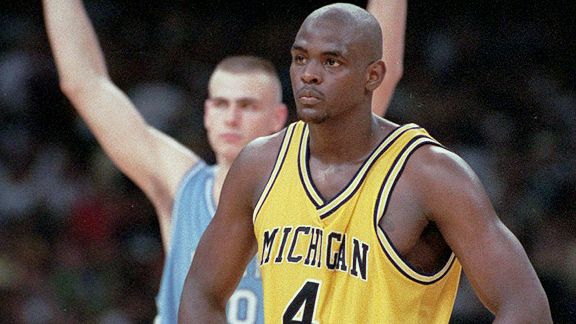
Chris Webber stared emotionless during the final seconds of the 1993 Championship game. He was neither high nor low, just there. We never really knew what he was thinking, and still don't. People want to know, but all we're left with is that blank stare.
And that's all we're going to get.     

Friday, March 11, 2011

A Leg Up

At about 3:20 Wednesday afternoon it hit me. Camped in front of my computer, as I usually am on match days, I needed to stand up and breathe. Spurs had held off Milan's offensive attack for 80 nail-biting minutes and were only 10 minutes away from advancing to the Champions League quarterfinals.
I looked out my window and into the dreary, overcast day. A school bus passed carrying middle school kids. Other than the lone bus, my outside surroundings were quiet -- not another person or car to be found. I suppose everyone was at work. If I remember correctly, that's what most people are doing at 3:20 on a Wednesday.
That's when it hit me. No one within a 30-mile radius is even aware of this game, let alone concerned about its outcome. I'm new to this international soccer thing, but I assume that sums up the ridiculousness of being a soccer fan in America.  Imagine your hometown NFL team tied up with two minutes left in their first round playoff game -- and absolutely no interest around you. No flags, hats, or sweatshirts bearing the team logo. No signs, news highlights, or talk radio. Nothing. Just nothing.
In a strange way, I'm attracted to the exclusivity. Spurs are my little secret in this neck of the woods, kind of like the people who claimed to love R.E.M in the early 80s. If rooting for them means I have to occasionally wake up at 6 in the morning, listen to games in Spanish, and yell at my computer as if it were a cashier that didn't give me correct change, then I'm all for it.
Perhaps a visual representation of what I looked like during Wednesday's game would be more helpful.

Here's me at the 25-minute mark. AC Milan was inches away from scoring. Three of the computers in this shot don't work. I keep them around to feel important.


I regained a little bit of composure in the 60th minute, as Spurs began to settle in. I even took off my tie to demonstrate how loose I was, and replaced my sweat-drenched shirt.


This is me in the 93rd minute, after Spurs came away with a 0-0 draw. I was so excited that I put a different tie on and raised the roof with clenched fists.


Besides being certifiably nuts, this match, and I think all 0-0 matches can help American fans towards a greater appreciation of sports. I think it's hard for some people to wrap their brain around 0-0. Why play the game at all, nothing happened, right? Wrong. The beauty of the game is found in its intricacies that don't always show up in the box score.
In America, we're conditioned to think the result is everything, and the result has to firmly place one team above the other. In other words: NO TIES! Good and bad games are often forgotten or excused because the desired result was achieved. Too often, we get caught up in the result, and forget about the process which got us to that point.
Take the 25th minute to illustrate my point. Spurs defender William Gallas (seen here beginning at the 3:44 mark) made a game-saving play that was just as spectacular and valuable as a sensational goal. Spurs goalkeeper Heurelho Gomes made a terrible challenge and ended up getting caught out of position. Milan's Pato slipped a pass to his streaking teammate Robinho, who promptly rifled a shot that deflected off Tottenham's Assou-Ekotto. Not anticipating the deflection, Gallas was trending left. He noticed the ball popped in the air, recovered, firmly planted his left leg on the goal line and cleared the ball mid-air with his right foot, about an inch in front of the goal line. It was an incredible defensive play from Gallas that took just as much skill and precision as a well-timed goal. I'll always remember that save.
Tottenham had won the previous match 1-0, so a 0-0 draw was basically a win. But what if they had lost 2-0 and Gallas made the same save? Many American-conditioned sports fans, myself included, probably would have looked at the game as a bad loss and left it at that.
I've noticed soccer fans seem to appreciate particular moments of a match, even if their team didn't come out victorious. I'm not suggesting they don't care who wins, but the end result isn't the only measure of success. At least that's what I've observed. Maybe I've been reading and interacting with fans and writers more concerned with the stylistics of soccer, which is entirely possible.
Either way, a bunch of wise thinkers have said that life is a journey, and the scenery we encounter along the way is more important than the destination. We can certainly apply this viewpoint to sports, and would be wise to.

Tuesday, March 8, 2011

Throw It Down, Big Man!

Here is a list of the Top 10 things I miss the most about the NBA:

1. Michael Jordan
2. The NBA on NBC theme song
3. Bill Walton (The Commentator)
4. High Top Fades
5. Broken Backboard Dunks
6. Lil' Penny Commercials
7. The Washington Bullets Logo
8. Detlef Schrempf
9. The Charlotte Hornets
10. The 2000-01 Sacramento Kings (RIP Sacramento, by the way)

In all seriousness, the Top 5 are very dear to me. Their loss has been a little easier to cope with because every few years, one of the Top 5 threatens to make a comeback. Jordan already came back once and is practicing with the Bobcats again. Bill Walton occasionally calls Celtics and Kings games. Brandon Jennings reintroduced the NBA to the high top fade for a short time last year. The NBA on NBC is never coming back, but the NBA on ESPN/ABC theme song is flying under the radar. It's no NBC, but pretty good nonetheless. The current group of youngsters will look back fondly on the ESPN/ABC theme like we do the NBC.
The age of broken backboards however, isn't coming back. I suppose that's a good thing. Raining glass can be pretty dangerous. The NBA also saves time and money -- two of the League's biggest assets at this point.
We all know that the rims and backboards are made sturdier nowadays, but how exactly do they work? Arthur Ehrat is credited with the invention of the breakaway rim as we know it today. Not a fan of basketball himself, Ehrat was contacted by his nephew, an assistant basketball coach at St. Louis University in 1975, about creating a rim that could withstand forceful slams. After a couple failed attempts, Ehrat struck gold -- in the form of a John Deere cultivator. He found that the spring was strong enough to not only withstand missed shots, but dunks as well.
Ehrat's new rim debuted in the 1978 Final Four. Dunking had been illegal since 1967 in the college game, but recently reinstated in 1976, due in large part to the popularity of Dr. J and the rest of the ABA's high-risers.
The NBA followed suit, introducing the breakaway rim in 1979 as a response to Darryl Dawkins, who shattered two backboards that year. While the new rim proved to be more successful than its predecessor, players were still bringing backboards down.
That changed in the early 1990s. NBA rims are now attached directly to the arm extending beyond the backboard. The arm, coupled with the springs on the breakaway rim absorb the force that the glass backboard used to. The video below contains a nice visual of this process, in addition to a disheartening experiment for those still hoping to see another broken NBA backboard in their lifetime. 


In 1992, Shaq became the last player to shatter a backboard in an NBA game. The once famous trend lasted for 46 years but will never be seen again, at least in the NBA anyway. In memoriam, I conclude with this: