Showing posts with label Duke Blue Devils. Show all posts

Tuesday, September 6, 2011

Why Don't You Like Me?


Maybe I'm wrong, but it seems that the younger generation, which I still consider myself to be a part of, has an unhealthy obsession with being hated. Perhaps this this just a poor reflection of the people I associate with and am trying to distance myself from, but I can't go on Facebook or sometimes even Twitter without someone mentioning their "haters." Whether these haters are perceived or real, I'm going with perceived 99 percent of the time, is besides the point. I blame rap music. (Just kidding).

For one to be hated, at least in the context of this younger generation, is usually the result of having achieved success in life. The "haters" are jealous of success and turn to bitterness and hatred of others as a way to mask their own problems. This is by no means a new concept, just one I feel is being flipped around and used as a badge of honor nowadays. I don't think 1950s businessmen gauged their success by the amount of negativity surrounding them, but I also wasn't alive in the 1950s.

The so-called normal people's (by that I mean not rich or famous) claims of being hated usually fall on deaf ears. Let's use my life as an example. I spend hours of my day reading books and Internet articles. I hand-write an unfinished novel in my former high school and college notebooks. When I'm not writing in those notebooks, I stare at the computer screen and think of sports-related things to write on this blog. I own one pair of jeans and about 8-10 T-Shirts. I have a medium-sized record collection, half of which was inherited. No one in their right mind would waste their time being jealous of me.

However, being hated is something the sports fan knows all too well. Miami football. Duke basketball. Yankees baseball. Cowboys football. Big-Three Heat basketball. Ask fans of these teams how kindly they're received. Chances are fans of these teams probably start to enjoy the hate after a while. Save for the still-in-the-process-of-trying-to-win-it-all-Heat, all of these teams have had tremendous success in the past. There are certainly other factors that contribute to the hatred of them and their fan base, but it all starts with success. No one cares about a perennial loser.

Since so many "normal people" gravitate towards sports, it seems natural that one's affiliation with a sports team is probably their only hateable offense. I've always wanted to know what this feels like. The closest I ever felt to hatred because of the team I rooted for was sophomore year of college. I went to school in Wisconsin and the Bears went to the Super Bowl. I wore my Bears hat like a scarlet letter. The Bears went on to lose the Super Bowl, so the joke was kind of on me in the end. The Cubs exist as a mere punchline. Outside of New York, the Bulls teams of the 90s were more revered than hated. 

I think this year's Wisconsin Badgers have a real chance of being the college football team everyone loves to hate. College football teams like Miami, Ohio State, and Notre Dame will always have their fair share of detractors regardless of how good they are, but hatred in sports moves in cycles. When the constants are losing, the public needs a new whipping boy. For Wisconsin, I think all the necessary elements are there for a one-year hatred period.

Take a look at Wisconsin's schedule. Now think of a sexually inappropriate joke to signify how easy something is. Their non-conference schedule includes home games against UNLV, Oregon State, and Div. 1-FCS's own South Dakota, and a game against Northern Illinois at "neutral" Soldier Field. Given the size of Wisconsin's fan base, number of alumni who live in Chicago, and the close proximity to Madison, this is basically another home game. Wisconsin doesn't face a true road contest until October 22nd in East Lansing! Add in the uncertainty surrounding Michigan State, Ohio State, and Penn State's programs, and it's very possible a home game against Nebraska, the fifth game of the season, will be Wisconsin's only roadblock to an undefeated season. Indiana, Purdue, Minnesota, and Illinois are well-dressed punching bags. People love to hate on team's with easy schedules. Especially those god-forsaken SEC supporters.          


Viewers of the Big Ten Network will remember the above commercial well. It's notable now because half of the featured coaches have since been canned, and for just how creepy Joe Paterno is. Would you entrust your child's future with this 84-year-old man? I thought this was supposed to be a promotional tool...You'll notice Bret Bielema sporting his patented Bielema voice.

"Big Dubyah. On the helmet."

"Alrighty, boys. Let's run the pigskin up the gut now. Woo-boy is it a good day for football."

Bielema grew up on a hog farm in Prophetstown, a tiny city in northwest Illinois. "I always chuckle because I came from a town of 1,800 people," Bielema once said. "But I had 2,500 pigs on my farm." If there's a better person to represent the state of Wisconsin and the Midwest as a whole, I can't think of anyone. During his time at Florida, head coach Steve Spurrier used to play with the dumb southerner stereotype. "Well, aww shucks, guys," he'd say. "I'm just slingin' the ball 'round, not worried bout scorin' no heap a points." He ran up the score on opponents and played dumb while doing so.

"We're just playing Wisconsin smash-mouth football," Bielema says. Bielema may just be the Midwest version of 90s Spurrier. Score points, a lot of them, and then rationalize it in the form of regional colloquialisms. Bielema already has the reputation of being a bit of a prick in that respect. The Badgers scored 201 points in their last three games of last year, including 83 on Indiana. They scored 70 or more in three different games. The motivation for this seemed to be because they could. People don't like when teams show up lesser opponents, and if his previous years at the helm are any indication, there will be plenty of that this year from Bielema.

Wisconsin wins the old-fashioned way. Run the ball (preferably 50 times a game), draw up a few intermediate passing routes to keep the defense honest, win the special teams battle, and play reasonably stout defense. There's nothing pretty about this kind of football unless you enjoy seeing 12 yard runs up the middle for six straight minutes. Plenty of people, including myself, love to see a good rushing attack pan out, but plenty others, especially neutrals, want to see the ball fly more than two times every drive. People hate to see boring win, and Wisconsin wins in boring fashion.

To recap: college football appears to be in need of a team to hate this year because the traditionally hated teams probably won't figure prominently in this year's national title race. Wisconsin has many of the necessary elements to make a team worth hating. They have a pathetic non-conference schedule and possibly a weak conference schedule as well. They have a coach with a reputation for running the score up, who represents the Midwest a little more strongly than anyone outside the Midwest is comfortable with. And Wisconsin does not play an exciting brand of football. Get your tomatoes ready.

There's only one thing left to say:

Tuesday, March 15, 2011

A Blank Canvas

ESPN's Fab Five documentary, which chronicled Michigan's basketball team during the 1992 and 1993 seasons aired on Sunday, with one glaring omission: Chris Webber. Envision a Jackson 5 documentary without Michael's input and that is essentially what the Fab Five documentary was. Yet, it still seemed to work.
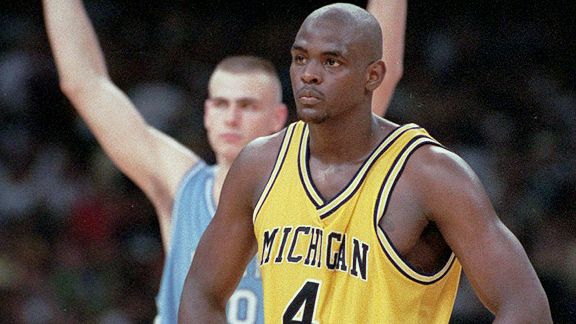
In my estimation, the most powerful image of the documentary was a hunched over Webber walking off the floor after Michigan lost the 1993 title game in which Webber called the infamous timeout his team didn't have (watch the entire sequence here, starting around the 18:11 mark).
The overall mood, extending into the tunnel and postgame press conference was reminiscent of a funeral. Seems fitting, considering it would be the last time the Fab Five would play a game together. Webber promptly entered the NBA Draft, and the Fab Four lost in next year's Elite 8. Juwan Howard and Jalen Rose declared for the 1994 Draft, officially spelling the end of the youthful excitement surrounding the program for the last three years.
The story of the Fab Five starts and ends with Webber. He was Michigan's prized hometown recruit and the top player in his class. He was an elite scorer, rebounder, passer, and could also handle the ball like a guard, despite being a 6'9 power forward.
Webber's time at Michigan is now shrouded in controversy due to the aforementioned timeout and subsequent 2002 indictment for lying to a grand jury about his relationship with booster Ed Martin. Martin reportedly gave Webber 280 thousand dollars during his time at Michigan with the expectation that Webber would pay him back when he signed his NBA contract. As a result of Webber's actions, Michigan vacated the Fab Five's entire sophomore season, as well as their two Final Four games in 1992. The banners commemorating the 1992 and 1993 Final Four runs were also taken down from Crisler Arena.
Webber made two high-profile mistakes and ending up costing himself and his team a Championship, official acknowledgement in the history books, and possibly millions of dollars in endorsements.
The Fab Five's influence spread well beyond those things. As Jalen Rose stated in the documentary, "We were bigger than the final score." The Fab Five ushered in a hip-hop influenced sense of style, bravado, and self-awareness that college basketball had never seen before. These kids, at 18 and 19 years old were well aware of the hypocrisy surrounding college hoops. They grew tired of the university and various retailers profiting off them, so they began wearing plain blue shirts during warm-ups so their innate style could not be co-opted and sold. You'd be hard-pressed to find another group of underclassmen as adept at understanding the business side of college athletics as the Xs and Os of the game.
I was too young to remember the Fab Five. By all accounts, they were an inescapable force. You may not have liked them, you may not have watched college basketball, but you had an opinion about the Fab Five. They mattered, just as much off the court as on it.
People watched because of their superior athleticism, and then to see them rub it in the faces of their opponent. People watched because they dressed like the Fab Five, or the Fab Five dressed how they always wanted to. People watched because they had the foresight to recognize the hip-hop movement, and how basketball and hip-hop would surely play off each other in the coming years. The Fab Five provided an alternative to ol' boring white-bred Duke. They were a team that was equally as cool to black inner-city teens as their white suburban counterparts.
That is the legacy the Fab Five left on the previous generation, but not to mine. I was 15 years old when Chris Webber was indicted. Growing up, I read more about Michigan's undoing than their glory days. Chris Webber's timeout showed up at the top of every "Biggest Sports Blunder" list on TV. While acknowledging their undoing, this documentary attempted to connect the younger generation with the swash-buckling, hip, and influential side of the Fab Five, as teenagers growing up in the mid-90s remember them.
It's easy to theorize why Webber wouldn't want to be a part of it. He's the focal point of Michigan's fall from grace. People forget Webber poured in 23 points on 11 of 18 shooting, grabbed 11 boards and blocked three shots in the 1993 Championship game. Not to mention he snatched an extremely difficult rebound and scored on the putback to cut North Carolina's lead to one. Then he grabbed the missed free throw on the other end to give Michigan a chance to tie. But all anyone remembers is Webber bringing the ball up the court, trending towards the sideline and calling a timeout. Webber was an active big who covered the entire floor, and his activity ultimately cost Michigan.
Webber's timeout play is an interesting sequence to analyze. The above video clearly shows a member of his team on the sideline calling for a timeout. After grabbing the rebound, Webber turns to the official and appears to almost call a timeout there. He holds off and instinctively turns to fire the ball to Jalen Rose. But Rose was covered, and Webber didn't notice the defender until he was mid-stride, ready to pass. He ends up traveling rather than throwing an errant pass.
I have no doubt in my mind that had Webber not traveled, the timeout talked about to this day never would have happened. He simply panicked after traveling. Anyone who has traveled in a game before knows the feeling. Every player knows when he travels because it feels unnatural. Your brain is telling you the play is dead, but the play hasn't actually been blown dead. Confusion sets in, and every play set, basketball move, or game situation is forgotten. You're a chicken with your head cut off, existing in a zone you know is off limits.
This happened to Webber. He stopped thinking and dribbled straight up the court, because that is what his basketball instinct told him to do when in trouble. He found himself caught in a trap and called time out. I think the image of his teammate signalling timeout from the bench was the last picture in his head. He called timeout, even though I think he was aware his team had none. It was a moment of panic, a brain fart if you will, that we've all experienced, just not on that large of a stage.
Webber reacted how anyone would. First with anger towards his bench, then with disbelief. He knew what he was supposed to do, but did the exact opposite. Just my theory, of course. But had Webber turned around with the ball and not trended forward, he could have calmly dribbled up the floor or waited for Rose to get open. He wouldn't have panicked and we're not talking about a timeout.
In his postgame interview, Webber was asked what was going through his mind when he the last play happened. His answer was very telling.
Webber proceeded to describe the play, and ended with, "Whatever I did, that what was going through my head." His language speaks to a disconnect from the moment. He lost himself in that final play.
Webber went on to have a fantastic NBA career. He was drafted first overall by the Magic and traded to the Warriors on draft night. He played in four All-Star Games and was selected to five All-NBA teams, including First Team in 2001. He also got paid, legally. Webber was one of the highest paid players of his generation. Only Jordan, Shaq, and Garnett were paid more to play basketball during Webber's career.
But he could never shake the memory of his timeout. Webber always seemed to wilt during crunch time of big games. Whether that was due to his gaff in 1993 we'll never know. But it was an easy explanation for his late game struggles, and used against him often.
Jalen Rose and Juwan Howard also went on to have solid NBA careers, proving to be competent second and third options for many years. Jimmy King played briefly in the NBA, but enjoyed more success in the CBA, along with Ray Jackson. The height of their star power was the Fab Five, they needed it more than Webber.
Webber's refusal to take part in the documentary is understandable. He was the Fab Five's best player, yet received most of the blame for the program's downfall. It's possible Webber just wants to move on with his life, but then again, we'll never know.
Chris Webber stared emotionless during the final seconds of the 1993 Championship game. He was neither high nor low, just there. We never really knew what he was thinking, and still don't. People want to know, but all we're left with is that blank stare.
And that's all we're going to get.