Showing posts with label 2011 NBA Playoffs. Show all posts

Saturday, May 28, 2011

"That's It."

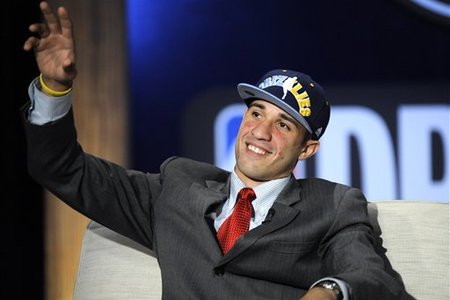
Peep the relaxed pose. I thought we had Game 5 in the bag.
Shock would be the appropriate word. The manifestation of "shock," especially amongst a large crowd will often turn raucous, and even violent. No such uprising occurred within the one hundred or so people filing through the Madison St. exit via the Third-Level United Center seats. Replace the Bulls jerseys with sports coats and fedoras, and you have an atmosphere reminiscent of the opening scene of Modern Times. Only one major difference: the figurative sheep in the movie are heading somewhere (to their grueling, soul-sucking factory jobs), and Bulls fans are leaving. Essentially walking away from the 2010-11 season.

In stark contrast to the ending of any sporting event, the mass is mostly silent, save for a few murmurs. Even if they wanted to discuss the game, it's unclear if they even knew what just hit them. Probably not. A teenager at the bottom of the stairs digs into his black backpack. He pulls out a Dirk Nowitzki jersey and throws it on. One guy begins to chant, "Nowitzki, Nowitzki..." He doesn't know the "W" is pronounced as a "V."

The symbolism is clear: Dirk Nowitzki will save us from validating the Miami Heat's season. They were good enough to beat the Bulls, but if they choke in the Finals? That would be almost better. One year down, five more to go. But Dirk Nowitzki isn't adding to the Bulls trophy case and the mass knows that. The Mavericks can win the title and it might make some of them feel good momentarily, but it won't change the fact the Bulls will end the season with practically every trophy except the one that matters.

The Nowitzki chants slowly fade as the man realizes no one is chanting along with him. But perhaps most amazing, is the teenager wearing the Nowitzki jersey expects no acknowledgement. He didn't try to play to the crowd or search for approval. He simply put the jersey on and continued to walk. His own one-man protest. But did he think the Bulls even had a chance at Game 5? Was the Nowitzki jersey just a precaution or the acceptance of an inevitable defeat?

After about ten minutes of silent waiting, my girlfriend and I squeeze into the #20 bus. We grab the two available seats closest to the driver. A massive woman with sad eyes and a shower cap atop her head sits across from us. She takes up two seats.

"Who won?" she kindly asks me. I can't tell if she's a sports fan, but I detect a tone of indifference in her voice.

"Not us," I mumble. I have the tendency to do that.

"What?"

"The Heat," I say.

"Oh," she responds softly.

In a strange way, her presence is very comforting. If anything, she reminds me that this isn't the end of the world. There are people, in the city of Chicago, on the bus outside of the United Center at that, who could care less about the outcome of this game. We don't say another word to each other for the rest of the ride.

"It's alright, we just need a little help," a man who steps onto the bus a few stops later says. "We just need to get rid of Boozer and we got three picks this year. We just need to get that boy [Rose] a little help." If it was only that easy.

As I step off the escalator up to the second floor of Ogilvie Train Station a man in a suit approaches me from my right. He takes one bud out of his ear and asks if the Bulls won. I tell him they didn't. "What?" he screams, as shocked as he is angry. A man to my left confirms, "The Bulls lost?" I nod my head. They both go on their way.

I'm the bearer of bad news. The guy in the Rose jersey intent on bringing everyone's mood down. Kill the messenger. Tomorrow is Friday for God's sake.

My girlfriend is in line at Dunkin' Donuts. I lean against a trash can. The confident, "I'm with the GOAT" swag from the picture above has disappeared. I feel like an extension of the trash can. A woman sitting near me is bundled in blankets from head to toe. She must have at least three blankets wrapped around every inch of her body. She has three blankets, a small coffee, and a beige handbag. It takes her a moment, but she is able to adjust the top half of her first blanket enough to peek her head out.

"Did we win?"

"No," I smile.

"So that's it?"

"That's it."

It took uttering those two (three?) little words to finally accept what had happened an hour ago. This was it. I remembered back to last summer when this current roster was being constructed. I remembered scouring the Internet, hoping for the latest news, or amusing myself with some of the rumors. I remembered, as the season drew on, feeling the Bulls would win every game they played. I hadn't felt like that since 1998. I remembered thinking, sometime in February, that the Bulls were good enough to win it all.

I realize now that I've never felt so strongly about a team as I do this one. The 1990s Bulls were an inheritance. I wasn't alive during the down years and too young to remember the battles with the Pistons. I was lucky enough to be born in 1987 in the state of Illinois. My childhood coincided with the second half of Michael Jordan's career and some of the greatest teams in NBA history. My childhood was the Bulls and I did nothing to deserve it. I was simply born in the right place at the right time.

The 2011 team felt more like a well-deserved promotion. I continued to support the Bulls through the 2000s and this year's team felt like repayment for the ups and downs (mostly downs) endured over the last decade. If any fanbase could claim to have paid dues, it's Bulls fans born into the glory of the 1990s who continued to stick around through the 2000s. On the Jumbotron before the game they showed a mix of highlights from the Championship teams and juxtaposed them with the 2010-11 highlights. Knowing already this wouldn't be they year, I nearly cried. A successful Bulls team, to me at least, is more than just having fun and watching good basketball. A successful Bulls team is a large chunk of my childhood and it's that feeling that I always hope can be recreated.        

On the train ride home I pondered the different ways to write about this game. I thought about what I believed to be the slanted calls in the third quarter, the deja vu moment when Rose missed his second free throw to tie the game (I was at the December 18th game against the Clippers when Rose missed the game-tying free throw with less than a second left), fuckin' Boozer, our lack of 4th quarter offense, the unbelievable way LeBron took over the 4th, etc. It wouldn't occur to me until the next day that the only way I could appropriately write about this game was to relay the moments after and the interest this team garnered, even amongst people who probably didn't watch a game all year.

I attempted to give the Bulls a standing ovation moments after the game ended. I stood and clapped alone. Maybe it looked too much like I was applauding the Heat, or maybe others weren't willing to follow the lead of a man screaming obscenities all game. Either way, I felt the Bulls' season-long effort deserved to be recognized. This was never supposed to happen. But somewhere along the line, all of us became so convinced this was the year.

My girlfriend and I stepped off the train and made our way to the 7-Eleven across the street. Dark and nearly one in the morning; the traffic lights were turned off. All we saw were a bunch of flashing red lights. Kind of fitting. My brother had parked the car in the 7-Eleven parking lot. He sat against the hood smoking a cigarette.

"How did ya like that third quarter?" I asked.    

Thursday, May 26, 2011

Remembering 1.7 Percent

Let me preface this post by stating, with the exception of the statistics, I don't believe a word of it. If that makes me less of a Bulls fan to the blind faithful, then I'm OK with that. Unable to sleep last night, I began thinking of ways to curb the sting of being down 3-1. This was the best I could come up with. They are a bunch of numbers that have no bearing on the outcome of a basketball game, but I'm hoping they can put things in perspective for some fellow Bulls fans. They didnt' help me sleep at night, but they may make someone feel better about the situation.


1.7

Let's start with the most glib number of all: 4 percent. Teams down 3-1 in the Playoffs have a 4 percent chance of winning the series. Of the 200 teams that have been down 3-1 in a series, 192 of them went on to lose that series. But there have been eight to pull of the impressive feat, and here they are (the home teams are bolded):

2006 - Suns over Lakers (Western Conference First Round)

2003 - Pistons over Magic (Eastern Conference First Round)

1997 - Heat over Knicks (Eastern Conference Semifinals)

1995 - Rockets over Suns (Western Conference Semifinals)

1981 - Celtics over 76ers (Eastern Conference Finals)

1979 - Bullets over Spurs (Western Conference Finals)

1970 - Lakers over Suns (Western Division Semifinals)

1968 - Celtics over 76ers (Eastern Conference Finals)  

1.7

While the odds aren't good, 6 of the 8 teams to come back from 3-1 were the home team, just as Chicago is. Obviously, 2 home games of a possible 3 remaining would seem to be an advantage. But notice that only 3 of the 8 comebacks were from either the Western or Eastern Conference/Divison Finals. One would suspect coming back in the later rounds would be more difficult, considering the competition would likely be tougher. This actually isn't the case. 

1.7

Let's start with the glib again. For nine straight years, the NBA has seen a Conference Finals series start 3-1. In each year, the team down 3-1 has lost. Five of those teams have forced a Game 6, and four have lost in five games. None were able to force a Game 7. Since the NBA began playing Conference/Division Finals as a "Best of 7" format in 1958, 47 series have started 3-1. Of those 47, 25 ended in 5 games, 14 went to a Game 6, and 8 went to a Game 7.

1.7

Three of the 47 teams (1981 Celtics, 1979 Bullets, and 1968 Celtics) were able to defeat their opponent after falling behind 3-1 in the Conference/Division Finals: good for 6.4 percent of the time. Two of those three were the higher-seeded team, even though 5 of the 8 who forced a Game 7, were the lower-seeded team.

1.7

To recap, teams down 3-1 in the Playoffs win their series 4 percent of the time. Teams down 3-1 in the Conference Finals win 6.4 percent of the time. Higher-seeded teams are less likely to force a Game 7 in the Conference Finals, but more likely to win a Game 7 if they can force it.

1.7

Bringing us to 1.7. You most likely knew the significance of the number, but if you didn't, here's why I've typed it at every paragraph break. In 2008, coming off a disappointing 33-49 season, the Bulls finished with the 9th worst record in the NBA, and were given a 1.7 percent chance of landing the 1st overall pick. The Bulls, of course, won the pick and drafted Derrick Rose. The improbable occurred and the future of our franchise was forever transformed. Had the odds held up and the Bulls received the 9th pick, they probably would have chosen between D.J. Augustin, Jerryd Bayless, or Brandon Rush. Try to imagine how successful the Bulls would have been the last three years substituting Rose for either of those three.

The moral of the story is the odds don't always hold up. Bulls fans should know better than any NBA fanbase about pulling off something deemed impossible. If a dream with a 1.7 percent chance can come true, 4 or 6.4 percent doesn't seem all too bad, does it? The games need to be played, just as the lottery balls needed to be chosen. Sure, there are hundreds of thousands more factors that go into how a game can be decided, versus basically the luck of the draw in the lottery. But if 1.7 has taught us anything, it's that "ANYTHING IS POSSIBBBBBBBBLE." Am I really going to end the post like this? Yes. Yes, I am.          

Monday, May 23, 2011

Choose Your Words Wisely


Chris Bosh followed up an atrocious Game 2 with the best game of his career. He scored 34 in a variety of ways: midrange, off the dribble, pick and rolls, on Chicago's reeling defense. The benefit, to me anyway, of Bosh going off, is that reporters can ask Wade and LeBron about him. Naturally, they wanted to know what changed. Did he prepare any differently for Game 3? To which Dwyane Wade offered a glimpse into Miami's pregame locker room routine. Wade revealed that while most of his teammates play music before games, Bosh keeps to himself and reads a book.

This newfound information excited me. Attempting to read a book while a group of grandiose, self-important individuals make noise sounded a lot like my freshman year of college. Maybe Chris Bosh and myself aren't so different after all!

My thoughts shifted focus. What books could Bosh possibly be reading before a big game? The sociologist in me was hoping for something totally unexpected. Hopefully a piece of literature so far removed from my comfortable opinions about Bosh that would force me to reconsider everything I ever thought about him. Maybe Fear and Loathing in Las Vegas? Roots? Lolita? The Odyssey (pictured above)?! There had to be more to Bosh than the soft, insecure, player with the strange mannerisms and a habit of getting all LL Cool J and licking his lips in a perfect circle.


In early May, Shandel Richardson of the Sun-Sentinel wrote about the differences amongst the Big Three. Bosh's love of reading and art, as well as his quiet nature were what Richardson felt set him apart from Wade and James. From the article:

...James and Wade are on their iPods listening to hip-hop lyrics in the locker room during pre-game. A few feet away, Bosh is plugging his headphones into his iPad, usually reading a novel or a book that teaches mental toughness.

The bolded was the answer I was looking for, but not exactly hoping for. So Bosh was reading a book or novel about mental toughness? That basically falls in line with Bosh's narrative up to this point. The article also mentions Bosh is a huge Harry Potter fan, by the way. I realize that saying a book is about "mental toughness" is ridiculously vague. Roots can largely be read as a novel about mental toughness, for instance. But doesn't this mental toughness business scream of self-help? Is Chris Bosh reading self-help books before games? More power to him if he is.

I was hoping for something that would put me on my ass. Like when I saw Andrew Bynum was reading Drown by Junot Diaz. No such luck this time around. It's still pretty cool that Bosh reads before games, though. As a coach, I probably wouldn't want my star power forward reading Lolita anyway.

* * *

Mr. Joakim Noah has found himself in some hot water after directing a homophobic slur to an unruly fan while on the bench. Hint: Noah said, "Fuck you, faggot." "Fuck you" is fine nowadays. But "faggot?" Not so much. Here's the video:


Noah was fined 50 thousand dollars for his words and expressed regret in his conversation with openly gay sportswriter Kevin Arnovitz. I was watching the incident with my brother, girlfriend, and a friend. We were originally split down the middle about whether Noah was directing his rage towards himself or someone else. It seemed unlikely, at least to myself and my friend, that Noah would snap at a fan. I'm pretty sure he's heckled ferociously everywhere he goes.

Noah was most likely frustrated that he had just picked up his second foul in the first quarter. The fan apparently said something about his mother. I'm sure he's heard insults about his mother before, but combined with an ineffective start to an important game, the moment got the best of him. Obviously, Noah was wrong. He was wrong for using the word he did. He was wrong for paying a heckling fan the time of day to begin with. Unfortunately, the fan in question will face no repercussions. A small percentage of paying fans at every game feel the price of admission affords them the privilege of saying whatever they want to players and coaches. Other than Sam Amico's "One Free Punch rule," there isn't much the NBA can do. It's up to players to control their emotions, Noah couldn't, and was caught on camera.

What worries me is that this incident received as much attention as it did solely because a homophobic slur was involved. What if Noah had called the guy a dick? The NBA probably does nothing. While I commend the NBA for running ads and addressing offensive incidents such as this one, Noah's slur was only part of the problem. Heated fan-player interactions will outlast whichever form of ignorance our country is preoccupied with fighting.

Friday, May 20, 2011

Dueling Banjos

The weekend is here, both Conference Finals have come to a 1-1 stalwart, and magnificently, feature what may be five of the NBA's six best players (Dwight Howard has been fishing a while now, someone rock the boat and wake him up). Kevin Durant dominated summer headlines, as Team USA ran their offense through him while slowly crunching international competition beneath their feet. LeBron, Wade, and "The Decision" took over from there. Derrick Rose received MVP honors and NBA writers penned one thousand different articles on the meaning of humility and how Rose is saving the NBA -- and the world. Lost in the fracas, as he usually seems to be, was Dirk Nowitzki.

Nowitzki is everything I've loved about this year's Playoffs. Heading into this season he was an immensely talented player, but a perpetual loser / choke artist. After Game 1 he became the best international player ever and possibly one of the ten greatest players of all-time. Step back, cock the basketball behind your head, fadeaway off of one leg, and throw perspective out the window.

I began searching for reasons why Nowitzki has been so underrated -- in terms of his legacy and the unique blend of size and skill he's brought to the game, moreso than being recognized as an All-Star and elite player. The first explanation would seem to be bad timing. Nowitzki's prime has coincided with the primes of Hall-of-Famers Kobe Bryant, Tim Duncan, Kevin Garnett, Paul Pierce, Allen Iverson, Shaquille O'Neal, Vince Carter, Steve Nash, and Jason Kidd. All were arguably better or more exciting players for the majority of their careers. Add in players like Stephon Marbury, Steve Francis, and Tracy McGrady who ultimately didn't have HOF careers, but for a short time took the league by storm. Then the post-2003 draft picks: LeBron James, Carmelo Anthony, Dwyane Wade, and Dwight Howard, who brought new excitement and marketability to a league who's star players were either getting old or failing to live up to the lofty standards that were set for them. If someone were to ask you in 25 years who the best 10 or 15 players of the last decade were, would it really be inconceivable to forget about Dirk?

For better or worse, athletes are measured by the number of Championships they've won. I'm sure you've seen the trailer for Bad Teacher by now. Unfortunately for Dirk, his two best Dallas Mavericks teams are best known for their epic Playoff collapses. The 2006 team was up 2-0 in the NBA Finals, firmly in control of Game 3 before surrendering a double digit lead in Miami, and went on to lose four straight. Then the 2007 team, Dallas' best team in franchise history, were ousted in the first round by 8th-seeded Golden State. Dirk played well in Games 2-5, but awful in Game 1 and series-clinching Game 6; the two most likely to be remembered. Those two seasons have come to define Dirk and the Dallas Mavericks. Despite the accolades and for all the substance they've played with the past decade, they're not good enough to win a Championship.

Then there's "Dirk's Quirks." He looked like a member of Ace of Base when he came into the league. This undoubtedly contributed to the "soft" discourse.


He's constantly adjusting his jersey even though it seems to fit him fine. He also has a tendency to try and tuck his hair around his ear, even though his hair seems to trend that way regardless. Dirk's quirks: they can be quite distracting. Next time the Mavs are on, observe how Dirk reacts when Dallas is struggling. He may get them back in it, but during a crucial stretch he's going to do the stupid jersey or hair adjustment and I promise you'll think a little less of him.

But back to why Dirk is finally getting his due as one of the toughest covers in NBA history. He scored in a variety of ways in his 48-point Game 1 performance. Nine of his fifteen shots came on the right side of the floor, and eight of those nine were 12 to 18 feet away from the basket. There was no secret to what Nowitzki was doing. He posted up every time down the floor, received the ball, and either drew a foul or shot is patented fadeaway. Oklahoma City's defenders were barely able to touch Nowitzki, so his 24 free throws were a bit of an aberration, but the fact that he made all 24 was not. 

There's one particular Nowitzki shot I want to talk about. Late in the 4th quarter and the Mavericks are up by seven. Nowitzki, who logged 41 minutes on the night was clearly tired. He received the ball in the post, 18-feet out. Serge Ibaka would be the victim this time. Nowitzki turned around and faced Ibaka. He was literally too tired to do anything, even bend over. He stood there with Ibaka in his face and the ball at his hip. Nowitzki held the ball for about five seconds before just raising up -- a last ditch effort. The highly arced ball fell right through the net. I don't care about a player's size or position. He isn't supposed to be able to catch the ball 18 feet out, face his defender, and swish a shot because he was too tired to do anything else. That has been Dirk Nowitzki in the 2010 Playoffs. 

The Thunder played him better in Game 2, fronting him and sending a help defender from the weakside. They also limited him to only ten free throw attempts. Nowitzki still made 10 of his 17 shots and made some excellent passes out of the double team. There's not much Oklahoma City can do with him, but they did just enough to win Game 2.

Meanwhile, Russell Westbrook is getting his typical treatment from the media. When he attacks the rim he's being too aggressive and needs to get the ball to Durant. When he doesn't attack he's being too passive and hurting his team. I'd hate to be in his position. What's funny is how Durant is getting off scot-free. Sometimes Westbrook can't get him the ball because he either hasn't used his screen properly, or isn't strong enough to create space for himself. Not Westbrook's fault, but he's received the brunt of the criticism. Magic Johnson, as part of ESPN's horrible "Bold Predictions" piece, actually said he expected Westbrook to have a 25-14-8 game. How the fuck can Westbrook win?

To Durant's credit, he'd defended Westbrook's decision-making, even drawing the ire of some who claim he's not being assertive enough. Rubbish, I say. Durant just wants to be one of the guys. Him and Westbrook have taken to MySpace to release their debut EP.


The NBA's answer to The Cool Kids?


I'm about to criticize Tom Thibodeau. Are you sure you want to do that? Yes. Really? Yes. I mean, I think so. Realllllly?


That's what I thought.

If you've watched even five Bulls games this year, you know that Thibs can be a little stubborn with his rotations. Of course, his stubbornness tends to pay off, so it's never really an issue. It was in Game 2 and cost the Bulls the game. Thibs subbed in Korver for Brewer with just under 9 minutes left in the game. The Bulls were playing with a Rose-Korver-Deng-Gibson-Asik lineup against Miami's Wade-James-Miller-Haslem-Bosh. Thibs' thinking was for Korver to hit a few threes (the Bulls were down 73-69 when Korver checked in) and get them right back in the game. Not a bad strategy except Korver has to play defense and Mike Miller was the only easy cover on the floor. Rose, who wouldn't sit the entire second half, was forced to guard Wade. This isn't bad for stretches, but not when the Bulls are completely dependent on Rose for offense at the end of a close game. Korver missed both of his three-point attempts in the 4th quarter. He was 1-3 from behind the arc in the 2nd quarter.

The Bulls are going to have trouble scoring against Miami regardless of the situation, but they most definitely won't be successful if Rose has to play the entire second half and guard Dwyane Wade for the last nine minutes of the game. Korver has to be given a short leash. If he's off he has to stay on the bench. At least with Brewer in the game, the Bulls have their best defensive lineup to accompany Rose. Rose can guard the most favorable perimeter match up and focus solely on offense. With Korver missing shots, too much pressure is put on a tired Rose to perform on both ends of the floor. Thibs stuck with Korver too long and it cost them.

I still maintain that the biggest advantage the Bulls have in this series is their coaching. Thibs won't make this type of mistake again. The Heat only scored 85 points despite 53 points on 54 percent shooting from James and Wade. The Bulls shot 34 percent (15 percent from three) and were in the game until the last couple of minutes. They let one get away.

Sometimes you have to lose yourself before you find anything.

Monday, May 16, 2011

The Ascension Of Taj Gibson

Bulls color commentator Stacey King dubbed Taj Gibson "Hard-Hat Lunch-Pail" earlier in the season. The name was supposed to give Gibson the distinction of a hard-nosed player. The type of bench guy that does the little things that usually don't end up in the box score but help his team win games. It goes without saying that Gibson and players like him are usually devoid of flash. To borrow another Staceyism, "Gibson must not have gotten the memo."

The second-year power forward provided the two flashiest and most memorable moments of Chicago's 103-82 Game One victory. The first coming at the beginning of the second quarter:


The backpedalling Wade acknowledged post-game that he had no chance of disrupting Gibson's momentum and blocking his shot. "First time I got dunked on all year," Wade added. "I'll take my 90-to-1 blocks to dunked on ratio." Of course, Wade has been dunked on this year, but not by a back-up power forward known mostly for his offensive rebounding and defensive rotations. Wade's admission, no matter how exaggerated, revealed a chink in his armor. It's one thing for him to lose a ball game, and quite another to be embarrassed while doing so.

Gibson's second dunk came in 4th quarter garbage time but was even more spectacular:


This clip was pretty much the game in a nut shell. The Bulls moved the ball, got open looks, and when it came time to crash the offensive boards, they did with much more zeal than Miami. Gibson skied above his own 7 foot teammate while Miller, Howard, and Haslem did little more than look on. Gibson's dunk was impressive aesthetically but no doubt garnered the attention it did because a) it was against Miami, and b) it was Taj Gibson, the unlikeliest of throwdown heroes in a game that featured Wade, James, and Rose.

Coming into the 2010-11 season, Gibson was thought of as more of a hard-luck loser than anything else. He played well beyond his years as a rookie last year, replacing an injured Tyrus Thomas in the starting lineup and kept the job even after Thomas returned. The Bulls needed an inside scorer and for all the things Gibson was capable of doing, volume scoring wasn't one of them. In came free-agent Carlos Boozer -- the man who was supposed to lessen Rose's burden on offense. Boozer injured his hand under mysterious circumstances, Gibson replaced him in the starting lineup, Boozer came back and returned to 20-10 form, and Gibson initially had a tough time adjusting to his reduced role off the bench.

Boozer struggled during the regular season when paired with Joakim Noah in late February. Noah returned from his thumb injury and Boozer's scoring and rebounding numbers dipped. Boozer's defense was also called into question numerous times. The Bulls were fortunate to encounter an easier stretch of their schedule while Noah was out. When the competition grew tougher all the way into the Playoffs, Boozer rarely responded. He blamed it on turf toe. Fans called for his head. I was one of those fans.

Gibson's contributions became more pronounced with Boozer as his natural foil. Boozer was making 14.4 million compared to Gibson's 1.1 million. Boozer missed 23 games of the season due to injury, while Gibson missed only two games in two years. Boozer played lazy defense, failed to close out shooters and was always late on his rotations, and to make matters worse, wasn't scoring effectively. Gibson played excellent defense, provided a shot-blocking presence down low, snatched offensive rebounds, and dove for loose balls. Gibson just seemed like he was trying harder, and improperly compensated for his effort.

The Bulls seem to be coming together at the right time. Boozer has looked active on the offensive and defensive end. He's getting his customary 10 to 15 shots per game and most of them are good looks. Gibson has finally embraced his role off the bench. He's teamed up with Asik to terrorize team's second units. Watching Gibson, there was very little doubt about whether he was up for this match up. The two are no longer contrasted like divorced parents. Boozer is the starter and Taj is one of the best reserve forwards in the NBA.

The Heat will hear from Gibson again. His big plays won't be as flashy the next time around, but that's to be expected. Take a harder look at what led to Gibson's two monster dunks: Running the floor and crashing the offensive boards. Two little things. The little things Gibson does so well.

Tuesday, May 10, 2011

Greivis Vasquez, Placeholder

Greivis Vasquez hit the two biggest shots of his young career in Memphis' 133-123 triple-overtime loss Monday night. The first was less of a calculated buzzer beating three-pointer, but more of an assured 26-foot fling to force a second overtime. Vasquez struck again at the end of the second overtime, converting a three point play over Westbrook to put the Grizzlies up three, seconds after Westbrook had tied the game with a trey.

Durant, Westbrook, Gasol, and Randolph were all bigger stories in this game. They're better players for one, played more minutes, had a bigger impact on the game, and will continue to factor into the NBA's changing of the guard. But I couldn't help but focus on Vasquez -- for the simple fact that he'd nudged his way, once again, into uncharted territory. He was only playing because Mike Conley Jr. fouled out in the first overtime.

I thought back to Draft Day when Vasquez emerged from the paying crowd after David Stern announced the Grizzlies had selected him with the 28th overall pick. There was Vasquez again, crashing a party he wasn't invited to.


I looked back at the 2010 NBA Draft blog I wrote in June to see if Vasquez's appearance elicited the same response in me as it does today. Not surprisingly, Vasquez was little more than a footnote in my post. I was discussing why 14 of the first 15 draft pick were in attendance:

The NBA extended more invitations to players this year. Very possible, but if they were going to invite 15 or so, they might as well have invited 20 to include players like Greivis Vasquez who had to sit in the stands; the equivalent of flying coach.

Fitting because the announcers have also chosen to discuss Vasquez as a subplot of Kevin Durant's story; the second and less important piece of a "Cool Story Bro" anecdote. Durant and Vasquez played high school ball together in Maryland, and now they're playing against each other in the Playoffs! They used to be best friends and now they're enemies for a few weeks! This story probably isn't even brought up if Vasquez was high school teammates with BJ Mullens.

Make no mistake, the Grizzlies are a better team when Conley, not Vasquez, is on the floor. Conley runs the offense more proficiently, he finds the open man more often than not, and usually is not looking to score first. But Vasquez plays like a guy who bought his own ticket to the NBA Draft. He plays like every minute he's on the floor is a minute somebody is trying to take away from him. I like those kind of players. They deserve to force overtime once in a while too.

Tuesday, May 3, 2011

Joe Johnson And The Definitions Of Swagger

I'm 24 years of age and am still not sure what the word "swagger" means. I have a general idea, but like all words, it becomes co-opted by various groups of people and undergoes a contextual transformation. For our purposes here, "swagger" will be discussed as a noun rather than a verb. According to The Merriam-Webster Dictionary, swagger is defined as:

     A very confident and typically arrogant or aggressive gait or manner.

An entry on UrbanDictionary.com takes the definition a step further, suggesting that swagger is not just an inherent attitude, but a reflection of one's appearance:

     The confidence exuded as a reflection of one's dress, shoe game, attitude, and how one handles a situation.

Rapper T.I., in his song "56 Bars," jokingly takes this another step further, referencing "swag" as an entity separate from the human being it represents:

     Somebody better tell 'em mane / They swag owe my swag everything / Very plain to see you study me awful hard / To the point that my swag need a bodyguard

Naturally, Atlanta's Joe Johnson would use such a layered, sometimes conflicting term to credit the Hawks' success. "I just think our swagger is a little bit different," Johnson told TNT's David Aldridge after Atlanta's 103-95 road win. "This is the post season, not the regular season."

The differentiation of the term usually boils down to whether swagger is something inherent, or always there; versus being a reflection of success, and only there when things are going well. So it's no surprise that Johnson speaks of his team's swagger as if it's a light switch in a dark room. The Atlanta Hawks have acquired the reputation of an all-or-nothing team. They're either going to play really well or very poorly, and probably lose interest at some point either way.

The question then is can the Hawks summon the magical swag they've found just in time for the Playoffs when they don't jump out to a 9-0 lead on the road and shoot 54 percent from behind the arc? Will 120-million dollar man Joe Johnson be able to make a positive impact on the floor when the Bulls are closing out better, and he's not hitting his shot? Most of us don't think so because the Hawks or Johnson haven't given us a reason to.

Atlanta's ability to hold on late in the 4th quarter in Game 6 of the Magic series was a necessary first step towards shedding their losing ways, or lack of swagger, whatever you want to call it. The Atlanta I remember would have tripped over the coffee table while reaching for the light switch. Now they have to do it again, and despite a 1-0 series lead, I bank on the old Atlanta showing up.

In the words of Sporting News' Sean Deveney, "Swagger is good, but it won't necessarily lead to a deep postseason run." Amen. Bulls in five.

Sunday, May 1, 2011

Russell Westbrook As Sonic The Hedgehog

Russell Westbrook must be confused. Everything was gravy a few short weeks ago. Westbrook, along with teammate Kevin Durant, despite being a Top-4 seed and serious Championship contender, were cast as the lovable underdogs. America's answer to the more productive, and less likable Miami Heat duo. The Thunder are no longer underdogs, but a team that has dropped their first game against a Memphis team, led by Zach Randolph and Marc Gasol, whose novelty outweighs basketball talent. Unfortunately for Westbrook, he picked a bad time to have his two worst Playoff performances. The first coming in a series-clinching Game 4 of the Denver series, and the second in an always pivotal first game of the Conference Semifinals. Both resulted in Oklahoma City losses -- their only two in 2011's short-lived postseason.

Oklahoma City's problems go well beyond Westbrook. Interior defense, bench play, and rebounding to name a few. Westbrook has been heavily scrutinized for his shot selection and the sheer volume of his shots. He attempted 30, many of them bad, in the Thunder's Game 4 loss in Denver. Westbrook had attempted 30 or more shots only once in the regular season, a three-point win over the Nets in which Kevin Durant didn't play. Westbrook attempted 23 shots in Oklahoma City's Game 1 loss, a number he reached in the regular season only eight of the 82 games he started. He attempted 23 or more shots in about ten percent of his regular season games, and has already hit that mark in three of the Thunder's six playoff games. That type of irregularity, especially in losing efforts, gets noticed.

"Offensively we're going too fast," Thunder head coach Scott Brooks hollered during a 2nd quarter timeout. "Let the offense work for us." Brooks hung on the word "fast" as if he'd just witnessed a murder. He might as well have been staring right at Westbrook. But Russell Westbrook knows only one speed. He's always going fast, and his speed can be just as detrimental as it is beneficial. He's Sonic the Hedgehog.      


Remember playing Sonic? His speed often times defied the power of a Sega Genesis controller. The user could rev him up and direct him towards various loops and trampolines, but ultimately where Sonic would end up was anybody's guess. The user was just as likely to fall into a wall of golden rings as a cave full of deadly spikes, and all of it happened so fast. Such is the Russell Westbrook conundrum.

Westbrook's game has always been a little bit out of control. It worked wonderfully in FIBA play where the size, strength, and speed of his opponents paled in comparison to his own. But in the NBA his style of play often leads to low percentage pull-up jumpers, errant passes, and stripped balls. Westbrook led the league in turnovers this year and his inaugural 2008-09 season. He added seven more in Game 1, accounting for about 40 percent of his team's turnovers.

This is how Westbrook has always played. He's a high risk, high reward player. He has attempted three more shots per game in the Playoffs than the regular season, but the turnovers and questionable shot selection have remained the same. The difference is that the Thunder normally win. They've still won four of their six games, but losses are put under a microscope in the Playoffs. Some people have had the nerve to suggest Westbrook is trying to be the hero this postseason, and as a result refusing to defer to Durant, the team's best player. I've also heard some suggestions that a possible Marbury-Garnett in Minnesota tiff is developing between the two. Nonsense. They've won with Westbrook playing this way and will continue to. It's just not always pretty.

The question shouldn't be how do we slow down Westbrook? But what's waiting on the other side of the loop?

Saturday, April 30, 2011

Day 13: Blazers-Mavericks (Game 6)

The first round of the NBA Playoffs is finally over and consequently, so is my Daily NBA Blog series. I know what you're thinking: "Who cares? I didn't really read any of them anyway, well, maybe the Bulls ones, and I skimmed over a few points in the others. I figured you'd be regurgitating the same old, tired story lines and didn't really feel like rereading them from a less reputable source."

Well, imaginary reader, you're not entirely wrong. But why such harsh judgement? Just because I've been known to come up short a time or two hundred doesn't mean I can't trump history and come through in the clutch. With the Dallas Mavericks as my witness, I'm asserting myself and shattering the preconceived notions that define me.

The Blazers were the popular upset pick (I picked them in six!) in the first round. Portland seemed to have put it all together, fully incorporating Gerald Wallace into their plans. They also put the clamps on Dallas in the last week of the season. Add to the equation Dallas' fair reputation as Playoff choke-artists and the ingredients for an upset seemed to be layed out in a straight line on the kitchen counter.

The most fascinating thing about this series is that, save for the last five minutes of Game 6, it went according to "plan." Dallas and Portland each took their first two home games. Dallas started Game 5 sluggish, slowly recovered, and blew Portland out in the second half. It was the type of "false-confidence" game Dallas has so willfully provided over the last five years. Just when you think they're destined for something great, they uphold your expectations and drop them at the pace of a JJ Barea floater.

Let's head to the the 44 second mark of the third quarter in Game 6. Jason Terry hits a long jumper to put the Mavericks up 75-58, the largest lead they would have all game. All the better. They have built up a lead perfectly suited to make Dallas fans think they're in control, and just close enough to make NBA fans feel like the Mavs can fuck this up. Portland follows with a LaMarcus Aldridge layup and two Gerald Wallace free throws to close out the quarter. 75-62. The seeds of a collapse have been planted.

The fourth quarter also begins according to "plan." Portland gets off to a 9-2 run and Dallas' 17-point lead from four minutes ago has suddenly dwindled to six with just under ten minutes remaining. Then Dirk Nowitzki happened. Dallas starts pounding the ball in the post to Nowitzki and he makes three straight shots, including his patented, one-legged fadeaway that I can't even convert regularly on my mini-hoop. Aldridge matched Nowitzki's brilliance and the game seemed to be heading towards a battle of bests. Give the ball to your best player, get the hell out of the way, and hope he can outscore the other team's best player.

A Gerald Wallace dunk with five and a half minutes left put the Blazers within one. The Blazers seemed poised to take over the game but didn't convert a field goal attempt for five minutes. The Mavericks inexplicably went away from Nowitzki but Terry, Marion, and Kidd put Portland away with a number of clutch shots of their own.  Nowitzki closed the game out with eight straight free throws.

Portland's future of contending for a Championship rests on Greg Oden's knees; not an enviable position. Meanwhile, Dallas reversed the choke narrative that had been written for them and we can finally see the Kobe-Dirk match up that somehow has alluded us all these years. With the NBA as their witness, the Dallas Mavericks asserted themselves and broke from the preconceived notions that defined them. But can they do it again? And again, and again....

Since it went so well the first time (semi-sarcasm) here are my second round picks:

EAST

(1) Bulls vs. (5) Hawks ---> Bulls in 5

(2) Heat vs. (3) Celtics ---> Heat in 7

WEST

(8) Grizzlies vs. (4) Thunder --->  Thunder in 6

(2) Lakers vs. (3) Mavericks ---> Lakers in 6  

Shout out to the Grizzlies, whose Game 6 victory I only caught parts of. Hence, I won't be writing about it. Zach Randolph is the best story of the Playoffs so far.

Thursday, April 28, 2011

Day 12: Heat-Sixers (Game 5)

Discussions surrounding the Heat started to become a little ridiculous after Game 2. The Heat were coming off an easy 21 point victory, and one writer wondered if winning big was detrimental to the Heat. Yes, the Heat somehow became more susceptible to an upset because they blew a team out. The article argued that because the Heat struggled to close games during the regular season, mopping the floor with teams in the postseason was simply a recreation of their successful runs. What the Heat really needed was to learn how to finish close games.

I digested this opinion and immediately thought, would we be asking the same question if it was the Lakers, Spurs, or Celtics rolling through the first round? Of course we wouldn't. We'd say these teams were elevating their game come Playoff time and priming themselves for the long stretch. Basically, we'd spin this positively.

But not when it comes to the Heat. Everything about the Heat is looked at critically. Some of that is the left over animosity following "The Decision" and some of it is fueled by the fear that the Heat may take over the league. The Heat haven't won anything yet, their critics will point out; and that is why we're allowed to question their crunch time struggles.

Strangely enough, Game 2 was the only one-sided affair. The four other games followed a similar pattern. The Sixers got off to a fast start, the Heat quickly squashed them in the second quarter, and both teams played relatively even in the second half, with the Heat converting down the stretch. With the exception of Game 2, every game was decided by 8 points or less. I'd call those close games. The Heat have proven themselves capable of closing out games in this series, but even that isn't enough. Boston's transition defense is better and they play at a slower pace. The Heat will need to beat Boston in order to earn any respect.

I've always maintained (speaking in generalities of course) that beating the Heat came down to limiting Chris Bosh. My line of thinking went: LeBron and Wade are going to score their customary 50 to 60 points regardless of how well you play them. Miami's team outside of the Big Three couldn't be counted on for any significant production. Therefore, Bosh and his 18 points per game were the wild card. If you could limit him to 10 or 12 and force the supporting cast to beat you, then you stand a pretty good chance of winning.

My thinking was largely molded from the Bosh's performances in Miami's opening game against Boston (8 points, 3-11 shooting) and his infamous 1-18 game in Chicago. The way I remembered them, Miami's losses were the result of poor games from Bosh and the supporting cast, while LeBron and Wade went off. The Game 4 loss seemed to support my theory. Bosh (12 points) and everyone not named Wade or LeBron (17 combined points) had their worst game of the series, and Wade and LeBron combined for 53.

My memory failed me.

Wade was just as likely to have a bad game as Bosh in games the Heat lost. Bosh averaged 18.7 ppg during the regular season, 17 ppg in Heat losses. In every Heat loss each member of the Big Three participated in, at least one of them had a bad game. But they also won plenty of games when either LeBron, Wade, or Bosh put together a less than stellar performance. They did it with great defense and timely scoring from their supporting cast.

So far the supporting cast has come through: 34, 30, 25, and 33 points in Games 1, 2, 3, and 5, and lockdown team defense. But we don't want to hear about that. How will the Heat respond when they have the ball for the last possession, down by two. Who takes the shot? LeBron did in Game 4 and the Heat lost. Ultimately, the Heat will be judged in the closing seconds of a ball game. The closing seconds figure to mean more against Boston.  

Day 11: Bulls-Pacers (Game 5)

Basketball fans are forever trying to be more than spectators. It's why you won't hear from a fan, "The Chicago Bulls needed to rebound better," but "We needed to rebound better." It's why authentic jerseys, even amongst middle age men, are so popular. It's why the Internet, and Twitter more specifically, are being used to try and get inside the mind's of athletes.

But fans are spectators. That's what they pay for -- to sit in their seats and watch their team play. Little is owed to them except for a team putting forth maximum effort. Now and then, they receive a little more. A home crowd loves to be acknowledged. Not just as thousands of color-coordinated people, but as an integral part of the basketball experience.

Taj Gibson and Joakim Noah played the Bulls' version of the Bash Brothers in Game 5. They protected the rim, more than matched the physicality of Indiana's frontcourt, and played to the crowd the way only the greatest ego-bruising duo could.

The final six minutes of the third quarter were a microcosm of the Bulls' season. With Rose sitting on the bench with four fouls, the offense struggled, surrendering most of an 11-point lead. Rose didn't sit out for more than three minutes before he reentered the game. He proceeded to score or assist on 15 of the Bulls' final 23 points to end the quarter. Included in that barrage were three Rose three-pointers, an aspect of his game he struggled with all series. The Bulls led 82-65 at that point, but as the quarter closed, Josh McRoberts was ejected for retaliating after what he called "an elbow to the throat" from Noah. Noah and Gibson buddied up like Franklin and Bash to gloat and urge the 20 thousand in attendance to do the same. They also accounted for five of the Bulls' nine blocks on the evening. It was a pretty fun night for them.

When players encourage a crowd reaction they're really saying, "You're part of this too." They want you to share, alter, or revel in the moment the same way they are. The normally mild-mannered Luol Deng did the same thing in Game 1, urging the crowd to get loud after Hansbrough put a hard foul on Rose. The Bulls rarely played to the crowd in the regular season. Maybe it's the bigger stage and the realization that home court could be a determining factor on the road to the Finals, but the Bulls have made the Playoffs more of a collective experience. It's more fun (and intense) that way.

Carlos Boozer scored two points in Game 5. If he's not scoring there's no reason for him to play, and he didn't play much. Gibson took most of Boozer's minutes, anchoring the defense along with Noah. Whether it's his toe injury or something going on mentally, Boozer needs to get it together. He had an overall excellent Game 2 and followed with three straight poor performances. Gibson will continue to get more minutes for defensive purposes anyway, but Boozer is Chicago's only legitimate low-post scoring threat. Playing on the perimeter is too risky for an entire game, especially as defensive pressure and intensity heighten deeper into the Playoffs.

I've always been a fan of Keith Bogans. I'll admit, part of the reason why I like Bogans so much is because of all the stupid ways Bulls fans have tried to downgrade, or failed to realize what he brings to the table. Bogans isn't on the floor for his offense and, as I explained in the post linked above, there are not enough shots to go around for Bogans to be a scorer anyway. Bogans is a lock down defender at the shooting guard position. He's a guy that his teammates like and respect, and a player that can get under the opposition's skin. Bogans only attempted 11 shots heading into Game 5, and he converted on four three-pointers. He made five of his seven attempts in Game 5.

Bogans' job is to keep defenses honest. The Bulls can and will win if he contributes next to nothing on the offensive end (Games 1 and 2) and they will also lose when he contributes next to nothing (Game 4). The point being that Keith Bogans doesn't win or lose the Bulls games. When Bogans can, by his standards, explode like he did in Games 3 and 5, he gives the defense something extra to think about. I would expect Bogans to have 2 or 3 games every series where he's unconscious. It's not out of the question considering he hasn't attempted a bad shot all year and 90 percent of his looks are wide-open threes. Keep thinking of replacement shooting guards. Meanwhile, Keith Bogans is quietly helping the Bulls win games.  

Tuesday, April 26, 2011

Day 10: Spurs-Grizzlies (Game 4)

I skipped Days 7-9 of the Daily NBA Blog because I visited my brother at college this weekend and didn't have time to write as a result. Who knew that simply stepping foot back on a college campus unleashed in me the three habits I'd since kicked so well: too much pizza, beer, and irregular sleep patterns. I still managed to catch large chunks, if not every game in its entirety and came away with a few thoughts that I forgot to write down. So much for that.

Maybe it was the Guinness, but Zach Randolph dancing to DJ Khaled's "All I Do Is Win," after Memphis notched a 91-88 win to take a 2-1 series lead over San Antonio, was the weekend's most memorable NBA moment. Why? Because of the improbability of the scene. If you would have told me before the playoffs that Chris Paul would hop in his time machine, single-handedly will his team to two victories over the best team in the NBA, and, in a matter of days, convince NBA observers that he was still the best point guard in the NBA, I would have believed you. If you would have told me that Brandon Roy would make four clutch shots IN A ROW, with the game on the line, to even up the series in Portland, I would have believed you. If you would have told me the Knicks would struggle, LeBron would miss a game winner, and Dwight Howard would put up 30 and 15 despite showing very little interest in the games, I would have believed all that too. But Randolph, dancing at midcourt, soaking in an adoring crowd's attention? Not for a second.

Zach Randolph is the type of athlete who hometown fans are skeptical of embracing (see: Portland, New York, LA). The fact of the matter is that Randolph as been a remarkably consistent model of productivity in his ten years in the league. He's long figured out the on court stuff (to an extent, but let's not get into that). His off-the-court behavior is what garners him the most attention and why, even after putting together his fourth 20-10 season in the last five years, he is not mentioned with the game's elite players. Why would Memphis fans, knowing Randolph is due for a screw-up, let their guard down and become emotionally invested in him? Here's one big reason:


After the game, the Spurs exited the floor, and Memphis fans stood and applauded Randolph as he danced, seemingly in slow motion, as he always does, to the beat of his own drum. He had signed a 4-year 71 million extension with the Grizzlies just days prior. Since coming to Memphis, Randolph has stayed out of trouble and played well. He deserved this moment, and I was happy for him and the Grizzlies franchise on their first home playoff win.

The Grizzlies and Pacers agreed upon a trade the day of the February 24th trade deadline that reportedly was going to send OJ Mayo to Indiana in exchange for Josh McRoberts and a 1st round pick. The trade was voided because it didn't meet the 3 PM deadline. Both sides tried to blame the other for the mix-up, but this fact remains: both teams, at least for their first round series', are better without the trade.

Mayo has been the most valuable player off a Memphis bench that has outplayed San Antonio's bench this series. Not only can he come off the bench and provide an offensive spark for the second unit like he did in Games 3 and 4, but can play major minutes if Memphis needs his three-point shooting, like they did in Game 1. McRoberts has been one of the centerpieces of Indiana's physical play. Along with Foster, he has come off the bench and not only offered hard fouls, but been aggressive on the boards. Both of these areas have given the Bulls trouble. If the Mayo-McRoberts trade goes through, I don't think either Indiana or Memphis is as successful in their respective series' as they have been up to this point.

Much of the talk after Game 4 centered around the end of the Spurs dynasty. First of all, the series isn't over. I don't think anyone would be surprised if San Antonio could mount a comeback. But even if they can pull off a miracle and advance, they're not beating Oklahoma City. All dynasties must crumble, but the Spurs have done so in such surprising fashion. They've compromised some of the defensive end and have preferred to rest Duncan more and try and outscore teams. Their biggest advantage during the regular season was their superior three-pointing shooting; tops in the league. Through the first two games in which they went 1-1, they shot 40.6 percent from behind the arc. Since then, 0-2 and 21.2 percent in Games 3 and 4.

Tim Duncan was routinely stripped when the Grizzlies doubled him. He also had a difficult time trying to pass out of the double team. Tony Parker played well, but his counterpart Mike Conley, as he has all series, kept up with him. Conley mid-range game was surprisingly effective and he only turned the ball over once. Spurs fans had been begging for Tiago Splitter to make an appearance and he finally did. Splitter provided a spark, hitting 5 of his 9 shots, but his production was negated by the collective effort of the Grizzlies' bench. Every player but one on Memphis' roster scored in Game 4. That stat says it all.

If this is in fact the end of the Spurs, then perhaps we should reflect on their remarkable regular season. Most teams gradually fade into obscurity, slowing dipping in the Playoff standings before missing the Playoffs all together and dismantling the roster. The Spurs finished one game off the NBA's best record and were 46-10 at the All-Star break. They weren't always the most entertaining team, but they always managed to surprise us in one way or another. 

Thursday, April 21, 2011

Day 6: Bulls-Pacers (Game 3)

The Pacers played Game 3 like a team who knew they were overmatched. They tried every trick in the book. Flopping, hard fouls and screens, and sticking their legs out on contested threes and passes, among other things. I'm not about to criticize Indiana for anything they did. In a Playoff series, adjustments are the key. The Pacers outplayed the Bulls in different facets of Game One and Two (some may say the entire games themselves) and still came up empty. They had to do something. Sure, flopping and cheap shots are dirty and dishonest, but what were they supposed to do? Roll over? If anything, the Pacers' style of play in Game 3 was a testament to how good the Bulls are at pulling out victories, even when they don't play well.

Indiana's physical play was the story of this game. Stacey King and Scottie Pippen were ready to suit up and give a hard foul to who ever was closest. Jeff Foster and Josh McRoberts came off the bench took turns clobbering the Bulls, trying to outdo the other each time. Foster in particular drew the ire of Chicago fans when he deliberately came down on Rose's face, prompting a reaction from Rose. Not much later, he swung a blatant elbow to Deng's head, which put him to floor. That's what Foster does. He's in the league for two reasons: to get rebounds and try to get under his opponent's skin.

Some people, King and Pippen included, were quick to criticize the Bulls for failing to retaliate. I think the opposite. Let Indiana try to play their bully brand of basketball. The second Chicago tries to make this in to a shoving match is the second Indiana can take advantage of them. The Bulls are a more talented BASKETBALL team. Playing basketball is what they do best. If Indiana can get Chicago thinking about fouls and how to retaliate, they've got them off their game plan, which is exactly what they want.

I'm starting to sound like a broken record, but the bench was awful for a third straight game. The Pacers' bench has outscored the Bulls' bench 27-25 in Game One, 43-22 in Game Two (that number is a bit inflated because of Collison's injury), and 32-20 in Game Three. I maintain that the bench goes as Brewer goes, and Thibs has been weary of playing Brewer. Although he did come up with two clutch free throws and a couple big rebounds to end the game as something positive to build on.

Kyle Korver has really saved the Bulls. 13 points, 4-4 threes in Game One, 5 points and one huge three in Game Two, and 12 points and three threes in Game Three. The Pacers have been trapping Rose as he crosses half court, usually forcing him to give the ball up to Noah at the top of the key. Indiana's defense was really active today and deflected a bunch of interior passes that the Bulls normally execute. Anyway, with the trap on late in the 4th quarter, Korver will get some open looks. As strange as it is to say, he's been just as valuable as Rose in closing games this series.

The Pacers have given it a valiant effort but are probably going to be swept. Things have looked picture perfect for them at times, but ultimately they're going to fall well short. Kind of like this Jeff Foster jumper.    

Day 5: Nuggets-Thunder (Game 2)

The NBA regular season is a long, sometimes predictable grind. The good teams will almost always beat the bad teams. Guys won't be playing as hard as they do in the Playoffs, and JaVale McGee will make you wish he was on your team and then quickly rescind that wish in a span of two minutes. To break the monotony, NBA followers and writers alike latch on to the exciting and unpredictable. What will Blake Griffin do next? Can the Spurs keep up their pace after the All-Star break? Anything having to do with the Miami Heat. These were all intriguing questions/issues because there were so many different ways to tell each story. They were consistent NBA stories, made better because of the thought that the way we felt about them could change drastically at any moment.
Then there was the Thunder -- a team that had a spectacular year, but fell short of the preseason hype surrounding them. Oklahoma City pushed the Lakers to their limit in last year's first round, and Kevin Durant led Team USA to Gold over the Summer in the FIBA World Championship. The Thunder were supposed to challenge for the top seed in the West and Durant was supposed to be the runaway MVP. That would have been a great, somewhat predictable, but ultimately intriguing storyline. A young, gifted player joins the ranks of the game's elite. He takes his team from an 8 to a 1 seed in the matter of one year and wins the MVP while doing so. Sound familiar? That was Derrick Rose and the Bulls. Chicago had the season Oklahoma City was expected to have.

Perhaps the bar was set to high. The Thunder did improve after all. They went from a 50-32 8-seed, to a 55-27 4-seed. Here are Durant's numbers this year compared to last:

2010-11: 27.7 ppg, 6.8 rpg, 2.7 apg, 46% FG, 23.7 PER
2009-10: 30.1 ppg, 7.6 rpg, 2.8 apg, 47% FG, 26.2 PER

His numbers were slightly lower, but not enough of a drop off to become an MVP afterthought like he was this year. The Playoffs are the great equalizer. In an ever-alternating Western Conference, the race to the Finals is wide open. The Thunder were one of many well-written drafts this year. Now they're a favorite to become the story.

What is wrong with Wilson Chandler? Denver's tattooed and scruffy small forward has contributed next to nothing on the offensive end. He scored nine points on just 4-10 shooting in Game One, and added only four points without converting a field goal in Game Two. The problem runs far deeper than shot selection. Chandler has always taken bad shots -- he just normally makes more of them. Chasing around Kevin Durant thirty minutes a game seems to be getting to him. Chandler likes to take his man off the dribble, begin to drive, then inexplicably step back for a fade away 18-footer. His legs aren't there for that shot, and unfortunately for Denver, they need more offense out of him to win.


James Harden's beard (and Harden too!) went off for 18 points in Game Two. Harden has to be one of the most frustrating players to watch in the NBA. He has the skills to be great. He can shoot from anywhere in the building, take his man off the dribble, finish in traffic, and defend when he wants to. Yet, the 4th overall selection in 2009 has reveled in mediocrity up to this point. I realize this is only his second year, but you never know what you're going to get on a night-to-night basis. Charles Barkley made a great point (shocking, I know) about Harden. He stated that Harden would be starting now, but his head coach Scott Brooks wants to bring him off the bench to provide a spark, similar to how the Spurs used to use Manu Ginobili.

Harden provided that spark in Game Two, showcasing all of the talents that I wish he could lay out on his kitchen table and super glue together. If the Thunder are going to contend, they need a reliable third scorer to take the pressure off Durant and Westbrook. They can't be expected to combine for 65 every night, let alone the 72 they posted in Game One. Harden is the only Thunder player capable of playing the third wheel. It's going to be difficult for anyone to beat them if Harden can efficiently give them 16-18 a night.

The Nuggets have become a fan favorite after the Melo trade. They dealt their big name/distraction that didn't want to be there and became a better team. All while the Knicks made little to no improvement after supposedly receiving the prize of the transaction. But sure enough, the Nuggets miss Carmelo Anthony. Not for the entire game, but they miss Carmelo Anthony in crunch time.

The Nuggets were the highest scoring team in the NBA. After trading Melo, they were off to the races, literally. Their uptempo style ran teams out of the gym. The Nuggets have a remarkable EIGHT players that averaged double figures for them this year. But that's part of the problem. The new-look Nuggets have not been in many close games during the season, but in games decided by 8 points or less, including Game One, they are 3-6. 

The Nuggets right now are a bullpen filled with guys that can throw 95 mph with movement, but none of them have a defined role. We've seen the Closer-By-Committee fail countless times in baseball and Denver's basketball version is doing the same. They don't have anyone they can count on to win a game for them in the closing seconds. Playoff games, or at least 4 out of 7 in a series are typically close. The Nuggets' success was fun because of what they represented, but they could really use a player like the one they dealt away. 

Wednesday, April 20, 2011

Day 4: Magic vs. Hawks (Game 2)

I think of Dwight Howard as an aggressive driver. He has a vision of where he wants to go but is constantly impeded by basketball's version of "No Left Turn" signs, slow drivers, and radar-gun-toting police officers. Howard wants to take his sweet ass time on the free throw line. He wants to swing the ball over his head but a defender's cheek bone is always in the way. He wants to run the floor and establish quick low-post position, but there's always a smaller, inferior player waiting to flop into the third row. Howard recognizes the game's expansiveness but is unable to adapt to the traffic cones scattered across the court.

Worse yet, Howard doesn't trust the police...er....referees. He believes they are out to get him. Watch how LeBron, Wade, or 2011 Derrick Rose operate. They're confident that when the time comes, they can force the referee to rule in their favor. Howard operates with the knowledge that it's him against the world. He'll receive a blow to the ribs or a slap across the face and can do nothing but flash that incredulous stare. He knows that the slightest, well, slight of the referee's hand will get him T'd up, and still is unable to contain himself.

But make no mistake, Howard has been contained. It could be his personality or it could be his wavering confidence in the ref's ability to protect him, but we're not seeing Howard fully realized. He's arguably the most dominant player in the game and there is not one NBA observer who thinks he couldn't be more dominant. Will Howard learn to suppress his aggressiveness just enough to avoid the squad car nestled within the bushes? Can he recognize where the squad cars typically hide? Or will he be content as the driver of a Maserati, going 45 miles per hour along with the Camrys?   

The Magic will always be about Howard. At least until he bolts to LA, anyway. His teammates can sometimes be nothing more than scenery. Dwight could morph into 1962 Wilt Chamberlain, average 50 and 25 a night (not as much of a stretch as it seems playing 48 minutes a night), and the Magic would still lose. Howard does his thing, but Orlando is still viewed as a team that lives and dies at the three-point line. Howard's defense and offensive numbers are constant but it is Orlando's three-point shooting that puts them over the top.

How then, did they win Game 2 after draining only five of their 23 three-pointers? Unexpected contributions from Howard, of course. Forget about Dwight's numbers, Atlanta has defended him masterfully in this series so far. They've refused to double team him, allowing the four-headed monster (Jason Collins, Etan Thomas, Josh Powell, and Zaza Pachulia) to go one-on-one. All four have enough size and strength (and six fouls) to hang with Howard for the required five to twenty minutes. Collins in particular has done a great job of stripping the ball from Howard in the post. Dwight already has 15 turnovers in two games, in large part due to Collins' active hands.

The Hack-A-Howard strategy backfired on Atlanta in Game Two. Howard, who shot 59 percent from the line this year, went 15-19 from the line. Sure, Jason Richardson's three to put Orlando up seven with just over a minute to play was the biggest shot of the game. Al Horford's early foul trouble and subsequent inability to get into the flow of the game was huge. The fact that Howard only attempted 12 shots is a painful reminder that even he can disappear during crucial stretches of a game. But ultimately, Howard's free throw shooting was the difference. That's probably not what Orlando wants to rely on to win a game.

Howard has sat out TWO minutes through the first TWO games. The Magic barely came out with a win from their home court advantage. Exactly how many of his teammates can Howard pile into that Maserati? It is on the verge of breaking down.

Monday, April 18, 2011

Day 3: Bulls-Pacers (Game 2)


Free-throw disparity was one of the hot button issues from the first game. The Bulls out shot the Pacers 32-17 from the line. Derrick Rose himself shot four more free throws in Game One than Indiana's entire team. Whenever one player, and a superstar player at that, out shoots an entire team from line, questions are sure to arise. Is said player receiving superstar treatment? Is (in Indiana's case) the underdog getting the raw end of the deal? To simply look at free throw disparity and assume the Bulls were getting the majority of the calls is lazy thinking. Rose went to the line 21 times because he drove to the basket practically every possession in the second half and forced the referees to blow the whistle. The Pacers, on the other hand, were content to settle for perimeter jumpers. Chicago frequently doubled the post in Game One and left open outside shooters.

Game Two was played differently, and what do you know, the free throw attempts were more evenly dispersed. Chicago still out shot Indiana 34-27, but the higher number of Pacer free throws were the result of less open perimeter shots and consequently more fouls in the paint.

I'm worried about Ronnie Brewer. Brewer sprained his thumb against New York and missed the final game of the regular season against New Jersey. He's playing through the pain and has looked uncomfortable doing so. It has flown under the radar, but Ronnie Brewer has been a non-factor in the first two games. If the NBA compiled an All-NBA Bench Team (which they really should), Brewer would have been the two-guard. He was the defensive spark that ignited this year's most effective bench.

Brewer so far has looked awkward with his shot and entry passes. He's also appeared more passive on the defensive end, which limits the second unit immensely. The second unit as a whole have been ineffective so far this series and Thibs has chopped their minutes as a result. The biggest reason for this, in my opinion, is Brewer's passive play. Hopefully this is a passing phase and not a potential problem heading into the tougher rounds.


The Boozer-Hansbrough match-up has been fascinating to watch. Hansbrough hung 22 on Boozer in Game One, consistently knocking down his mid-range shots when Boozer helped off him. The Bulls pounded the ball in to Boozer in the first half of Game Two this time he had his way with Hansbrough. The two also earned double technicals with three minutes remaining in the game.

Hansbrough and Boozer are prototypical "Make 'Em Mad" players. Boozer because of bobbling head, demonstrativeness, and incessant yelling. Hansbrough because of his Ritalin-like focus, whiteness, and pesky play. Basically, both are annoying as shit. Especially if you have to play against one of them in the playoffs. They've been prodding at each other in both games, like a kid poking a rabid dog with a stick. Eventually the leash will break. The leash will probably be Game Three.

The Pacers held the Bulls to 54.5 percent shooting in the paint. Incredibly, they shot the same number of shots and an identical field goal percentage in the paint in Game One. But the Pacers were tougher around the rim in Game Two. They fouled rather than give up easy buckets. Even the majority of Chicago's made shots were highly contested. Indiana has made Chicago earn it at the line. And they have. The Bulls as a team have shot 80 percent from the line this series (53-66). Derrick Rose has done the bulk of the damage (31-34, 91 percent).

Sunday, April 17, 2011

Day 2: Celtics-Knicks (Game 1)

A Celtics-Knicks first round match up wasn't supposed to happen. Then trades happened. The Celtics were the top team in the East and expected to reach the NBA Finals for a second straight year. Hours before the trade deadline they traded center Kendrick Perkins, who many considered the anchor of their very good defense. The Celtics went into a tailspin, finished the season 15-12 and dropped to the 3-seed in the Eastern Conference. Perkins had missed most of the season when the Celtics were playing well, so he hardly was the sole reason for their collapse. But his departure certainly became the easy answer. Undoubtedly, the close-knit Celtics were at least damaged emotionally by the unexpected trade.

Three days prior to Boston's deal, the Knicks acquired their year-long target, Carmelo Anthony. The much scrutinized Knicks finished the season 14-14 with Melo and were accused of giving up too much for him. What often goes overlooked is that New York was only 28-26 before the Melo deal, so record-wise, they weren't much worse. The new look Nuggets finished the season 18-7 and improved to a 5-seed, fueling much of the criticism the Knicks received. Both limped unexpectedly into the playoffs and created for themselves an unlikely match up.

Jermiane O'Neal, yes that Jermaine O'Neal, could be the key to the series. Jermaine was supposed to back-up the bigger, more famous O'Neal, but 350-pound 39 year-olds generally have a difficult time getting back into basketball shape. Shaq's expected presence was one of the big reasons the Celtics felt they could trade Perkins. He didn't play in Game One and it is unclear when or if he will ever play again. So naturally the other O'Neal went 6-6 from the field, provided Boston's only shot-blocking presence (something they badly needed), and took a couple of crucial charges that quelled New York's third quarter runs. Forget his offense, if O'Neal plays defense like he did today all series, Boston will easily control the paint. Remember, that wasn't a given coming into this series.


Rajon Rondo has a jumpshot only his mother could love. Just look at that thing. Does Ray Allen politely suggest that he keep his elbow in? How can Rondo's shot possibly be this bad when he has one of the greatest shooters in NBA history as a teammate and possible mentor? The Knicks didn't respect Rondo's shot either. Doc Rivers said they left Rondo wide open in practice to simulate what the games were going to be like. How about that for a confidence booster. Maybe not so surprisingly, it worked. Rondo knocked down three of his six mid-range attempts. He got to the basket at will even though his defenders were playing three feet off of him. If he makes that shot even 40 percent of the time, how can you defend him? I don't think there's a way.

Once upon a time, Bill Walker resided at the end of the Celtics' bench during the 2008-09 season. He never got in the game but was the typical overbearingly excited and supportive 12th man. He's familiar with this Boston team. When Carmelo Anthony picked up two quick fouls, Walker entered the game as his replacement. He immediately got in Rondo's face. Then he got tangled up with O'Neal, and jawed with Pierce. It's always fascinating to watch a guy play against his old team. More often than not, he plays with a greater intensity level and is more effective because of it. Walker won't play enough minutes to have an enormous impact in this series, but couldn't he be used to get in Boston's head? The last thing the Celtics will put up with is a former bench-warmer trying to show them up. This could become an interesting subplot.

I should probably conclude with Melo's shooting woes, broken down by quarter. He didn't attempt a shot in the 1st quarter. He made 4 of his 7 attempts in the 2nd quarter, including two threes. He went 1 of 7 in the 3rd quarter. He finished 0-3 in the 4th quarter, including a stupid long three to end the game with six seconds remaining on the clock. That's 5-18 for the game and if you take away the one good quarter: 1-11. Expect a big Game 2 from Carmelo.