Bulls color commentator Stacey King dubbed Taj Gibson "Hard-Hat Lunch-Pail" earlier in the season. The name was supposed to give Gibson the distinction of a hard-nosed player. The type of bench guy that does the little things that usually don't end up in the box score but help his team win games. It goes without saying that Gibson and players like him are usually devoid of flash. To borrow another Staceyism, "Gibson must not have gotten the memo."
The second-year power forward provided the two flashiest and most memorable moments of Chicago's 103-82 Game One victory. The first coming at the beginning of the second quarter:
The backpedalling Wade acknowledged post-game that he had no chance of disrupting Gibson's momentum and blocking his shot. "First time I got dunked on all year," Wade added. "I'll take my 90-to-1 blocks to dunked on ratio." Of course, Wade has been dunked on this year, but not by a back-up power forward known mostly for his offensive rebounding and defensive rotations. Wade's admission, no matter how exaggerated, revealed a chink in his armor. It's one thing for him to lose a ball game, and quite another to be embarrassed while doing so.
Gibson's second dunk came in 4th quarter garbage time but was even more spectacular:
This clip was pretty much the game in a nut shell. The Bulls moved the ball, got open looks, and when it came time to crash the offensive boards, they did with much more zeal than Miami. Gibson skied above his own 7 foot teammate while Miller, Howard, and Haslem did little more than look on. Gibson's dunk was impressive aesthetically but no doubt garnered the attention it did because a) it was against Miami, and b) it was Taj Gibson, the unlikeliest of throwdown heroes in a game that featured Wade, James, and Rose.
Coming into the 2010-11 season, Gibson was thought of as more of a hard-luck loser than anything else. He played well beyond his years as a rookie last year, replacing an injured Tyrus Thomas in the starting lineup and kept the job even after Thomas returned. The Bulls needed an inside scorer and for all the things Gibson was capable of doing, volume scoring wasn't one of them. In came free-agent Carlos Boozer -- the man who was supposed to lessen Rose's burden on offense. Boozer injured his hand under mysterious circumstances, Gibson replaced him in the starting lineup, Boozer came back and returned to 20-10 form, and Gibson initially had a tough time adjusting to his reduced role off the bench.
Boozer struggled during the regular season when paired with Joakim Noah in late February. Noah returned from his thumb injury and Boozer's scoring and rebounding numbers dipped. Boozer's defense was also called into question numerous times. The Bulls were fortunate to encounter an easier stretch of their schedule while Noah was out. When the competition grew tougher all the way into the Playoffs, Boozer rarely responded. He blamed it on turf toe. Fans called for his head. I was one of those fans.
Gibson's contributions became more pronounced with Boozer as his natural foil. Boozer was making 14.4 million compared to Gibson's 1.1 million. Boozer missed 23 games of the season due to injury, while Gibson missed only two games in two years. Boozer played lazy defense, failed to close out shooters and was always late on his rotations, and to make matters worse, wasn't scoring effectively. Gibson played excellent defense, provided a shot-blocking presence down low, snatched offensive rebounds, and dove for loose balls. Gibson just seemed like he was trying harder, and improperly compensated for his effort.
The Bulls seem to be coming together at the right time. Boozer has looked active on the offensive and defensive end. He's getting his customary 10 to 15 shots per game and most of them are good looks. Gibson has finally embraced his role off the bench. He's teamed up with Asik to terrorize team's second units. Watching Gibson, there was very little doubt about whether he was up for this match up. The two are no longer contrasted like divorced parents. Boozer is the starter and Taj is one of the best reserve forwards in the NBA.
The Heat will hear from Gibson again. His big plays won't be as flashy the next time around, but that's to be expected. Take a harder look at what led to Gibson's two monster dunks: Running the floor and crashing the offensive boards. Two little things. The little things Gibson does so well.

Monday, May 16, 2011


Tuesday, May 10, 2011
Greivis Vasquez, Placeholder
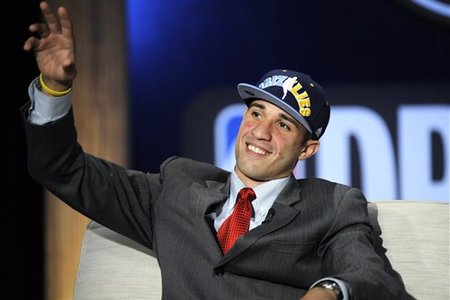
Durant, Westbrook, Gasol, and Randolph were all bigger stories in this game. They're better players for one, played more minutes, had a bigger impact on the game, and will continue to factor into the NBA's changing of the guard. But I couldn't help but focus on Vasquez -- for the simple fact that he'd nudged his way, once again, into uncharted territory. He was only playing because Mike Conley Jr. fouled out in the first overtime.
I thought back to Draft Day when Vasquez emerged from the paying crowd after David Stern announced the Grizzlies had selected him with the 28th overall pick. There was Vasquez again, crashing a party he wasn't invited to.
I looked back at the 2010 NBA Draft blog I wrote in June to see if Vasquez's appearance elicited the same response in me as it does today. Not surprisingly, Vasquez was little more than a footnote in my post. I was discussing why 14 of the first 15 draft pick were in attendance:
The NBA extended more invitations to players this year. Very possible, but if they were going to invite 15 or so, they might as well have invited 20 to include players like Greivis Vasquez who had to sit in the stands; the equivalent of flying coach.
Fitting because the announcers have also chosen to discuss Vasquez as a subplot of Kevin Durant's story; the second and less important piece of a "Cool Story Bro" anecdote. Durant and Vasquez played high school ball together in Maryland, and now they're playing against each other in the Playoffs! They used to be best friends and now they're enemies for a few weeks! This story probably isn't even brought up if Vasquez was high school teammates with BJ Mullens.
Make no mistake, the Grizzlies are a better team when Conley, not Vasquez, is on the floor. Conley runs the offense more proficiently, he finds the open man more often than not, and usually is not looking to score first. But Vasquez plays like a guy who bought his own ticket to the NBA Draft. He plays like every minute he's on the floor is a minute somebody is trying to take away from him. I like those kind of players. They deserve to force overtime once in a while too.
Tuesday, May 3, 2011
Joe Johnson And The Definitions Of Swagger

A very confident and typically arrogant or aggressive gait or manner.
An entry on UrbanDictionary.com takes the definition a step further, suggesting that swagger is not just an inherent attitude, but a reflection of one's appearance:
The confidence exuded as a reflection of one's dress, shoe game, attitude, and how one handles a situation.
Rapper T.I., in his song "56 Bars," jokingly takes this another step further, referencing "swag" as an entity separate from the human being it represents:
Somebody better tell 'em mane / They swag owe my swag everything / Very plain to see you study me awful hard / To the point that my swag need a bodyguard
Naturally, Atlanta's Joe Johnson would use such a layered, sometimes conflicting term to credit the Hawks' success. "I just think our swagger is a little bit different," Johnson told TNT's David Aldridge after Atlanta's 103-95 road win. "This is the post season, not the regular season."
The differentiation of the term usually boils down to whether swagger is something inherent, or always there; versus being a reflection of success, and only there when things are going well. So it's no surprise that Johnson speaks of his team's swagger as if it's a light switch in a dark room. The Atlanta Hawks have acquired the reputation of an all-or-nothing team. They're either going to play really well or very poorly, and probably lose interest at some point either way.
The question then is can the Hawks summon the magical swag they've found just in time for the Playoffs when they don't jump out to a 9-0 lead on the road and shoot 54 percent from behind the arc? Will 120-million dollar man Joe Johnson be able to make a positive impact on the floor when the Bulls are closing out better, and he's not hitting his shot? Most of us don't think so because the Hawks or Johnson haven't given us a reason to.
Atlanta's ability to hold on late in the 4th quarter in Game 6 of the Magic series was a necessary first step towards shedding their losing ways, or lack of swagger, whatever you want to call it. The Atlanta I remember would have tripped over the coffee table while reaching for the light switch. Now they have to do it again, and despite a 1-0 series lead, I bank on the old Atlanta showing up.
In the words of Sporting News' Sean Deveney, "Swagger is good, but it won't necessarily lead to a deep postseason run." Amen. Bulls in five.
Sunday, May 1, 2011
Russell Westbrook As Sonic The Hedgehog

Oklahoma City's problems go well beyond Westbrook. Interior defense, bench play, and rebounding to name a few. Westbrook has been heavily scrutinized for his shot selection and the sheer volume of his shots. He attempted 30, many of them bad, in the Thunder's Game 4 loss in Denver. Westbrook had attempted 30 or more shots only once in the regular season, a three-point win over the Nets in which Kevin Durant didn't play. Westbrook attempted 23 shots in Oklahoma City's Game 1 loss, a number he reached in the regular season only eight of the 82 games he started. He attempted 23 or more shots in about ten percent of his regular season games, and has already hit that mark in three of the Thunder's six playoff games. That type of irregularity, especially in losing efforts, gets noticed.
"Offensively we're going too fast," Thunder head coach Scott Brooks hollered during a 2nd quarter timeout. "Let the offense work for us." Brooks hung on the word "fast" as if he'd just witnessed a murder. He might as well have been staring right at Westbrook. But Russell Westbrook knows only one speed. He's always going fast, and his speed can be just as detrimental as it is beneficial. He's Sonic the Hedgehog.
Remember playing Sonic? His speed often times defied the power of a Sega Genesis controller. The user could rev him up and direct him towards various loops and trampolines, but ultimately where Sonic would end up was anybody's guess. The user was just as likely to fall into a wall of golden rings as a cave full of deadly spikes, and all of it happened so fast. Such is the Russell Westbrook conundrum.
Westbrook's game has always been a little bit out of control. It worked wonderfully in FIBA play where the size, strength, and speed of his opponents paled in comparison to his own. But in the NBA his style of play often leads to low percentage pull-up jumpers, errant passes, and stripped balls. Westbrook led the league in turnovers this year and his inaugural 2008-09 season. He added seven more in Game 1, accounting for about 40 percent of his team's turnovers.
This is how Westbrook has always played. He's a high risk, high reward player. He has attempted three more shots per game in the Playoffs than the regular season, but the turnovers and questionable shot selection have remained the same. The difference is that the Thunder normally win. They've still won four of their six games, but losses are put under a microscope in the Playoffs. Some people have had the nerve to suggest Westbrook is trying to be the hero this postseason, and as a result refusing to defer to Durant, the team's best player. I've also heard some suggestions that a possible Marbury-Garnett in Minnesota tiff is developing between the two. Nonsense. They've won with Westbrook playing this way and will continue to. It's just not always pretty.
The question shouldn't be how do we slow down Westbrook? But what's waiting on the other side of the loop?
Saturday, April 30, 2011
Day 13: Blazers-Mavericks (Game 6)

Well, imaginary reader, you're not entirely wrong. But why such harsh judgement? Just because I've been known to come up short a time or two hundred doesn't mean I can't trump history and come through in the clutch. With the Dallas Mavericks as my witness, I'm asserting myself and shattering the preconceived notions that define me.
The Blazers were the popular upset pick (I picked them in six!) in the first round. Portland seemed to have put it all together, fully incorporating Gerald Wallace into their plans. They also put the clamps on Dallas in the last week of the season. Add to the equation Dallas' fair reputation as Playoff choke-artists and the ingredients for an upset seemed to be layed out in a straight line on the kitchen counter.
The most fascinating thing about this series is that, save for the last five minutes of Game 6, it went according to "plan." Dallas and Portland each took their first two home games. Dallas started Game 5 sluggish, slowly recovered, and blew Portland out in the second half. It was the type of "false-confidence" game Dallas has so willfully provided over the last five years. Just when you think they're destined for something great, they uphold your expectations and drop them at the pace of a JJ Barea floater.
Let's head to the the 44 second mark of the third quarter in Game 6. Jason Terry hits a long jumper to put the Mavericks up 75-58, the largest lead they would have all game. All the better. They have built up a lead perfectly suited to make Dallas fans think they're in control, and just close enough to make NBA fans feel like the Mavs can fuck this up. Portland follows with a LaMarcus Aldridge layup and two Gerald Wallace free throws to close out the quarter. 75-62. The seeds of a collapse have been planted.

A Gerald Wallace dunk with five and a half minutes left put the Blazers within one. The Blazers seemed poised to take over the game but didn't convert a field goal attempt for five minutes. The Mavericks inexplicably went away from Nowitzki but Terry, Marion, and Kidd put Portland away with a number of clutch shots of their own. Nowitzki closed the game out with eight straight free throws.
Portland's future of contending for a Championship rests on Greg Oden's knees; not an enviable position. Meanwhile, Dallas reversed the choke narrative that had been written for them and we can finally see the Kobe-Dirk match up that somehow has alluded us all these years. With the NBA as their witness, the Dallas Mavericks asserted themselves and broke from the preconceived notions that defined them. But can they do it again? And again, and again....
Since it went so well the first time (semi-sarcasm) here are my second round picks:
EAST
(1) Bulls vs. (5) Hawks ---> Bulls in 5
(2) Heat vs. (3) Celtics ---> Heat in 7
WEST
(8) Grizzlies vs. (4) Thunder ---> Thunder in 6
(2) Lakers vs. (3) Mavericks ---> Lakers in 6
Shout out to the Grizzlies, whose Game 6 victory I only caught parts of. Hence, I won't be writing about it. Zach Randolph is the best story of the Playoffs so far.
Thursday, April 28, 2011
Day 12: Heat-Sixers (Game 5)

I digested this opinion and immediately thought, would we be asking the same question if it was the Lakers, Spurs, or Celtics rolling through the first round? Of course we wouldn't. We'd say these teams were elevating their game come Playoff time and priming themselves for the long stretch. Basically, we'd spin this positively.
But not when it comes to the Heat. Everything about the Heat is looked at critically. Some of that is the left over animosity following "The Decision" and some of it is fueled by the fear that the Heat may take over the league. The Heat haven't won anything yet, their critics will point out; and that is why we're allowed to question their crunch time struggles.
Strangely enough, Game 2 was the only one-sided affair. The four other games followed a similar pattern. The Sixers got off to a fast start, the Heat quickly squashed them in the second quarter, and both teams played relatively even in the second half, with the Heat converting down the stretch. With the exception of Game 2, every game was decided by 8 points or less. I'd call those close games. The Heat have proven themselves capable of closing out games in this series, but even that isn't enough. Boston's transition defense is better and they play at a slower pace. The Heat will need to beat Boston in order to earn any respect.
I've always maintained (speaking in generalities of course) that beating the Heat came down to limiting Chris Bosh. My line of thinking went: LeBron and Wade are going to score their customary 50 to 60 points regardless of how well you play them. Miami's team outside of the Big Three couldn't be counted on for any significant production. Therefore, Bosh and his 18 points per game were the wild card. If you could limit him to 10 or 12 and force the supporting cast to beat you, then you stand a pretty good chance of winning.
My thinking was largely molded from the Bosh's performances in Miami's opening game against Boston (8 points, 3-11 shooting) and his infamous 1-18 game in Chicago. The way I remembered them, Miami's losses were the result of poor games from Bosh and the supporting cast, while LeBron and Wade went off. The Game 4 loss seemed to support my theory. Bosh (12 points) and everyone not named Wade or LeBron (17 combined points) had their worst game of the series, and Wade and LeBron combined for 53.
My memory failed me.
Wade was just as likely to have a bad game as Bosh in games the Heat lost. Bosh averaged 18.7 ppg during the regular season, 17 ppg in Heat losses. In every Heat loss each member of the Big Three participated in, at least one of them had a bad game. But they also won plenty of games when either LeBron, Wade, or Bosh put together a less than stellar performance. They did it with great defense and timely scoring from their supporting cast.
So far the supporting cast has come through: 34, 30, 25, and 33 points in Games 1, 2, 3, and 5, and lockdown team defense. But we don't want to hear about that. How will the Heat respond when they have the ball for the last possession, down by two. Who takes the shot? LeBron did in Game 4 and the Heat lost. Ultimately, the Heat will be judged in the closing seconds of a ball game. The closing seconds figure to mean more against Boston.
Day 11: Bulls-Pacers (Game 5)

But fans are spectators. That's what they pay for -- to sit in their seats and watch their team play. Little is owed to them except for a team putting forth maximum effort. Now and then, they receive a little more. A home crowd loves to be acknowledged. Not just as thousands of color-coordinated people, but as an integral part of the basketball experience.
Taj Gibson and Joakim Noah played the Bulls' version of the Bash Brothers in Game 5. They protected the rim, more than matched the physicality of Indiana's frontcourt, and played to the crowd the way only the greatest ego-bruising duo could.
The final six minutes of the third quarter were a microcosm of the Bulls' season. With Rose sitting on the bench with four fouls, the offense struggled, surrendering most of an 11-point lead. Rose didn't sit out for more than three minutes before he reentered the game. He proceeded to score or assist on 15 of the Bulls' final 23 points to end the quarter. Included in that barrage were three Rose three-pointers, an aspect of his game he struggled with all series. The Bulls led 82-65 at that point, but as the quarter closed, Josh McRoberts was ejected for retaliating after what he called "an elbow to the throat" from Noah. Noah and Gibson buddied up like Franklin and Bash to gloat and urge the 20 thousand in attendance to do the same. They also accounted for five of the Bulls' nine blocks on the evening. It was a pretty fun night for them.
When players encourage a crowd reaction they're really saying, "You're part of this too." They want you to share, alter, or revel in the moment the same way they are. The normally mild-mannered Luol Deng did the same thing in Game 1, urging the crowd to get loud after Hansbrough put a hard foul on Rose. The Bulls rarely played to the crowd in the regular season. Maybe it's the bigger stage and the realization that home court could be a determining factor on the road to the Finals, but the Bulls have made the Playoffs more of a collective experience. It's more fun (and intense) that way.
Carlos Boozer scored two points in Game 5. If he's not scoring there's no reason for him to play, and he didn't play much. Gibson took most of Boozer's minutes, anchoring the defense along with Noah. Whether it's his toe injury or something going on mentally, Boozer needs to get it together. He had an overall excellent Game 2 and followed with three straight poor performances. Gibson will continue to get more minutes for defensive purposes anyway, but Boozer is Chicago's only legitimate low-post scoring threat. Playing on the perimeter is too risky for an entire game, especially as defensive pressure and intensity heighten deeper into the Playoffs.
I've always been a fan of Keith Bogans. I'll admit, part of the reason why I like Bogans so much is because of all the stupid ways Bulls fans have tried to downgrade, or failed to realize what he brings to the table. Bogans isn't on the floor for his offense and, as I explained in the post linked above, there are not enough shots to go around for Bogans to be a scorer anyway. Bogans is a lock down defender at the shooting guard position. He's a guy that his teammates like and respect, and a player that can get under the opposition's skin. Bogans only attempted 11 shots heading into Game 5, and he converted on four three-pointers. He made five of his seven attempts in Game 5.
Bogans' job is to keep defenses honest. The Bulls can and will win if he contributes next to nothing on the offensive end (Games 1 and 2) and they will also lose when he contributes next to nothing (Game 4). The point being that Keith Bogans doesn't win or lose the Bulls games. When Bogans can, by his standards, explode like he did in Games 3 and 5, he gives the defense something extra to think about. I would expect Bogans to have 2 or 3 games every series where he's unconscious. It's not out of the question considering he hasn't attempted a bad shot all year and 90 percent of his looks are wide-open threes. Keep thinking of replacement shooting guards. Meanwhile, Keith Bogans is quietly helping the Bulls win games.
Subscribe to:
Posts (Atom)