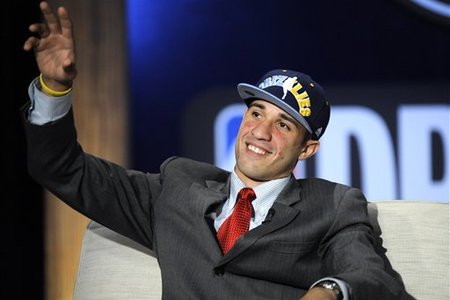
Greivis Vasquez hit the two biggest shots of his young career in Memphis' 133-123 triple-overtime loss Monday night. The first was less of a calculated buzzer beating three-pointer, but more of an assured 26-foot fling to force a second overtime. Vasquez struck again at the end of the second overtime, converting a three point play over Westbrook to put the Grizzlies up three, seconds after Westbrook had tied the game with a trey.
Durant, Westbrook, Gasol, and Randolph were all bigger stories in this game. They're better players for one, played more minutes, had a bigger impact on the game, and will continue to factor into the NBA's changing of the guard. But I couldn't help but focus on Vasquez -- for the simple fact that he'd nudged his way, once again, into uncharted territory. He was only playing because Mike Conley Jr. fouled out in the first overtime.
I thought back to Draft Day when Vasquez emerged from the paying crowd after David Stern announced the Grizzlies had selected him with the 28th overall pick. There was Vasquez again, crashing a party he wasn't invited to.
I looked back at the 2010 NBA Draft blog I wrote in June to see if Vasquez's appearance elicited the same response in me as it does today. Not surprisingly, Vasquez was little more than a footnote in my post. I was discussing why 14 of the first 15 draft pick were in attendance:
The NBA extended more invitations to players this year. Very possible, but if they were going to invite 15 or so, they might as well have invited 20 to include players like Greivis Vasquez who had to sit in the stands; the equivalent of flying coach.
Fitting because the announcers have also chosen to discuss Vasquez as a subplot of Kevin Durant's story; the second and less important piece of a "Cool Story Bro" anecdote. Durant and Vasquez played high school ball together in Maryland, and now they're playing against each other in the Playoffs! They used to be best friends and now they're enemies for a few weeks! This story probably isn't even brought up if Vasquez was high school teammates with BJ Mullens.
Make no mistake, the Grizzlies are a better team when Conley, not Vasquez, is on the floor. Conley runs the offense more proficiently, he finds the open man more often than not, and usually is not looking to score first. But Vasquez plays like a guy who bought his own ticket to the NBA Draft. He plays like every minute he's on the floor is a minute somebody is trying to take away from him. I like those kind of players. They deserve to force overtime once in a while too.
Showing posts with label Oklahoma City Thunder. Show all posts
Tuesday, May 10, 2011
Sunday, May 1, 2011
Russell Westbrook As Sonic The Hedgehog
Russell Westbrook must be confused. Everything was gravy a few short weeks ago. Westbrook, along with teammate Kevin Durant, despite being a Top-4 seed and serious Championship contender, were cast as the lovable underdogs. America's answer to the more productive, and less likable Miami Heat duo. The Thunder are no longer underdogs, but a team that has dropped their first game against a Memphis team, led by Zach Randolph and Marc Gasol, whose novelty outweighs basketball talent. Unfortunately for Westbrook, he picked a bad time to have his two worst Playoff performances. The first coming in a series-clinching Game 4 of the Denver series, and the second in an always pivotal first game of the Conference Semifinals. Both resulted in Oklahoma City losses -- their only two in 2011's short-lived postseason.
Oklahoma City's problems go well beyond Westbrook. Interior defense, bench play, and rebounding to name a few. Westbrook has been heavily scrutinized for his shot selection and the sheer volume of his shots. He attempted 30, many of them bad, in the Thunder's Game 4 loss in Denver. Westbrook had attempted 30 or more shots only once in the regular season, a three-point win over the Nets in which Kevin Durant didn't play. Westbrook attempted 23 shots in Oklahoma City's Game 1 loss, a number he reached in the regular season only eight of the 82 games he started. He attempted 23 or more shots in about ten percent of his regular season games, and has already hit that mark in three of the Thunder's six playoff games. That type of irregularity, especially in losing efforts, gets noticed.
"Offensively we're going too fast," Thunder head coach Scott Brooks hollered during a 2nd quarter timeout. "Let the offense work for us." Brooks hung on the word "fast" as if he'd just witnessed a murder. He might as well have been staring right at Westbrook. But Russell Westbrook knows only one speed. He's always going fast, and his speed can be just as detrimental as it is beneficial. He's Sonic the Hedgehog.
Remember playing Sonic? His speed often times defied the power of a Sega Genesis controller. The user could rev him up and direct him towards various loops and trampolines, but ultimately where Sonic would end up was anybody's guess. The user was just as likely to fall into a wall of golden rings as a cave full of deadly spikes, and all of it happened so fast. Such is the Russell Westbrook conundrum.
Westbrook's game has always been a little bit out of control. It worked wonderfully in FIBA play where the size, strength, and speed of his opponents paled in comparison to his own. But in the NBA his style of play often leads to low percentage pull-up jumpers, errant passes, and stripped balls. Westbrook led the league in turnovers this year and his inaugural 2008-09 season. He added seven more in Game 1, accounting for about 40 percent of his team's turnovers.
This is how Westbrook has always played. He's a high risk, high reward player. He has attempted three more shots per game in the Playoffs than the regular season, but the turnovers and questionable shot selection have remained the same. The difference is that the Thunder normally win. They've still won four of their six games, but losses are put under a microscope in the Playoffs. Some people have had the nerve to suggest Westbrook is trying to be the hero this postseason, and as a result refusing to defer to Durant, the team's best player. I've also heard some suggestions that a possible Marbury-Garnett in Minnesota tiff is developing between the two. Nonsense. They've won with Westbrook playing this way and will continue to. It's just not always pretty.
The question shouldn't be how do we slow down Westbrook? But what's waiting on the other side of the loop?
Oklahoma City's problems go well beyond Westbrook. Interior defense, bench play, and rebounding to name a few. Westbrook has been heavily scrutinized for his shot selection and the sheer volume of his shots. He attempted 30, many of them bad, in the Thunder's Game 4 loss in Denver. Westbrook had attempted 30 or more shots only once in the regular season, a three-point win over the Nets in which Kevin Durant didn't play. Westbrook attempted 23 shots in Oklahoma City's Game 1 loss, a number he reached in the regular season only eight of the 82 games he started. He attempted 23 or more shots in about ten percent of his regular season games, and has already hit that mark in three of the Thunder's six playoff games. That type of irregularity, especially in losing efforts, gets noticed.
"Offensively we're going too fast," Thunder head coach Scott Brooks hollered during a 2nd quarter timeout. "Let the offense work for us." Brooks hung on the word "fast" as if he'd just witnessed a murder. He might as well have been staring right at Westbrook. But Russell Westbrook knows only one speed. He's always going fast, and his speed can be just as detrimental as it is beneficial. He's Sonic the Hedgehog.
Remember playing Sonic? His speed often times defied the power of a Sega Genesis controller. The user could rev him up and direct him towards various loops and trampolines, but ultimately where Sonic would end up was anybody's guess. The user was just as likely to fall into a wall of golden rings as a cave full of deadly spikes, and all of it happened so fast. Such is the Russell Westbrook conundrum.
Westbrook's game has always been a little bit out of control. It worked wonderfully in FIBA play where the size, strength, and speed of his opponents paled in comparison to his own. But in the NBA his style of play often leads to low percentage pull-up jumpers, errant passes, and stripped balls. Westbrook led the league in turnovers this year and his inaugural 2008-09 season. He added seven more in Game 1, accounting for about 40 percent of his team's turnovers.
This is how Westbrook has always played. He's a high risk, high reward player. He has attempted three more shots per game in the Playoffs than the regular season, but the turnovers and questionable shot selection have remained the same. The difference is that the Thunder normally win. They've still won four of their six games, but losses are put under a microscope in the Playoffs. Some people have had the nerve to suggest Westbrook is trying to be the hero this postseason, and as a result refusing to defer to Durant, the team's best player. I've also heard some suggestions that a possible Marbury-Garnett in Minnesota tiff is developing between the two. Nonsense. They've won with Westbrook playing this way and will continue to. It's just not always pretty.
The question shouldn't be how do we slow down Westbrook? But what's waiting on the other side of the loop?
Thursday, April 21, 2011
Day 5: Nuggets-Thunder (Game 2)
The NBA regular season is a long, sometimes predictable grind. The good teams will almost always beat the bad teams. Guys won't be playing as hard as they do in the Playoffs, and JaVale McGee will make you wish he was on your team and then quickly rescind that wish in a span of two minutes. To break the monotony, NBA followers and writers alike latch on to the exciting and unpredictable. What will Blake Griffin do next? Can the Spurs keep up their pace after the All-Star break? Anything having to do with the Miami Heat. These were all intriguing questions/issues because there were so many different ways to tell each story. They were consistent NBA stories, made better because of the thought that the way we felt about them could change drastically at any moment.
Then there was the Thunder -- a team that had a spectacular year, but fell short of the preseason hype surrounding them. Oklahoma City pushed the Lakers to their limit in last year's first round, and Kevin Durant led Team USA to Gold over the Summer in the FIBA World Championship. The Thunder were supposed to challenge for the top seed in the West and Durant was supposed to be the runaway MVP. That would have been a great, somewhat predictable, but ultimately intriguing storyline. A young, gifted player joins the ranks of the game's elite. He takes his team from an 8 to a 1 seed in the matter of one year and wins the MVP while doing so. Sound familiar? That was Derrick Rose and the Bulls. Chicago had the season Oklahoma City was expected to have.
Perhaps the bar was set to high. The Thunder did improve after all. They went from a 50-32 8-seed, to a 55-27 4-seed. Here are Durant's numbers this year compared to last:
2010-11: 27.7 ppg, 6.8 rpg, 2.7 apg, 46% FG, 23.7 PER
2009-10: 30.1 ppg, 7.6 rpg, 2.8 apg, 47% FG, 26.2 PER
His numbers were slightly lower, but not enough of a drop off to become an MVP afterthought like he was this year. The Playoffs are the great equalizer. In an ever-alternating Western Conference, the race to the Finals is wide open. The Thunder were one of many well-written drafts this year. Now they're a favorite to become the story.
What is wrong with Wilson Chandler? Denver's tattooed and scruffy small forward has contributed next to nothing on the offensive end. He scored nine points on just 4-10 shooting in Game One, and added only four points without converting a field goal in Game Two. The problem runs far deeper than shot selection. Chandler has always taken bad shots -- he just normally makes more of them. Chasing around Kevin Durant thirty minutes a game seems to be getting to him. Chandler likes to take his man off the dribble, begin to drive, then inexplicably step back for a fade away 18-footer. His legs aren't there for that shot, and unfortunately for Denver, they need more offense out of him to win.
Then there was the Thunder -- a team that had a spectacular year, but fell short of the preseason hype surrounding them. Oklahoma City pushed the Lakers to their limit in last year's first round, and Kevin Durant led Team USA to Gold over the Summer in the FIBA World Championship. The Thunder were supposed to challenge for the top seed in the West and Durant was supposed to be the runaway MVP. That would have been a great, somewhat predictable, but ultimately intriguing storyline. A young, gifted player joins the ranks of the game's elite. He takes his team from an 8 to a 1 seed in the matter of one year and wins the MVP while doing so. Sound familiar? That was Derrick Rose and the Bulls. Chicago had the season Oklahoma City was expected to have.
Perhaps the bar was set to high. The Thunder did improve after all. They went from a 50-32 8-seed, to a 55-27 4-seed. Here are Durant's numbers this year compared to last:
2010-11: 27.7 ppg, 6.8 rpg, 2.7 apg, 46% FG, 23.7 PER
2009-10: 30.1 ppg, 7.6 rpg, 2.8 apg, 47% FG, 26.2 PER
His numbers were slightly lower, but not enough of a drop off to become an MVP afterthought like he was this year. The Playoffs are the great equalizer. In an ever-alternating Western Conference, the race to the Finals is wide open. The Thunder were one of many well-written drafts this year. Now they're a favorite to become the story.
What is wrong with Wilson Chandler? Denver's tattooed and scruffy small forward has contributed next to nothing on the offensive end. He scored nine points on just 4-10 shooting in Game One, and added only four points without converting a field goal in Game Two. The problem runs far deeper than shot selection. Chandler has always taken bad shots -- he just normally makes more of them. Chasing around Kevin Durant thirty minutes a game seems to be getting to him. Chandler likes to take his man off the dribble, begin to drive, then inexplicably step back for a fade away 18-footer. His legs aren't there for that shot, and unfortunately for Denver, they need more offense out of him to win.
James Harden's beard (and Harden too!) went off for 18 points in Game Two. Harden has to be one of the most frustrating players to watch in the NBA. He has the skills to be great. He can shoot from anywhere in the building, take his man off the dribble, finish in traffic, and defend when he wants to. Yet, the 4th overall selection in 2009 has reveled in mediocrity up to this point. I realize this is only his second year, but you never know what you're going to get on a night-to-night basis. Charles Barkley made a great point (shocking, I know) about Harden. He stated that Harden would be starting now, but his head coach Scott Brooks wants to bring him off the bench to provide a spark, similar to how the Spurs used to use Manu Ginobili.
Harden provided that spark in Game Two, showcasing all of the talents that I wish he could lay out on his kitchen table and super glue together. If the Thunder are going to contend, they need a reliable third scorer to take the pressure off Durant and Westbrook. They can't be expected to combine for 65 every night, let alone the 72 they posted in Game One. Harden is the only Thunder player capable of playing the third wheel. It's going to be difficult for anyone to beat them if Harden can efficiently give them 16-18 a night.
The Nuggets have become a fan favorite after the Melo trade. They dealt their big name/distraction that didn't want to be there and became a better team. All while the Knicks made little to no improvement after supposedly receiving the prize of the transaction. But sure enough, the Nuggets miss Carmelo Anthony. Not for the entire game, but they miss Carmelo Anthony in crunch time.
The Nuggets were the highest scoring team in the NBA. After trading Melo, they were off to the races, literally. Their uptempo style ran teams out of the gym. The Nuggets have a remarkable EIGHT players that averaged double figures for them this year. But that's part of the problem. The new-look Nuggets have not been in many close games during the season, but in games decided by 8 points or less, including Game One, they are 3-6.
The Nuggets right now are a bullpen filled with guys that can throw 95 mph with movement, but none of them have a defined role. We've seen the Closer-By-Committee fail countless times in baseball and Denver's basketball version is doing the same. They don't have anyone they can count on to win a game for them in the closing seconds. Playoff games, or at least 4 out of 7 in a series are typically close. The Nuggets' success was fun because of what they represented, but they could really use a player like the one they dealt away.
Friday, December 10, 2010
Shaun Livingston's Knee and the Winter Blues
It's getting colder, snow is starting to pile up, and if that wasn't depressing enough, I thought about Shaun Livingston the other day. I first watched Livingston in 2004 while he was playing for Peoria Central in the Illinois State Championships. I marveled at the way he effortlessly weaved his way through smaller defenders en route to the basket. Think Kevin Durant body type but a little shorter playing the point guard position, exceptional handles, but nowhere near Durant's ability to score -- that was Shaun Livingston in 2004, playing against high schoolers.
Little did I know, Livingston had led Peoria Central to Class AA title the year before against Eddy Curry's alma mater, Thornwood. That would be back-to-back titles and McDonald's All-American honors for Livingston to conclude his high school career.
Livingston committed to Duke but chose to enter the 2004 NBA Draft. He was drafted 4th overall by the Los Angeles Clippers. Livingston's decision to forgo college and his horrific knee injury are the most credited reasons for him not living up to his potential. The former allegation is a gross misjudgement.
Livingston certainly would have benefited from playing a year or two under Coach K -- any player would. He also would have teamed up with JJ Redick and Shelden Williams to form possibly the greatest trio of college basketball players that all went on to mediocre NBA careers.
Livingston probably wouldn't have improved his draft stock much higher than it already was coming out of high school. The first overall picks the next three years were big men (Bogut, Bargnani, and Oden), and teams are much more likely to take a flyer on a big man than point guard with the top overall selection.
The half courts sets in the college game probably aren't suited to what I believe were Livingston's strengths -- pushing the ball, and isolating his defender one-on-one. Some time had Duke would have definitely improved his defense though.
After a promising rookie year, the Clippers traded for Sam Cassell, which halted what was expected to be a spike in Livingston's playing time. Instead, Livingston backed up Cassell at the point and occasionally played shooting guard -- a position that didn't utilize his skills. The 2005-06 Clippers enjoyed their best season in franchise history since moving to Los Angeles. They won 49 games, defeated the Denver Nuggets in the first round of the playoffs, and took the Suns all the way to seven games before losing in the Conference Semifinals. Livingston's playoff numbers mirror his career stats: 9 points and 4 assists in 27 minutes per game.
The following year, Livingston would experience his claim to fame, a horrific knee injury that would tear his ACL and PCL, sprain his MCL, and dislocate his kneecap and shinbone. And all that happened on the same play, it's no wonder the video was a YouTube sensation.
Livingston's injury was season-ending and looked at first glance like it could have ended his career. It came at the worst possible time, seeing as Cassell's contract was up after that season, and Livingston would have likely been given the reigns to the Clippers franchise. Instead, the Clippers decided not to pick up his qualifying offer, opting instead to make him an unrestricted free agent.
For the next two years, Livingston spent time with the Heat, Grizzlies, Thunder, and even the D-League's Tulsa 66ers before finding a home at the end of last season with the Wizards. He played well enough in 26 games with Washington to earn a 2 year contract offer this offseason from the Bobcats. In Charlotte he finds himself in a similar situation, backing up D.J. Augustin at the point.
No one will say it, but Livingston's lack of playing time (25 mpg over his career, 17 this season) isn't all related to his play. His knee simply can't handle the stress of 35 or more minutes per game. Livingston was injury plagued before his 2007 injury, that was just the culmination of everything that has went wrong with his career.
Like so many before him, Livingston had the ability to revolutionize his position but couldn't stay healthy. Rather than dwell on what his career could have been, let's instead appreciate the fact that he's still playing. Watch that video again. It's a miracle he can even walk.
Little did I know, Livingston had led Peoria Central to Class AA title the year before against Eddy Curry's alma mater, Thornwood. That would be back-to-back titles and McDonald's All-American honors for Livingston to conclude his high school career.
Livingston committed to Duke but chose to enter the 2004 NBA Draft. He was drafted 4th overall by the Los Angeles Clippers. Livingston's decision to forgo college and his horrific knee injury are the most credited reasons for him not living up to his potential. The former allegation is a gross misjudgement.
Livingston certainly would have benefited from playing a year or two under Coach K -- any player would. He also would have teamed up with JJ Redick and Shelden Williams to form possibly the greatest trio of college basketball players that all went on to mediocre NBA careers.
Livingston probably wouldn't have improved his draft stock much higher than it already was coming out of high school. The first overall picks the next three years were big men (Bogut, Bargnani, and Oden), and teams are much more likely to take a flyer on a big man than point guard with the top overall selection.
The half courts sets in the college game probably aren't suited to what I believe were Livingston's strengths -- pushing the ball, and isolating his defender one-on-one. Some time had Duke would have definitely improved his defense though.
After a promising rookie year, the Clippers traded for Sam Cassell, which halted what was expected to be a spike in Livingston's playing time. Instead, Livingston backed up Cassell at the point and occasionally played shooting guard -- a position that didn't utilize his skills. The 2005-06 Clippers enjoyed their best season in franchise history since moving to Los Angeles. They won 49 games, defeated the Denver Nuggets in the first round of the playoffs, and took the Suns all the way to seven games before losing in the Conference Semifinals. Livingston's playoff numbers mirror his career stats: 9 points and 4 assists in 27 minutes per game.
The following year, Livingston would experience his claim to fame, a horrific knee injury that would tear his ACL and PCL, sprain his MCL, and dislocate his kneecap and shinbone. And all that happened on the same play, it's no wonder the video was a YouTube sensation.
Livingston's injury was season-ending and looked at first glance like it could have ended his career. It came at the worst possible time, seeing as Cassell's contract was up after that season, and Livingston would have likely been given the reigns to the Clippers franchise. Instead, the Clippers decided not to pick up his qualifying offer, opting instead to make him an unrestricted free agent.
For the next two years, Livingston spent time with the Heat, Grizzlies, Thunder, and even the D-League's Tulsa 66ers before finding a home at the end of last season with the Wizards. He played well enough in 26 games with Washington to earn a 2 year contract offer this offseason from the Bobcats. In Charlotte he finds himself in a similar situation, backing up D.J. Augustin at the point.
No one will say it, but Livingston's lack of playing time (25 mpg over his career, 17 this season) isn't all related to his play. His knee simply can't handle the stress of 35 or more minutes per game. Livingston was injury plagued before his 2007 injury, that was just the culmination of everything that has went wrong with his career.
Like so many before him, Livingston had the ability to revolutionize his position but couldn't stay healthy. Rather than dwell on what his career could have been, let's instead appreciate the fact that he's still playing. Watch that video again. It's a miracle he can even walk.
Wednesday, October 27, 2010
Rose And Westbrook Battle For Point Guard Supremacy
I never thought I'd say this, but in tonight's season opener, fresh off a FIBA World Championship this summer, leading the league in scoring last year, and pretty much crowned this year's MVP, Kevin Durant will not be the center of attention in tonight's game. At least not my attention, anyway. Although I do have a low attention span.
Don't sleep on Durant and Deng's match up. Deng had the best preseason of any Bull, showing the ability to consistently hit the three. That should be a great match up. But no match up shall be greater than Derrick Rose and Russel Westbrook.
Team USA teammates this summer, Rose and Westbrook seemed to have been linked the entire offseason. The question being, who is better?
Westbrook has received overwhelming support. All of a sudden, I began hearing a lot of "Westbrook is better than Rose" opinions, when that wasn't even mildly feasible after the 2009-10 season.
So I wondered where this opinion was coming from. So I went to the source. The place I always go when questionable opinions seem to have a strong following - Bill Simmons.
Wrote Simmons on ESPN.com:
"We went into this tournament thinking Rose and Rondo were the two best under-24 point guards in some order. Rondo got sent home, then Westbrook outplayed Rose so convincingly in the tournament that, at some point, everyone who loves basketball glanced around in confusion and said, "Hold on, does Oklahoma City now have the best young point guard AND the best young player in the league?"
For whatever reason, Simmons' opinions seem to gain steam quickly and are rarely questioned. Especially amongst college-aged sports fans such as myself.
Everyone is entitled to their opinion, but hopefully I can dispel this Westbrook > Rose myth. Yes, Westbrook scored more points than Rose in the FIBA tournament. Seventeen more to be exact, and 1.9 more points per game. Their overall shooting percentages were almost identical, Westbrook shot better from behind the arc and on the free throw line. Rose had slightly more assists, Westbrook slightly more rebounds.
Really the only thing that distinguished Westbrook was his scoring total and ability to get to the basket. People are acting like Rose hasn't show the same ability - in the NBA.
Rose switched off from point guard to shooting guard playing alongside Chauncey Billups in the starting lineup. The offense ran through Durant in that starting lineup.
Krzyzewski frequently emptied his entire bench, bringing in five new players rather than playing the starters with the reserves. Consequently, Westbrook was given more free reign on the offense. Who was the go to guy on the second team? Rudy Gay? Who ever it was, that player didn't demand touches like Durant. Westbrook was able to create for himself and penetrate, while Rose was expected to be more of a distributor.
The only time in international play that I can remember Rose playing his NBA game was in the exhibition match against Spain. On Team USA's last two possessions, Rose drove the lane, hung in the air and scored, then drove to the basket again and drew the foul. He knocked down both free throws and won the game for the USA.
The point I'm trying to get at is that international play should not be used to determine who is a better NBA player. Not only is the style of play different, but players are expected to play different roles than they normally would. I believe that Westbrook's role was fairly similar to his NBA role, whereas Rose's was not.
While both are not yet on Rondo's level, tonight's match up should add more to the best young point guard discussion. Kevin Durant deserves a day outside of the spotlight.
Don't sleep on Durant and Deng's match up. Deng had the best preseason of any Bull, showing the ability to consistently hit the three. That should be a great match up. But no match up shall be greater than Derrick Rose and Russel Westbrook.
Team USA teammates this summer, Rose and Westbrook seemed to have been linked the entire offseason. The question being, who is better?
Westbrook has received overwhelming support. All of a sudden, I began hearing a lot of "Westbrook is better than Rose" opinions, when that wasn't even mildly feasible after the 2009-10 season.
So I wondered where this opinion was coming from. So I went to the source. The place I always go when questionable opinions seem to have a strong following - Bill Simmons.
Wrote Simmons on ESPN.com:
"We went into this tournament thinking Rose and Rondo were the two best under-24 point guards in some order. Rondo got sent home, then Westbrook outplayed Rose so convincingly in the tournament that, at some point, everyone who loves basketball glanced around in confusion and said, "Hold on, does Oklahoma City now have the best young point guard AND the best young player in the league?"
For whatever reason, Simmons' opinions seem to gain steam quickly and are rarely questioned. Especially amongst college-aged sports fans such as myself.
Everyone is entitled to their opinion, but hopefully I can dispel this Westbrook > Rose myth. Yes, Westbrook scored more points than Rose in the FIBA tournament. Seventeen more to be exact, and 1.9 more points per game. Their overall shooting percentages were almost identical, Westbrook shot better from behind the arc and on the free throw line. Rose had slightly more assists, Westbrook slightly more rebounds.
Really the only thing that distinguished Westbrook was his scoring total and ability to get to the basket. People are acting like Rose hasn't show the same ability - in the NBA.
Rose switched off from point guard to shooting guard playing alongside Chauncey Billups in the starting lineup. The offense ran through Durant in that starting lineup.
Krzyzewski frequently emptied his entire bench, bringing in five new players rather than playing the starters with the reserves. Consequently, Westbrook was given more free reign on the offense. Who was the go to guy on the second team? Rudy Gay? Who ever it was, that player didn't demand touches like Durant. Westbrook was able to create for himself and penetrate, while Rose was expected to be more of a distributor.
The only time in international play that I can remember Rose playing his NBA game was in the exhibition match against Spain. On Team USA's last two possessions, Rose drove the lane, hung in the air and scored, then drove to the basket again and drew the foul. He knocked down both free throws and won the game for the USA.
The point I'm trying to get at is that international play should not be used to determine who is a better NBA player. Not only is the style of play different, but players are expected to play different roles than they normally would. I believe that Westbrook's role was fairly similar to his NBA role, whereas Rose's was not.
While both are not yet on Rondo's level, tonight's match up should add more to the best young point guard discussion. Kevin Durant deserves a day outside of the spotlight.
Subscribe to:
Posts (Atom)