Around this time last year, I affectionately dubbed A Pack To Be Named Later the "Best Blog Ever." I've come to realize this proclamation was a bit hasty. In the last year, I've come across many blogs I would consider better. So in the spirit of highlighting a really great blog -- and jacking their idea a second time -- I'd like to crown "A Pack..." as the "Best Blog You've Probably Never Heard Of." Their mission is simple: purchase a pack of sports cards, open said pack of sports cards, the scan and post the cards for their readers to see. Anyone who loved cards as a kid (or still does) could easily lose themselves for an hour on this site.
I bought two packs of the 2009/10 Upper Deck Greats of the Game series -- a set dedicated to the greats of the college game. I bought them at a Dollar Store. Don't laugh. The Dollar Store is an untapped gold mine for card collecting. Firstly, there is no purchasing competition because no one knows they can buy basketball cards at the Dollar Store. Second, $1 for a pack of relatively new cards is cheaper than anywhere else. The big drawback, of course, is selection. What's there is there and sometimes what's there sucks.
Not the case this time, as the Greats of the Game set is a pretty good one. I looked up the set's details when I got home and am kicking myself now. The retail price for a box of these cards is $65 and contains 16 packs of 8 cards (128 cards). Each box contains TWO AUTOGRAPHS and ONE MEMORABILIA card (jersey swatches, etc). Each pack at the Dollar Store contained only five cards, so I could have bought 26 packs (130 cards) and ended up with the equivalent of a box. It would have been $39!!! cheaper and the odds say I would have driven home with three (sentimentally) valuable cards. Oh well. Here were the ten cards I pulled. No autographs, no memorabilia, just some damn good basketball players.
We'll never even see a middling NBA player from the Naval Academy in today's game, let alone a player as talented as Robinson.
Here's something fun to do in college: drunkenly argue with your roommate about whether Magic Johnson or Oscar Robertson is the greatest NBA point guard. You both will inevitably agree on one of them -- then some one at the party neither of you know will throw John Stockton's name into the ring.
Pulling a Michael Jordan from the pack is and always will be a big deal to me. He is incapable of taking a bad action photo.
And to follow Jordan up with Rose, almost too good to be true! Not much to say except I still can't believe he plays for the Bulls, I still can't believe he's one of the League's best players, and I still can't believe he's going to get better. Rose's career thus far is like going from 0 to 60 mph in 0.7 seconds.
George Gervin was listed at 6'7 and 180 lbs. in his playing days. He looks even skinnier than that in every picture I've seen of him. Think Kevin Durant but two inches shorter, 30 pounds lighter and less range. I would love to see if he could score on today's bigger, stronger players. Also: the American flag in the background is the stuff of legends. What a shot!
For Part II of the 2009/10 Upper Deck Greats of the Game pack opening, click here.
Showing posts with label Kevin Durant. Show all posts
Tuesday, November 29, 2011
Friday, May 20, 2011
Dueling Banjos
The weekend is here, both Conference Finals have come to a 1-1 stalwart, and magnificently, feature what may be five of the NBA's six best players (Dwight Howard has been fishing a while now, someone rock the boat and wake him up). Kevin Durant dominated summer headlines, as Team USA ran their offense through him while slowly crunching international competition beneath their feet. LeBron, Wade, and "The Decision" took over from there. Derrick Rose received MVP honors and NBA writers penned one thousand different articles on the meaning of humility and how Rose is saving the NBA -- and the world. Lost in the fracas, as he usually seems to be, was Dirk Nowitzki.
Nowitzki is everything I've loved about this year's Playoffs. Heading into this season he was an immensely talented player, but a perpetual loser / choke artist. After Game 1 he became the best international player ever and possibly one of the ten greatest players of all-time. Step back, cock the basketball behind your head, fadeaway off of one leg, and throw perspective out the window.
I began searching for reasons why Nowitzki has been so underrated -- in terms of his legacy and the unique blend of size and skill he's brought to the game, moreso than being recognized as an All-Star and elite player. The first explanation would seem to be bad timing. Nowitzki's prime has coincided with the primes of Hall-of-Famers Kobe Bryant, Tim Duncan, Kevin Garnett, Paul Pierce, Allen Iverson, Shaquille O'Neal, Vince Carter, Steve Nash, and Jason Kidd. All were arguably better or more exciting players for the majority of their careers. Add in players like Stephon Marbury, Steve Francis, and Tracy McGrady who ultimately didn't have HOF careers, but for a short time took the league by storm. Then the post-2003 draft picks: LeBron James, Carmelo Anthony, Dwyane Wade, and Dwight Howard, who brought new excitement and marketability to a league who's star players were either getting old or failing to live up to the lofty standards that were set for them. If someone were to ask you in 25 years who the best 10 or 15 players of the last decade were, would it really be inconceivable to forget about Dirk?
For better or worse, athletes are measured by the number of Championships they've won. I'm sure you've seen the trailer for Bad Teacher by now. Unfortunately for Dirk, his two best Dallas Mavericks teams are best known for their epic Playoff collapses. The 2006 team was up 2-0 in the NBA Finals, firmly in control of Game 3 before surrendering a double digit lead in Miami, and went on to lose four straight. Then the 2007 team, Dallas' best team in franchise history, were ousted in the first round by 8th-seeded Golden State. Dirk played well in Games 2-5, but awful in Game 1 and series-clinching Game 6; the two most likely to be remembered. Those two seasons have come to define Dirk and the Dallas Mavericks. Despite the accolades and for all the substance they've played with the past decade, they're not good enough to win a Championship.
Then there's "Dirk's Quirks." He looked like a member of Ace of Base when he came into the league. This undoubtedly contributed to the "soft" discourse.
The NBA's answer to The Cool Kids?
I'm about to criticize Tom Thibodeau. Are you sure you want to do that? Yes. Really? Yes. I mean, I think so. Realllllly?
Nowitzki is everything I've loved about this year's Playoffs. Heading into this season he was an immensely talented player, but a perpetual loser / choke artist. After Game 1 he became the best international player ever and possibly one of the ten greatest players of all-time. Step back, cock the basketball behind your head, fadeaway off of one leg, and throw perspective out the window.
I began searching for reasons why Nowitzki has been so underrated -- in terms of his legacy and the unique blend of size and skill he's brought to the game, moreso than being recognized as an All-Star and elite player. The first explanation would seem to be bad timing. Nowitzki's prime has coincided with the primes of Hall-of-Famers Kobe Bryant, Tim Duncan, Kevin Garnett, Paul Pierce, Allen Iverson, Shaquille O'Neal, Vince Carter, Steve Nash, and Jason Kidd. All were arguably better or more exciting players for the majority of their careers. Add in players like Stephon Marbury, Steve Francis, and Tracy McGrady who ultimately didn't have HOF careers, but for a short time took the league by storm. Then the post-2003 draft picks: LeBron James, Carmelo Anthony, Dwyane Wade, and Dwight Howard, who brought new excitement and marketability to a league who's star players were either getting old or failing to live up to the lofty standards that were set for them. If someone were to ask you in 25 years who the best 10 or 15 players of the last decade were, would it really be inconceivable to forget about Dirk?
For better or worse, athletes are measured by the number of Championships they've won. I'm sure you've seen the trailer for Bad Teacher by now. Unfortunately for Dirk, his two best Dallas Mavericks teams are best known for their epic Playoff collapses. The 2006 team was up 2-0 in the NBA Finals, firmly in control of Game 3 before surrendering a double digit lead in Miami, and went on to lose four straight. Then the 2007 team, Dallas' best team in franchise history, were ousted in the first round by 8th-seeded Golden State. Dirk played well in Games 2-5, but awful in Game 1 and series-clinching Game 6; the two most likely to be remembered. Those two seasons have come to define Dirk and the Dallas Mavericks. Despite the accolades and for all the substance they've played with the past decade, they're not good enough to win a Championship.
Then there's "Dirk's Quirks." He looked like a member of Ace of Base when he came into the league. This undoubtedly contributed to the "soft" discourse.
He's constantly adjusting his jersey even though it seems to fit him fine. He also has a tendency to try and tuck his hair around his ear, even though his hair seems to trend that way regardless. Dirk's quirks: they can be quite distracting. Next time the Mavs are on, observe how Dirk reacts when Dallas is struggling. He may get them back in it, but during a crucial stretch he's going to do the stupid jersey or hair adjustment and I promise you'll think a little less of him.
But back to why Dirk is finally getting his due as one of the toughest covers in NBA history. He scored in a variety of ways in his 48-point Game 1 performance. Nine of his fifteen shots came on the right side of the floor, and eight of those nine were 12 to 18 feet away from the basket. There was no secret to what Nowitzki was doing. He posted up every time down the floor, received the ball, and either drew a foul or shot is patented fadeaway. Oklahoma City's defenders were barely able to touch Nowitzki, so his 24 free throws were a bit of an aberration, but the fact that he made all 24 was not.
There's one particular Nowitzki shot I want to talk about. Late in the 4th quarter and the Mavericks are up by seven. Nowitzki, who logged 41 minutes on the night was clearly tired. He received the ball in the post, 18-feet out. Serge Ibaka would be the victim this time. Nowitzki turned around and faced Ibaka. He was literally too tired to do anything, even bend over. He stood there with Ibaka in his face and the ball at his hip. Nowitzki held the ball for about five seconds before just raising up -- a last ditch effort. The highly arced ball fell right through the net. I don't care about a player's size or position. He isn't supposed to be able to catch the ball 18 feet out, face his defender, and swish a shot because he was too tired to do anything else. That has been Dirk Nowitzki in the 2010 Playoffs.
The Thunder played him better in Game 2, fronting him and sending a help defender from the weakside. They also limited him to only ten free throw attempts. Nowitzki still made 10 of his 17 shots and made some excellent passes out of the double team. There's not much Oklahoma City can do with him, but they did just enough to win Game 2.
Meanwhile, Russell Westbrook is getting his typical treatment from the media. When he attacks the rim he's being too aggressive and needs to get the ball to Durant. When he doesn't attack he's being too passive and hurting his team. I'd hate to be in his position. What's funny is how Durant is getting off scot-free. Sometimes Westbrook can't get him the ball because he either hasn't used his screen properly, or isn't strong enough to create space for himself. Not Westbrook's fault, but he's received the brunt of the criticism. Magic Johnson, as part of ESPN's horrible "Bold Predictions" piece, actually said he expected Westbrook to have a 25-14-8 game. How the fuck can Westbrook win?
To Durant's credit, he'd defended Westbrook's decision-making, even drawing the ire of some who claim he's not being assertive enough. Rubbish, I say. Durant just wants to be one of the guys. Him and Westbrook have taken to MySpace to release their debut EP.
The NBA's answer to The Cool Kids?
I'm about to criticize Tom Thibodeau. Are you sure you want to do that? Yes. Really? Yes. I mean, I think so. Realllllly?
That's what I thought.
If you've watched even five Bulls games this year, you know that Thibs can be a little stubborn with his rotations. Of course, his stubbornness tends to pay off, so it's never really an issue. It was in Game 2 and cost the Bulls the game. Thibs subbed in Korver for Brewer with just under 9 minutes left in the game. The Bulls were playing with a Rose-Korver-Deng-Gibson-Asik lineup against Miami's Wade-James-Miller-Haslem-Bosh. Thibs' thinking was for Korver to hit a few threes (the Bulls were down 73-69 when Korver checked in) and get them right back in the game. Not a bad strategy except Korver has to play defense and Mike Miller was the only easy cover on the floor. Rose, who wouldn't sit the entire second half, was forced to guard Wade. This isn't bad for stretches, but not when the Bulls are completely dependent on Rose for offense at the end of a close game. Korver missed both of his three-point attempts in the 4th quarter. He was 1-3 from behind the arc in the 2nd quarter.
The Bulls are going to have trouble scoring against Miami regardless of the situation, but they most definitely won't be successful if Rose has to play the entire second half and guard Dwyane Wade for the last nine minutes of the game. Korver has to be given a short leash. If he's off he has to stay on the bench. At least with Brewer in the game, the Bulls have their best defensive lineup to accompany Rose. Rose can guard the most favorable perimeter match up and focus solely on offense. With Korver missing shots, too much pressure is put on a tired Rose to perform on both ends of the floor. Thibs stuck with Korver too long and it cost them.
I still maintain that the biggest advantage the Bulls have in this series is their coaching. Thibs won't make this type of mistake again. The Heat only scored 85 points despite 53 points on 54 percent shooting from James and Wade. The Bulls shot 34 percent (15 percent from three) and were in the game until the last couple of minutes. They let one get away.
Sometimes you have to lose yourself before you find anything.
Tuesday, May 10, 2011
Greivis Vasquez, Placeholder
Greivis Vasquez hit the two biggest shots of his young career in Memphis' 133-123 triple-overtime loss Monday night. The first was less of a calculated buzzer beating three-pointer, but more of an assured 26-foot fling to force a second overtime. Vasquez struck again at the end of the second overtime, converting a three point play over Westbrook to put the Grizzlies up three, seconds after Westbrook had tied the game with a trey.
Durant, Westbrook, Gasol, and Randolph were all bigger stories in this game. They're better players for one, played more minutes, had a bigger impact on the game, and will continue to factor into the NBA's changing of the guard. But I couldn't help but focus on Vasquez -- for the simple fact that he'd nudged his way, once again, into uncharted territory. He was only playing because Mike Conley Jr. fouled out in the first overtime.
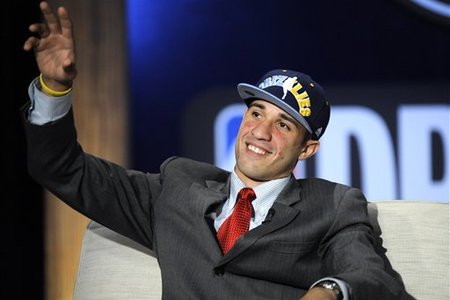
I thought back to Draft Day when Vasquez emerged from the paying crowd after David Stern announced the Grizzlies had selected him with the 28th overall pick. There was Vasquez again, crashing a party he wasn't invited to.
I looked back at the 2010 NBA Draft blog I wrote in June to see if Vasquez's appearance elicited the same response in me as it does today. Not surprisingly, Vasquez was little more than a footnote in my post. I was discussing why 14 of the first 15 draft pick were in attendance:
The NBA extended more invitations to players this year. Very possible, but if they were going to invite 15 or so, they might as well have invited 20 to include players like Greivis Vasquez who had to sit in the stands; the equivalent of flying coach.
Fitting because the announcers have also chosen to discuss Vasquez as a subplot of Kevin Durant's story; the second and less important piece of a "Cool Story Bro" anecdote. Durant and Vasquez played high school ball together in Maryland, and now they're playing against each other in the Playoffs! They used to be best friends and now they're enemies for a few weeks! This story probably isn't even brought up if Vasquez was high school teammates with BJ Mullens.
Make no mistake, the Grizzlies are a better team when Conley, not Vasquez, is on the floor. Conley runs the offense more proficiently, he finds the open man more often than not, and usually is not looking to score first. But Vasquez plays like a guy who bought his own ticket to the NBA Draft. He plays like every minute he's on the floor is a minute somebody is trying to take away from him. I like those kind of players. They deserve to force overtime once in a while too.
Durant, Westbrook, Gasol, and Randolph were all bigger stories in this game. They're better players for one, played more minutes, had a bigger impact on the game, and will continue to factor into the NBA's changing of the guard. But I couldn't help but focus on Vasquez -- for the simple fact that he'd nudged his way, once again, into uncharted territory. He was only playing because Mike Conley Jr. fouled out in the first overtime.
I thought back to Draft Day when Vasquez emerged from the paying crowd after David Stern announced the Grizzlies had selected him with the 28th overall pick. There was Vasquez again, crashing a party he wasn't invited to.
I looked back at the 2010 NBA Draft blog I wrote in June to see if Vasquez's appearance elicited the same response in me as it does today. Not surprisingly, Vasquez was little more than a footnote in my post. I was discussing why 14 of the first 15 draft pick were in attendance:
The NBA extended more invitations to players this year. Very possible, but if they were going to invite 15 or so, they might as well have invited 20 to include players like Greivis Vasquez who had to sit in the stands; the equivalent of flying coach.
Fitting because the announcers have also chosen to discuss Vasquez as a subplot of Kevin Durant's story; the second and less important piece of a "Cool Story Bro" anecdote. Durant and Vasquez played high school ball together in Maryland, and now they're playing against each other in the Playoffs! They used to be best friends and now they're enemies for a few weeks! This story probably isn't even brought up if Vasquez was high school teammates with BJ Mullens.
Make no mistake, the Grizzlies are a better team when Conley, not Vasquez, is on the floor. Conley runs the offense more proficiently, he finds the open man more often than not, and usually is not looking to score first. But Vasquez plays like a guy who bought his own ticket to the NBA Draft. He plays like every minute he's on the floor is a minute somebody is trying to take away from him. I like those kind of players. They deserve to force overtime once in a while too.
Sunday, May 1, 2011
Russell Westbrook As Sonic The Hedgehog
Russell Westbrook must be confused. Everything was gravy a few short weeks ago. Westbrook, along with teammate Kevin Durant, despite being a Top-4 seed and serious Championship contender, were cast as the lovable underdogs. America's answer to the more productive, and less likable Miami Heat duo. The Thunder are no longer underdogs, but a team that has dropped their first game against a Memphis team, led by Zach Randolph and Marc Gasol, whose novelty outweighs basketball talent. Unfortunately for Westbrook, he picked a bad time to have his two worst Playoff performances. The first coming in a series-clinching Game 4 of the Denver series, and the second in an always pivotal first game of the Conference Semifinals. Both resulted in Oklahoma City losses -- their only two in 2011's short-lived postseason.
Oklahoma City's problems go well beyond Westbrook. Interior defense, bench play, and rebounding to name a few. Westbrook has been heavily scrutinized for his shot selection and the sheer volume of his shots. He attempted 30, many of them bad, in the Thunder's Game 4 loss in Denver. Westbrook had attempted 30 or more shots only once in the regular season, a three-point win over the Nets in which Kevin Durant didn't play. Westbrook attempted 23 shots in Oklahoma City's Game 1 loss, a number he reached in the regular season only eight of the 82 games he started. He attempted 23 or more shots in about ten percent of his regular season games, and has already hit that mark in three of the Thunder's six playoff games. That type of irregularity, especially in losing efforts, gets noticed.
"Offensively we're going too fast," Thunder head coach Scott Brooks hollered during a 2nd quarter timeout. "Let the offense work for us." Brooks hung on the word "fast" as if he'd just witnessed a murder. He might as well have been staring right at Westbrook. But Russell Westbrook knows only one speed. He's always going fast, and his speed can be just as detrimental as it is beneficial. He's Sonic the Hedgehog.
Remember playing Sonic? His speed often times defied the power of a Sega Genesis controller. The user could rev him up and direct him towards various loops and trampolines, but ultimately where Sonic would end up was anybody's guess. The user was just as likely to fall into a wall of golden rings as a cave full of deadly spikes, and all of it happened so fast. Such is the Russell Westbrook conundrum.
Westbrook's game has always been a little bit out of control. It worked wonderfully in FIBA play where the size, strength, and speed of his opponents paled in comparison to his own. But in the NBA his style of play often leads to low percentage pull-up jumpers, errant passes, and stripped balls. Westbrook led the league in turnovers this year and his inaugural 2008-09 season. He added seven more in Game 1, accounting for about 40 percent of his team's turnovers.
This is how Westbrook has always played. He's a high risk, high reward player. He has attempted three more shots per game in the Playoffs than the regular season, but the turnovers and questionable shot selection have remained the same. The difference is that the Thunder normally win. They've still won four of their six games, but losses are put under a microscope in the Playoffs. Some people have had the nerve to suggest Westbrook is trying to be the hero this postseason, and as a result refusing to defer to Durant, the team's best player. I've also heard some suggestions that a possible Marbury-Garnett in Minnesota tiff is developing between the two. Nonsense. They've won with Westbrook playing this way and will continue to. It's just not always pretty.
The question shouldn't be how do we slow down Westbrook? But what's waiting on the other side of the loop?
Oklahoma City's problems go well beyond Westbrook. Interior defense, bench play, and rebounding to name a few. Westbrook has been heavily scrutinized for his shot selection and the sheer volume of his shots. He attempted 30, many of them bad, in the Thunder's Game 4 loss in Denver. Westbrook had attempted 30 or more shots only once in the regular season, a three-point win over the Nets in which Kevin Durant didn't play. Westbrook attempted 23 shots in Oklahoma City's Game 1 loss, a number he reached in the regular season only eight of the 82 games he started. He attempted 23 or more shots in about ten percent of his regular season games, and has already hit that mark in three of the Thunder's six playoff games. That type of irregularity, especially in losing efforts, gets noticed.
"Offensively we're going too fast," Thunder head coach Scott Brooks hollered during a 2nd quarter timeout. "Let the offense work for us." Brooks hung on the word "fast" as if he'd just witnessed a murder. He might as well have been staring right at Westbrook. But Russell Westbrook knows only one speed. He's always going fast, and his speed can be just as detrimental as it is beneficial. He's Sonic the Hedgehog.
Remember playing Sonic? His speed often times defied the power of a Sega Genesis controller. The user could rev him up and direct him towards various loops and trampolines, but ultimately where Sonic would end up was anybody's guess. The user was just as likely to fall into a wall of golden rings as a cave full of deadly spikes, and all of it happened so fast. Such is the Russell Westbrook conundrum.
Westbrook's game has always been a little bit out of control. It worked wonderfully in FIBA play where the size, strength, and speed of his opponents paled in comparison to his own. But in the NBA his style of play often leads to low percentage pull-up jumpers, errant passes, and stripped balls. Westbrook led the league in turnovers this year and his inaugural 2008-09 season. He added seven more in Game 1, accounting for about 40 percent of his team's turnovers.
This is how Westbrook has always played. He's a high risk, high reward player. He has attempted three more shots per game in the Playoffs than the regular season, but the turnovers and questionable shot selection have remained the same. The difference is that the Thunder normally win. They've still won four of their six games, but losses are put under a microscope in the Playoffs. Some people have had the nerve to suggest Westbrook is trying to be the hero this postseason, and as a result refusing to defer to Durant, the team's best player. I've also heard some suggestions that a possible Marbury-Garnett in Minnesota tiff is developing between the two. Nonsense. They've won with Westbrook playing this way and will continue to. It's just not always pretty.
The question shouldn't be how do we slow down Westbrook? But what's waiting on the other side of the loop?
Thursday, April 21, 2011
Day 5: Nuggets-Thunder (Game 2)
The NBA regular season is a long, sometimes predictable grind. The good teams will almost always beat the bad teams. Guys won't be playing as hard as they do in the Playoffs, and JaVale McGee will make you wish he was on your team and then quickly rescind that wish in a span of two minutes. To break the monotony, NBA followers and writers alike latch on to the exciting and unpredictable. What will Blake Griffin do next? Can the Spurs keep up their pace after the All-Star break? Anything having to do with the Miami Heat. These were all intriguing questions/issues because there were so many different ways to tell each story. They were consistent NBA stories, made better because of the thought that the way we felt about them could change drastically at any moment.
Then there was the Thunder -- a team that had a spectacular year, but fell short of the preseason hype surrounding them. Oklahoma City pushed the Lakers to their limit in last year's first round, and Kevin Durant led Team USA to Gold over the Summer in the FIBA World Championship. The Thunder were supposed to challenge for the top seed in the West and Durant was supposed to be the runaway MVP. That would have been a great, somewhat predictable, but ultimately intriguing storyline. A young, gifted player joins the ranks of the game's elite. He takes his team from an 8 to a 1 seed in the matter of one year and wins the MVP while doing so. Sound familiar? That was Derrick Rose and the Bulls. Chicago had the season Oklahoma City was expected to have.
Perhaps the bar was set to high. The Thunder did improve after all. They went from a 50-32 8-seed, to a 55-27 4-seed. Here are Durant's numbers this year compared to last:
2010-11: 27.7 ppg, 6.8 rpg, 2.7 apg, 46% FG, 23.7 PER
2009-10: 30.1 ppg, 7.6 rpg, 2.8 apg, 47% FG, 26.2 PER
His numbers were slightly lower, but not enough of a drop off to become an MVP afterthought like he was this year. The Playoffs are the great equalizer. In an ever-alternating Western Conference, the race to the Finals is wide open. The Thunder were one of many well-written drafts this year. Now they're a favorite to become the story.
What is wrong with Wilson Chandler? Denver's tattooed and scruffy small forward has contributed next to nothing on the offensive end. He scored nine points on just 4-10 shooting in Game One, and added only four points without converting a field goal in Game Two. The problem runs far deeper than shot selection. Chandler has always taken bad shots -- he just normally makes more of them. Chasing around Kevin Durant thirty minutes a game seems to be getting to him. Chandler likes to take his man off the dribble, begin to drive, then inexplicably step back for a fade away 18-footer. His legs aren't there for that shot, and unfortunately for Denver, they need more offense out of him to win.
Then there was the Thunder -- a team that had a spectacular year, but fell short of the preseason hype surrounding them. Oklahoma City pushed the Lakers to their limit in last year's first round, and Kevin Durant led Team USA to Gold over the Summer in the FIBA World Championship. The Thunder were supposed to challenge for the top seed in the West and Durant was supposed to be the runaway MVP. That would have been a great, somewhat predictable, but ultimately intriguing storyline. A young, gifted player joins the ranks of the game's elite. He takes his team from an 8 to a 1 seed in the matter of one year and wins the MVP while doing so. Sound familiar? That was Derrick Rose and the Bulls. Chicago had the season Oklahoma City was expected to have.
Perhaps the bar was set to high. The Thunder did improve after all. They went from a 50-32 8-seed, to a 55-27 4-seed. Here are Durant's numbers this year compared to last:
2010-11: 27.7 ppg, 6.8 rpg, 2.7 apg, 46% FG, 23.7 PER
2009-10: 30.1 ppg, 7.6 rpg, 2.8 apg, 47% FG, 26.2 PER
His numbers were slightly lower, but not enough of a drop off to become an MVP afterthought like he was this year. The Playoffs are the great equalizer. In an ever-alternating Western Conference, the race to the Finals is wide open. The Thunder were one of many well-written drafts this year. Now they're a favorite to become the story.
What is wrong with Wilson Chandler? Denver's tattooed and scruffy small forward has contributed next to nothing on the offensive end. He scored nine points on just 4-10 shooting in Game One, and added only four points without converting a field goal in Game Two. The problem runs far deeper than shot selection. Chandler has always taken bad shots -- he just normally makes more of them. Chasing around Kevin Durant thirty minutes a game seems to be getting to him. Chandler likes to take his man off the dribble, begin to drive, then inexplicably step back for a fade away 18-footer. His legs aren't there for that shot, and unfortunately for Denver, they need more offense out of him to win.
James Harden's beard (and Harden too!) went off for 18 points in Game Two. Harden has to be one of the most frustrating players to watch in the NBA. He has the skills to be great. He can shoot from anywhere in the building, take his man off the dribble, finish in traffic, and defend when he wants to. Yet, the 4th overall selection in 2009 has reveled in mediocrity up to this point. I realize this is only his second year, but you never know what you're going to get on a night-to-night basis. Charles Barkley made a great point (shocking, I know) about Harden. He stated that Harden would be starting now, but his head coach Scott Brooks wants to bring him off the bench to provide a spark, similar to how the Spurs used to use Manu Ginobili.
Harden provided that spark in Game Two, showcasing all of the talents that I wish he could lay out on his kitchen table and super glue together. If the Thunder are going to contend, they need a reliable third scorer to take the pressure off Durant and Westbrook. They can't be expected to combine for 65 every night, let alone the 72 they posted in Game One. Harden is the only Thunder player capable of playing the third wheel. It's going to be difficult for anyone to beat them if Harden can efficiently give them 16-18 a night.
The Nuggets have become a fan favorite after the Melo trade. They dealt their big name/distraction that didn't want to be there and became a better team. All while the Knicks made little to no improvement after supposedly receiving the prize of the transaction. But sure enough, the Nuggets miss Carmelo Anthony. Not for the entire game, but they miss Carmelo Anthony in crunch time.
The Nuggets were the highest scoring team in the NBA. After trading Melo, they were off to the races, literally. Their uptempo style ran teams out of the gym. The Nuggets have a remarkable EIGHT players that averaged double figures for them this year. But that's part of the problem. The new-look Nuggets have not been in many close games during the season, but in games decided by 8 points or less, including Game One, they are 3-6.
The Nuggets right now are a bullpen filled with guys that can throw 95 mph with movement, but none of them have a defined role. We've seen the Closer-By-Committee fail countless times in baseball and Denver's basketball version is doing the same. They don't have anyone they can count on to win a game for them in the closing seconds. Playoff games, or at least 4 out of 7 in a series are typically close. The Nuggets' success was fun because of what they represented, but they could really use a player like the one they dealt away.
Thursday, January 20, 2011
San Antonio's 70 Win Pace
I usually don't start paying attention to the NBA standings until after the All-Star break. Playoff positioning is usually determined in the last two months, as teams either cement their standing or make a deal to try and move up. But what the Spurs are doing this regular season so far deserves special attention.
Now I knew the Spurs were rolling, obviously, but I wasn't aware of the waters they're currently treading. When the Western Conference standings scrolled across my TV screen a few nights ago and I saw: 1) San Antonio Spurs - 35-6 (the Spurs beat the Raptors yesterday and are now 36-6), I had to do a double take. 35-6!? I did some quick math. That's 41 games, the midway point of the NBA season. I did some more math. They're on pace for 70 wins. That's dangerously close to the 1996 Bulls' record setting 72 win season.
It's not like I pop bottles after the the last team loses their 11th game every year. In fact, I don't think about the record at all. I always kind of assumed it would never be broken. It takes a steady combination of luck, health, motivation, and talent to even approach 70 wins. It's rare to see these four factors working in unison in today's NBA.
Still, three teams in recent history have come close: The 2007 Mavericks (67 wins), 2008 Celtics (66 wins), and 2009 Cavaliers (66 wins). All three teams have two things in common:
1) The core of each team was in the primes of their career.
2) A huge motivating factor (I'll explain them next) occurred the year before. This factor inspired them so much that they returned the next year and took the league by storm.
2007 MAVERICKS
Ages of Core Players: Dirk Nowitzki (28), Josh Howard (26), Jason Terry (29).
Motivating Factor: Up 2-0 in the 2006 NBA Finals, the Mavericks held a 13 point lead in Game 3 with just over 6 minutes left in the game. The Mavs were outplayed in the first half but had put together an excellent defensive 3rd quarter, outscoring the Heat 34-16 and took that momentum into the 4th. The Heat mounted a furious comeback behind Wade's 42 points (and 18 free throw attempts) to edge out the Mavs 98-96. It should be noted that Nowitzki had an opportunity to tie the game with one second on the clock, but missed his second free throw.
The Mavs went on to lose the next three games, completing one of the most epic collapses in NBA history. Motivated by how they went out the year before, the Mavs dominated regular season competition all year. But we all remember what happened next. They choked again. This time in the first round against 8th seeded Golden State. Can you think of a worse way to lose in two consecutive years?
2008 CELTICS
Ages of Core Players: Kevin Garnett (31), Paul Pierce (30), Ray Allen (32)
Motivating Factor: The Celtics had won 24 games the year before and had been slowly wasting the prime years of Pierce's career. Then Boston GM Danny Ainge got bold and dealt for veteran future Hall of Famers Garnett and Allen. Despite already decorated careers, neither of the three had won a Championship. Ainge's message was clear: Championship or bust.
The Celtics terrorized the league, starting the season 27-3. It was obvious that this team was taking nothing for granted and came to play every night. Add to that a weak division, and the Celtics were practically unbeatable in the regular season. At this time, Rajon Rondo was looked at as a possible liability.
Despite their struggles in the first two rounds, the Celtics went on to defeat the Lakers in the Finals and vindicate the careers of the Big Three.
2009 CAVALIERS
Age of Core Players: LeBron James (24), Mo Williams (26). Who was the third wheel on this team? Was there even a third wheel? I think that speaks to how good LeBron was playing.
Motivating Factor: Two year prior the Cavs (or should I say LeBron) made an improbable run to the NBA Finals. They capitalized off a weak Eastern Conference and the spectacular individual play of James. Their run was cut short by who else but the San Antonio Spurs in the Finals.
The following year, the Cavs were pitted against the newly formed Boston team in the second round. They lost but took Boston to seven games and looked like a team on the verge. The Celtics also showed signs of weakness that year, as they went 0-6 on the road in the first two rounds. The Cavs were poised to takeover the East, and LeBron -- the league.
The Cavs steamrolled through the first two rounds sweeping both Detroit and Atlanta. While LeBron averaged 38.5 points a game in the EC Finals, it wasn't enough to take down a Magic team that was firing on all cylinders and feeding off the confidence of defeating Boston the round before.
Now for a look at the Spurs. Here's what they've done in the regular season the last 10 years. Their playoff seed is in parentheses next to their win total.
2001 - 58 (1), Lost WC Finals
2002 - 58 (2), Lost in Semifinal
2003 - 60 (1), Won Championship
2004 - 57 (3), Lost in Semifinal
2005 - 59 (2), Won Championship
2006 - 63 (1), Lost in Semifinal
2007 - 58 (3), Won Championship
2008 - 56 (3), Lost in WC Finals
2009 - 54 (3), Lost in First Round
2010 - 50 (7), Lost in Semifinal
And here are some offseason playoff seed predictions for the Spurs:
Basketball-Reference - 3rd
CBSSports.com - 3rd
SI.com - 4th
ESPN.com - 5th
Sporting News - 8th
It's safe to say that no one expected the Spurs to perform the way they have up to this point. But why? Perhaps they set the bar too high . From 2000-08 they averaged 59 wins a season and won three Championships. The last two years they've averaged 52 wins (we're going to pretend like that's a bad thing) and were eliminated in the first round in 2008, and swept out of the second round in 2009. In other words, it appeared like the dynasty was about to crumble.
But let's not forget that in 2008 Ginobili missed half the season and the playoffs. In 2009, the Spurs struggled to incorporate Richard Jefferson into the offense and made an effort to get younger. Needless to say, it was going to take a year to adjust. But when you're an aging team and get swept by the uptempo Suns' offense, the easy explanation is that you are too old to contend anymore.
What intrigues me the most about the Spurs is they defy the two categories of a 70-win challenger I layed out earlier. Duncan (34) and Ginobili (33), while still effective players, are past their prime. They haven't made any huge additions, and no Tiago Splitter doesn't count. Not yet, at least. (Interesting sidenote: The sites that predicted the Spurs would finish in the Top 3 did so with the assumption that Splitter would be more of a contributor than he has been this year).
So what is their motivating factor? It has been three years since they were serious Championship contenders. I have three theories.
1) They've finally developed the chemistry with Jefferson and the younger players they expected last year. Duncan and Ginobili don't have to play as many minutes, which is a huge bonus.
2) We were so blinded by the Lakers and Thunder in the offseason that we forgot there were other teams in the West capable of making it to the Finals. Everyone (myself included) basically gave the West to the Lakers, and another, smaller contingent bought into the Scoring Title/Team USA hype surrounding Durant. Our obsessions with those teams probably led us to forget how good the Spurs have been and still are.
3) The Spurs want badly to beat the Lakers. The Lakers eliminated the Spurs from the 2001, 2002, 2004, and 2008 playoffs. That's four years out of a possible seven! The Spurs did get some revenge in 2003 when they defeated the Lakers in the Conference Semifinals en route to the Championship. There would be no better way than to take down the Lakers when everybody crowned them champs in the offseason and viewed the Spurs as an afterthought.
Or maybe the Spurs are just underappreciated and have been for the last decade? Yeah. I like that one the best.
Now I knew the Spurs were rolling, obviously, but I wasn't aware of the waters they're currently treading. When the Western Conference standings scrolled across my TV screen a few nights ago and I saw: 1) San Antonio Spurs - 35-6 (the Spurs beat the Raptors yesterday and are now 36-6), I had to do a double take. 35-6!? I did some quick math. That's 41 games, the midway point of the NBA season. I did some more math. They're on pace for 70 wins. That's dangerously close to the 1996 Bulls' record setting 72 win season.
It's not like I pop bottles after the the last team loses their 11th game every year. In fact, I don't think about the record at all. I always kind of assumed it would never be broken. It takes a steady combination of luck, health, motivation, and talent to even approach 70 wins. It's rare to see these four factors working in unison in today's NBA.
Still, three teams in recent history have come close: The 2007 Mavericks (67 wins), 2008 Celtics (66 wins), and 2009 Cavaliers (66 wins). All three teams have two things in common:
1) The core of each team was in the primes of their career.
2) A huge motivating factor (I'll explain them next) occurred the year before. This factor inspired them so much that they returned the next year and took the league by storm.
2007 MAVERICKS
Ages of Core Players: Dirk Nowitzki (28), Josh Howard (26), Jason Terry (29).
Motivating Factor: Up 2-0 in the 2006 NBA Finals, the Mavericks held a 13 point lead in Game 3 with just over 6 minutes left in the game. The Mavs were outplayed in the first half but had put together an excellent defensive 3rd quarter, outscoring the Heat 34-16 and took that momentum into the 4th. The Heat mounted a furious comeback behind Wade's 42 points (and 18 free throw attempts) to edge out the Mavs 98-96. It should be noted that Nowitzki had an opportunity to tie the game with one second on the clock, but missed his second free throw.
The Mavs went on to lose the next three games, completing one of the most epic collapses in NBA history. Motivated by how they went out the year before, the Mavs dominated regular season competition all year. But we all remember what happened next. They choked again. This time in the first round against 8th seeded Golden State. Can you think of a worse way to lose in two consecutive years?
2008 CELTICS
Ages of Core Players: Kevin Garnett (31), Paul Pierce (30), Ray Allen (32)
Motivating Factor: The Celtics had won 24 games the year before and had been slowly wasting the prime years of Pierce's career. Then Boston GM Danny Ainge got bold and dealt for veteran future Hall of Famers Garnett and Allen. Despite already decorated careers, neither of the three had won a Championship. Ainge's message was clear: Championship or bust.
The Celtics terrorized the league, starting the season 27-3. It was obvious that this team was taking nothing for granted and came to play every night. Add to that a weak division, and the Celtics were practically unbeatable in the regular season. At this time, Rajon Rondo was looked at as a possible liability.
Despite their struggles in the first two rounds, the Celtics went on to defeat the Lakers in the Finals and vindicate the careers of the Big Three.
2009 CAVALIERS
Age of Core Players: LeBron James (24), Mo Williams (26). Who was the third wheel on this team? Was there even a third wheel? I think that speaks to how good LeBron was playing.
Motivating Factor: Two year prior the Cavs (or should I say LeBron) made an improbable run to the NBA Finals. They capitalized off a weak Eastern Conference and the spectacular individual play of James. Their run was cut short by who else but the San Antonio Spurs in the Finals.
The following year, the Cavs were pitted against the newly formed Boston team in the second round. They lost but took Boston to seven games and looked like a team on the verge. The Celtics also showed signs of weakness that year, as they went 0-6 on the road in the first two rounds. The Cavs were poised to takeover the East, and LeBron -- the league.
The Cavs steamrolled through the first two rounds sweeping both Detroit and Atlanta. While LeBron averaged 38.5 points a game in the EC Finals, it wasn't enough to take down a Magic team that was firing on all cylinders and feeding off the confidence of defeating Boston the round before.
Now for a look at the Spurs. Here's what they've done in the regular season the last 10 years. Their playoff seed is in parentheses next to their win total.
2001 - 58 (1), Lost WC Finals
2002 - 58 (2), Lost in Semifinal
2003 - 60 (1), Won Championship
2004 - 57 (3), Lost in Semifinal
2005 - 59 (2), Won Championship
2006 - 63 (1), Lost in Semifinal
2007 - 58 (3), Won Championship
2008 - 56 (3), Lost in WC Finals
2009 - 54 (3), Lost in First Round
2010 - 50 (7), Lost in Semifinal
And here are some offseason playoff seed predictions for the Spurs:
Basketball-Reference - 3rd
CBSSports.com - 3rd
SI.com - 4th
ESPN.com - 5th
Sporting News - 8th
It's safe to say that no one expected the Spurs to perform the way they have up to this point. But why? Perhaps they set the bar too high . From 2000-08 they averaged 59 wins a season and won three Championships. The last two years they've averaged 52 wins (we're going to pretend like that's a bad thing) and were eliminated in the first round in 2008, and swept out of the second round in 2009. In other words, it appeared like the dynasty was about to crumble.
But let's not forget that in 2008 Ginobili missed half the season and the playoffs. In 2009, the Spurs struggled to incorporate Richard Jefferson into the offense and made an effort to get younger. Needless to say, it was going to take a year to adjust. But when you're an aging team and get swept by the uptempo Suns' offense, the easy explanation is that you are too old to contend anymore.
What intrigues me the most about the Spurs is they defy the two categories of a 70-win challenger I layed out earlier. Duncan (34) and Ginobili (33), while still effective players, are past their prime. They haven't made any huge additions, and no Tiago Splitter doesn't count. Not yet, at least. (Interesting sidenote: The sites that predicted the Spurs would finish in the Top 3 did so with the assumption that Splitter would be more of a contributor than he has been this year).
So what is their motivating factor? It has been three years since they were serious Championship contenders. I have three theories.
1) They've finally developed the chemistry with Jefferson and the younger players they expected last year. Duncan and Ginobili don't have to play as many minutes, which is a huge bonus.
2) We were so blinded by the Lakers and Thunder in the offseason that we forgot there were other teams in the West capable of making it to the Finals. Everyone (myself included) basically gave the West to the Lakers, and another, smaller contingent bought into the Scoring Title/Team USA hype surrounding Durant. Our obsessions with those teams probably led us to forget how good the Spurs have been and still are.
3) The Spurs want badly to beat the Lakers. The Lakers eliminated the Spurs from the 2001, 2002, 2004, and 2008 playoffs. That's four years out of a possible seven! The Spurs did get some revenge in 2003 when they defeated the Lakers in the Conference Semifinals en route to the Championship. There would be no better way than to take down the Lakers when everybody crowned them champs in the offseason and viewed the Spurs as an afterthought.
Or maybe the Spurs are just underappreciated and have been for the last decade? Yeah. I like that one the best.
Tuesday, January 18, 2011
Rudy Gay - The Most Interesting Man In The NBA
Remember back to the 2007-2008 NBA season. The Raptors were coming off their best regular season in franchise history. Chris Bosh was the face of the franchise and still relatively likable. Only one problem. Bosh was trailing Kevin Garnett massively in the All-Star vote. Garnett's stats weren't as good but he was playing his first year for the eventual NBA Champion Boston Celtics. The hype alone surrounding the Big 3 was enough to push Garnett into the starting lineup.
So Bosh dropped this video, which was then a pretty revolutionary marketing strategy. His votes skyrocketed but it was not enough to oust Garnett, or LeBron James for that matter, of a starting forward spot. Garnett ended up missing the game due to injury, and Bosh took his place in the starting lineup. The video worked (kind of), and Bosh earned his second consecutive All-Star start.
Memphis Grizzlies forward Rudy Gay recently put out a All-Star promotional video of his own, shown above. It parodies the Dos Equis commercials and is just as good if not better than Bosh's video two years ago. Only one problem. Gay, unlike Bosh two years earlier, doesn't deserve to be an All-Star. In fact, he's not even in the Top 10 vote-getters amongst forwards as of the last update on January 13th. It's not that he isn't a great player, but more due to the fact that he has names like Durant, Anthony, Gasol, Griffin, Duncan, and Nowitzki to compete with.
In that respect, it almost feels like a good video was wasted to fight a losing battle. Maybe next year. By then, Duncan and Nowitzki may be showing their age and Carmelo will be in the East.
Wednesday, October 27, 2010
Rose And Westbrook Battle For Point Guard Supremacy
I never thought I'd say this, but in tonight's season opener, fresh off a FIBA World Championship this summer, leading the league in scoring last year, and pretty much crowned this year's MVP, Kevin Durant will not be the center of attention in tonight's game. At least not my attention, anyway. Although I do have a low attention span.
Don't sleep on Durant and Deng's match up. Deng had the best preseason of any Bull, showing the ability to consistently hit the three. That should be a great match up. But no match up shall be greater than Derrick Rose and Russel Westbrook.
Team USA teammates this summer, Rose and Westbrook seemed to have been linked the entire offseason. The question being, who is better?
Westbrook has received overwhelming support. All of a sudden, I began hearing a lot of "Westbrook is better than Rose" opinions, when that wasn't even mildly feasible after the 2009-10 season.
So I wondered where this opinion was coming from. So I went to the source. The place I always go when questionable opinions seem to have a strong following - Bill Simmons.
Wrote Simmons on ESPN.com:
"We went into this tournament thinking Rose and Rondo were the two best under-24 point guards in some order. Rondo got sent home, then Westbrook outplayed Rose so convincingly in the tournament that, at some point, everyone who loves basketball glanced around in confusion and said, "Hold on, does Oklahoma City now have the best young point guard AND the best young player in the league?"
For whatever reason, Simmons' opinions seem to gain steam quickly and are rarely questioned. Especially amongst college-aged sports fans such as myself.
Everyone is entitled to their opinion, but hopefully I can dispel this Westbrook > Rose myth. Yes, Westbrook scored more points than Rose in the FIBA tournament. Seventeen more to be exact, and 1.9 more points per game. Their overall shooting percentages were almost identical, Westbrook shot better from behind the arc and on the free throw line. Rose had slightly more assists, Westbrook slightly more rebounds.
Really the only thing that distinguished Westbrook was his scoring total and ability to get to the basket. People are acting like Rose hasn't show the same ability - in the NBA.
Rose switched off from point guard to shooting guard playing alongside Chauncey Billups in the starting lineup. The offense ran through Durant in that starting lineup.
Krzyzewski frequently emptied his entire bench, bringing in five new players rather than playing the starters with the reserves. Consequently, Westbrook was given more free reign on the offense. Who was the go to guy on the second team? Rudy Gay? Who ever it was, that player didn't demand touches like Durant. Westbrook was able to create for himself and penetrate, while Rose was expected to be more of a distributor.
The only time in international play that I can remember Rose playing his NBA game was in the exhibition match against Spain. On Team USA's last two possessions, Rose drove the lane, hung in the air and scored, then drove to the basket again and drew the foul. He knocked down both free throws and won the game for the USA.
The point I'm trying to get at is that international play should not be used to determine who is a better NBA player. Not only is the style of play different, but players are expected to play different roles than they normally would. I believe that Westbrook's role was fairly similar to his NBA role, whereas Rose's was not.
While both are not yet on Rondo's level, tonight's match up should add more to the best young point guard discussion. Kevin Durant deserves a day outside of the spotlight.
Don't sleep on Durant and Deng's match up. Deng had the best preseason of any Bull, showing the ability to consistently hit the three. That should be a great match up. But no match up shall be greater than Derrick Rose and Russel Westbrook.
Team USA teammates this summer, Rose and Westbrook seemed to have been linked the entire offseason. The question being, who is better?
Westbrook has received overwhelming support. All of a sudden, I began hearing a lot of "Westbrook is better than Rose" opinions, when that wasn't even mildly feasible after the 2009-10 season.
So I wondered where this opinion was coming from. So I went to the source. The place I always go when questionable opinions seem to have a strong following - Bill Simmons.
Wrote Simmons on ESPN.com:
"We went into this tournament thinking Rose and Rondo were the two best under-24 point guards in some order. Rondo got sent home, then Westbrook outplayed Rose so convincingly in the tournament that, at some point, everyone who loves basketball glanced around in confusion and said, "Hold on, does Oklahoma City now have the best young point guard AND the best young player in the league?"
For whatever reason, Simmons' opinions seem to gain steam quickly and are rarely questioned. Especially amongst college-aged sports fans such as myself.
Everyone is entitled to their opinion, but hopefully I can dispel this Westbrook > Rose myth. Yes, Westbrook scored more points than Rose in the FIBA tournament. Seventeen more to be exact, and 1.9 more points per game. Their overall shooting percentages were almost identical, Westbrook shot better from behind the arc and on the free throw line. Rose had slightly more assists, Westbrook slightly more rebounds.
Really the only thing that distinguished Westbrook was his scoring total and ability to get to the basket. People are acting like Rose hasn't show the same ability - in the NBA.
Rose switched off from point guard to shooting guard playing alongside Chauncey Billups in the starting lineup. The offense ran through Durant in that starting lineup.
Krzyzewski frequently emptied his entire bench, bringing in five new players rather than playing the starters with the reserves. Consequently, Westbrook was given more free reign on the offense. Who was the go to guy on the second team? Rudy Gay? Who ever it was, that player didn't demand touches like Durant. Westbrook was able to create for himself and penetrate, while Rose was expected to be more of a distributor.
The only time in international play that I can remember Rose playing his NBA game was in the exhibition match against Spain. On Team USA's last two possessions, Rose drove the lane, hung in the air and scored, then drove to the basket again and drew the foul. He knocked down both free throws and won the game for the USA.
The point I'm trying to get at is that international play should not be used to determine who is a better NBA player. Not only is the style of play different, but players are expected to play different roles than they normally would. I believe that Westbrook's role was fairly similar to his NBA role, whereas Rose's was not.
While both are not yet on Rondo's level, tonight's match up should add more to the best young point guard discussion. Kevin Durant deserves a day outside of the spotlight.
Friday, September 10, 2010
Team USA's Top Five Players
Any stock broker, single guy at the bar, or college quarterback can tell you it's good to have options. Such was the case for this post. The beginning of the NFL season and the end of the FIBA World Championship have provided an endless amount of things to talk about. In fact, I narrowed it down to a few ideas:
1) The amount of times Fran Frashcilla said "feast or famine" in one broadcast. I can imagine a broadcast journalism professor shouting at the TV, "Redundancy, Redundancy!"
2) The Cold War 2.0: How much the US and Russia still hate each other. The US gets mad when Russia takes credit for the 1972 Olympic gold medal in basketball. Russia gets mad when the US takes credit for Carly Patterson's 2004 Olympic All Around Gold Medal. There's still monkeys up in space somewhere. When will it all end?
3) Russian national team coach David Blatt's facial contortions. Furthering my point that international basketball not only has the strangest looking players of any sport, but coaches as well.
4) They say the camera adds ten pounds. Does HD add five years to Brett Favre's appearance?
Ok, so I like lists. A lot. I also was talking about options earlier. Team USA has 11 first or second options on their respective NBA teams, and one third option (sorry Tyson Chandler). So in an effort to tie all of this together, if I had the option, here are the top five players on Team USA I would take to build my team around.
Number 5: Rudy Gay - Before this tournament I would have said Danny Granger, but what Gay has done in this tournament is undeniable. So much so, that Granger has been relegated to the end of the bench. Gay gets overshadowed in Memphis because Zach Randolph helps with the scoring load. He also happens to be overlooked in FIBA play because he's playing behind Durant.
Here's what I love best about Gay's tournament: he's shooting 58 percent from the field, compared to his career 45 percent in the NBA. If there's one knock on Gay is that he needs to develop a more consistent outside shot. He's shown he can do that in FIBA play, let's see if it translates to the NBA. If it does, Gay will average 20 points a game and battle for one of the last All-Star spots in the West.
Number 4: Andre Iguodala - Iguodala may be the best player the casual NBA fan has never heard of. He averaged 17/6/5 last year. He's just a notch below the elite guard-forward guys such like Wade, LeBron, and Kobe.
What has hurt Iguodala through out his career is that he's never played with a playmaking point guard that can create opportunities for him. Louis Williams, Allen Iverson, Andre Miller were all shoot first point guards. Jrue Holliday will be handed the reigns this year, but he seems to be pretty offensive minded as well. Too often Iguodala has been isolated and forced to create his own shot, which has led to some bad shots, and a not-so-impressive shooting percentage. The talent is there, he just needs to be surrounded by players that can bring it out.
I also love Iguodala's durability. He's played all 82 games in five of his six NBA seasons. If I'm building a team, I want a guy I can count on to be out there every night.
Number 3: Russell Westbrook - I admit, I'm placing Westbrook this high based off potential. While he still needs work on his shot and needs to his limit his turnovers, he's entering his third NBA season and will turn 22 later this year.
Westbrook fits the new mold of point guards. He's big, fast, athletic, and has ability to get to the basket at will. If he continues to improve it's not inconceivable to see him developing into a Chris Paul type of point guard that is an elite player on both ends of the floor.
The big difference right now is that Westbrook is nowhere near the shooter Paul is. He's entering his third year, which is normally around the time guys start to improve their shot. Derrick Rose improved his shooting considerably from his second to third year.
The good thing is that with Durant around, Westbrook will never be expected to carry the scoring load.
Number 2: Derrick Rose - Is Rose this high on the list because he plays for the Bulls? Yes. But I mean that in a objective way and not a homer-pick kind of way. The fact that I've been able to see about 85 percent of Derrick Rose's NBA games allows me to comment on the types of things that don't show up in the stat book.
For instance, what's the biggest knock on Rose? He only averages 6 assists a game. The line of thinking as that the elite point guards average around 10 or more assists per game. And if a point guard doesn't average his 10 then he's either not elite, or a dreaded "score-first point guard."
While his stats may suggest otherwise, Rose is in fact an elite, "true" point guard. His lack of assists have more to do with the incompetence of his teammates than anything he's done. Rose's game is penetrating and then either kicking it out to a teammate or finishing the drive. He's also improved his shot to the point where teams can't play off him like they did in his first two seasons.
Team USA's style of play doesn't utilize is skill set and he has still managed to play very well. At this point, he has better body control and his a better finisher at the rim than Westbrook. They both have a similar skill set.
Rose also has the experience of putting an entire team on his back early in his NBA career and carrying them to the playoffs. Last year's Bulls team had no business being in the playoffs, and the 2008 Bulls had no business taking the Celtics to 7 games. Replace Rose with any other point guard besides D-Will, Paul, or Nash, and the 2009 team doesn't make the playoffs, and the 2008 team is eliminated in 5 games.
Number 1: Kevin Durant - Everything that needs to be said about Kevin Durant has already been said. He's the best scorer in the game at age 22. He should have been drafted before Greg Oden. He's a humble and hardworking guy. The only thing left for him to do is win a couple of MVP awards and NBA Finals trophies.
Here's my attempt at a fresh take on Kevin Durant and the number 3 player on this list, Russell Westbrook. Durant (2nd overall) and Westbrook (4th overall) were drafted in the 2007 and 2008 drafts, respectively. Very rarely do teams get back to back top 5 picks, and when they do (Bulls, Grizzlies, Clippers, T'Wolves) they fuck at least one of the picks up. The selections of Durant and Westbrook will be only the 4th successful back to back top 5 picks for a team in the last 20 years, and the first since 1992-93. Here's the 3 other duos:
1990-91 - Derrick Coleman (1st overall) and Kenny Anderson (2nd overall). During their 4 years together Coleman average 20 points and 10 rebounds for the last three years with the Nets that were not marred by injuries. Anderson averaged 17 points and 9 assists a game. The Nets would never make it out of the first round of the playoffs.
1991-92 - Larry Johnson (1st overall) and Alonzo Mourning (2nd overall). During their 3 years together Johnson averaged 18 points and 9 rebounds and Mourning averaged 21 points and 10 rebounds a game. The farthest Charlotte would get is to the second round of the playoffs.
1992-93 - Shaquille O'Neal (1st overall) and Penny Hardaway (3rd overall, drafted by Golden State and traded to the Magic). During their 3 years together, Shaq averaged 27 points and 12 rebounds a game, while Penny averaged 19 points and 7 assists a game. The Magic would be the the most successful of the duos, reaching the 1995 NBA Finals, and the 1996 Eastern Conference Finals.
It's hard to imagine Durant and Westbrook matching the play of O'Neal and Hardaway. The Magic duo was one of the greatest of all-time. However, you'll notice a pattern amongst these three duos. The Magic were the only duo unaffected by injuries, and consequently advanced the furthest in the playoffs (Penny's string of injuries would begin the year after Shaq bolted to LA).These duos also spent no more than four years with each other, not enough time to build a championship winning chemistry.
If Durant and Westbrook and can stay healthy and remain in Oklahoma City, they may experience something none of these duos experienced, an NBA Championship together.
1) The amount of times Fran Frashcilla said "feast or famine" in one broadcast. I can imagine a broadcast journalism professor shouting at the TV, "Redundancy, Redundancy!"
2) The Cold War 2.0: How much the US and Russia still hate each other. The US gets mad when Russia takes credit for the 1972 Olympic gold medal in basketball. Russia gets mad when the US takes credit for Carly Patterson's 2004 Olympic All Around Gold Medal. There's still monkeys up in space somewhere. When will it all end?
3) Russian national team coach David Blatt's facial contortions. Furthering my point that international basketball not only has the strangest looking players of any sport, but coaches as well.
4) They say the camera adds ten pounds. Does HD add five years to Brett Favre's appearance?
Ok, so I like lists. A lot. I also was talking about options earlier. Team USA has 11 first or second options on their respective NBA teams, and one third option (sorry Tyson Chandler). So in an effort to tie all of this together, if I had the option, here are the top five players on Team USA I would take to build my team around.
Number 5: Rudy Gay - Before this tournament I would have said Danny Granger, but what Gay has done in this tournament is undeniable. So much so, that Granger has been relegated to the end of the bench. Gay gets overshadowed in Memphis because Zach Randolph helps with the scoring load. He also happens to be overlooked in FIBA play because he's playing behind Durant.
Here's what I love best about Gay's tournament: he's shooting 58 percent from the field, compared to his career 45 percent in the NBA. If there's one knock on Gay is that he needs to develop a more consistent outside shot. He's shown he can do that in FIBA play, let's see if it translates to the NBA. If it does, Gay will average 20 points a game and battle for one of the last All-Star spots in the West.
Number 4: Andre Iguodala - Iguodala may be the best player the casual NBA fan has never heard of. He averaged 17/6/5 last year. He's just a notch below the elite guard-forward guys such like Wade, LeBron, and Kobe.
What has hurt Iguodala through out his career is that he's never played with a playmaking point guard that can create opportunities for him. Louis Williams, Allen Iverson, Andre Miller were all shoot first point guards. Jrue Holliday will be handed the reigns this year, but he seems to be pretty offensive minded as well. Too often Iguodala has been isolated and forced to create his own shot, which has led to some bad shots, and a not-so-impressive shooting percentage. The talent is there, he just needs to be surrounded by players that can bring it out.
I also love Iguodala's durability. He's played all 82 games in five of his six NBA seasons. If I'm building a team, I want a guy I can count on to be out there every night.
Number 3: Russell Westbrook - I admit, I'm placing Westbrook this high based off potential. While he still needs work on his shot and needs to his limit his turnovers, he's entering his third NBA season and will turn 22 later this year.
Westbrook fits the new mold of point guards. He's big, fast, athletic, and has ability to get to the basket at will. If he continues to improve it's not inconceivable to see him developing into a Chris Paul type of point guard that is an elite player on both ends of the floor.
The big difference right now is that Westbrook is nowhere near the shooter Paul is. He's entering his third year, which is normally around the time guys start to improve their shot. Derrick Rose improved his shooting considerably from his second to third year.
The good thing is that with Durant around, Westbrook will never be expected to carry the scoring load.
Number 2: Derrick Rose - Is Rose this high on the list because he plays for the Bulls? Yes. But I mean that in a objective way and not a homer-pick kind of way. The fact that I've been able to see about 85 percent of Derrick Rose's NBA games allows me to comment on the types of things that don't show up in the stat book.
For instance, what's the biggest knock on Rose? He only averages 6 assists a game. The line of thinking as that the elite point guards average around 10 or more assists per game. And if a point guard doesn't average his 10 then he's either not elite, or a dreaded "score-first point guard."
While his stats may suggest otherwise, Rose is in fact an elite, "true" point guard. His lack of assists have more to do with the incompetence of his teammates than anything he's done. Rose's game is penetrating and then either kicking it out to a teammate or finishing the drive. He's also improved his shot to the point where teams can't play off him like they did in his first two seasons.
Team USA's style of play doesn't utilize is skill set and he has still managed to play very well. At this point, he has better body control and his a better finisher at the rim than Westbrook. They both have a similar skill set.
Rose also has the experience of putting an entire team on his back early in his NBA career and carrying them to the playoffs. Last year's Bulls team had no business being in the playoffs, and the 2008 Bulls had no business taking the Celtics to 7 games. Replace Rose with any other point guard besides D-Will, Paul, or Nash, and the 2009 team doesn't make the playoffs, and the 2008 team is eliminated in 5 games.
Number 1: Kevin Durant - Everything that needs to be said about Kevin Durant has already been said. He's the best scorer in the game at age 22. He should have been drafted before Greg Oden. He's a humble and hardworking guy. The only thing left for him to do is win a couple of MVP awards and NBA Finals trophies.
Here's my attempt at a fresh take on Kevin Durant and the number 3 player on this list, Russell Westbrook. Durant (2nd overall) and Westbrook (4th overall) were drafted in the 2007 and 2008 drafts, respectively. Very rarely do teams get back to back top 5 picks, and when they do (Bulls, Grizzlies, Clippers, T'Wolves) they fuck at least one of the picks up. The selections of Durant and Westbrook will be only the 4th successful back to back top 5 picks for a team in the last 20 years, and the first since 1992-93. Here's the 3 other duos:
1990-91 - Derrick Coleman (1st overall) and Kenny Anderson (2nd overall). During their 4 years together Coleman average 20 points and 10 rebounds for the last three years with the Nets that were not marred by injuries. Anderson averaged 17 points and 9 assists a game. The Nets would never make it out of the first round of the playoffs.
1991-92 - Larry Johnson (1st overall) and Alonzo Mourning (2nd overall). During their 3 years together Johnson averaged 18 points and 9 rebounds and Mourning averaged 21 points and 10 rebounds a game. The farthest Charlotte would get is to the second round of the playoffs.
1992-93 - Shaquille O'Neal (1st overall) and Penny Hardaway (3rd overall, drafted by Golden State and traded to the Magic). During their 3 years together, Shaq averaged 27 points and 12 rebounds a game, while Penny averaged 19 points and 7 assists a game. The Magic would be the the most successful of the duos, reaching the 1995 NBA Finals, and the 1996 Eastern Conference Finals.
It's hard to imagine Durant and Westbrook matching the play of O'Neal and Hardaway. The Magic duo was one of the greatest of all-time. However, you'll notice a pattern amongst these three duos. The Magic were the only duo unaffected by injuries, and consequently advanced the furthest in the playoffs (Penny's string of injuries would begin the year after Shaq bolted to LA).These duos also spent no more than four years with each other, not enough time to build a championship winning chemistry.
If Durant and Westbrook and can stay healthy and remain in Oklahoma City, they may experience something none of these duos experienced, an NBA Championship together.
Subscribe to:
Posts (Atom)