Showing posts with label Los Angeles Lakers. Show all posts

Wednesday, June 1, 2011

A Wolf In Genie's Clothing

The day has finally arrived. Shaquille O'Neal has decided to retire and I'm overcome with the sentiment I always thought I would be: It's about time. Shaq's beaten and bloated body checked out three years ago. His media personality -- the attention-seeking egomaniac that cunningly masqueraded as a charming quote machine has run its course. At age 39, Shaq finally retired and don't think for a second that his timing -- a Wednesday, on the day off between NBA Finals games -- was not strategic. He wanted the spotlight all to himself, and the media will undoubtedly comply. It's the least they could do, really, for someone who provided week's worth of headlines and talking points during his 19-year career.

I'm probably being too harsh on Shaq. For all of his perceived character flaws, he was a tremendous player. Probably the most physically dominant basketball player I've ever seen. My appreciation for Shaq's offensive prowess divvies up nicely into three parts, which coincide with his stints in Orlando, Los Angeles, and Miami.

I was five years old when the Magic selected O'Neal with the first overall pick in the 1992 Draft. Growing up, I remember hearing about the physically imposing presence that Shaq was. He unabashedly dunked on his opponents, he brought down backboards, and did so because he was so much bigger and stronger than everyone he went up against. According to the people around me, Shaq was basically a brute. He dominated more because of his strength, almost in opposition to a fruitful set of basketball skills. This partly accurate understanding seems to have stuck.

When Shaq joined the Lakers in 1996, I was mostly preoccupied with the Bulls. Shaq's turn-of-the-decade championship years were when I really started to pay attention. I was intrigued by Shaq because he was still the most physically dominant player in the League -- capable of 30 and 15 every time out -- but possessed skills that I rarely heard people talk about. Sure, many if not most of his points were catches within five feet that he easily threw down. But I remember Shaq's footwork in the post being much more advanced than I would have thought for someone his size. I also thought he was never properly credited for his excellent touch around the basket. This was also around the time when team's began employing the "Hack-a-Shaq" philosophy. Shaq will always be remembered for his poor free throw shooting, mainly because sending him to the line in the early 2000s was the only chance you had at containing him.

Shaq joined the Heat in 2004 with plenty left in the tank. He almost won the MVP after his first year in Miami and was rewarded with a 100 million dollar contract. He began to break down the following year and was never truly the same. Shaq could no longer play major minutes and had lost some of the underrated athleticism that made him more than just a dunker. Forced to contribute in other ways, Shaq became a great passer, particularly out of double-teams in the post, and was a huge reason the Heat won the title in 2006.

O'Neal's last three years have rubbed me the wrong way. He was dealt to Phoenix and made some disparaging remarks about his teammates and coach in Miami on the way out. This was Shaq's specialty through out his career: he burned bridges everywhere he played, and disregarded the efforts and importance of the star player that played alongside him; and even non-teammates such as Yao Ming and Dwight Howard who threatened to take his spot as the next big thing at the center position. He blatantly chased championships during the last two years of his career in Cleveland and Boston. All of this has been swept under the rug though because he's Shaq. And the good-natured, 7-foot goofball couldn't possibly be in it for any other reason than to dunk a few basketballs and share a few laughs.

* * *

It's time to open up "The Box." "The Box" is a white, 16 x 25 cardboard box that weighs roughly 15 pounds and sits atop my bookshelf. It is filled with basketball memorabilia I collected during my childhood, mostly between 1993-2003. I start digging around inside whenever I feel the urge, or something like Shaq's retirement happens. I found a few interesting Shaq artifacts.

Here are a couple of cards from Shaq's Lakers days. Notice the way the back of both cards focus on his size and strength. Click on all of these pictures to enlarge.


The only player with a 40-20 in each of the first two games of a Playoff series. When you accomplish something having to do with points and rebounds that Wilt Chamberlain didn't, you're other-worldly.


In 2000-01, O'Neal scored 974 more points than any other center. By contrast, Dwight Howard led the League in scoring amongst centers in 2010-11. He scored 111 more points than Brook Lopez.


Here's a Shaq action figure. He's donning his 1993 NBA All-Star jersey. This once belonged to my brother. Hopefully he's not still looking for it.
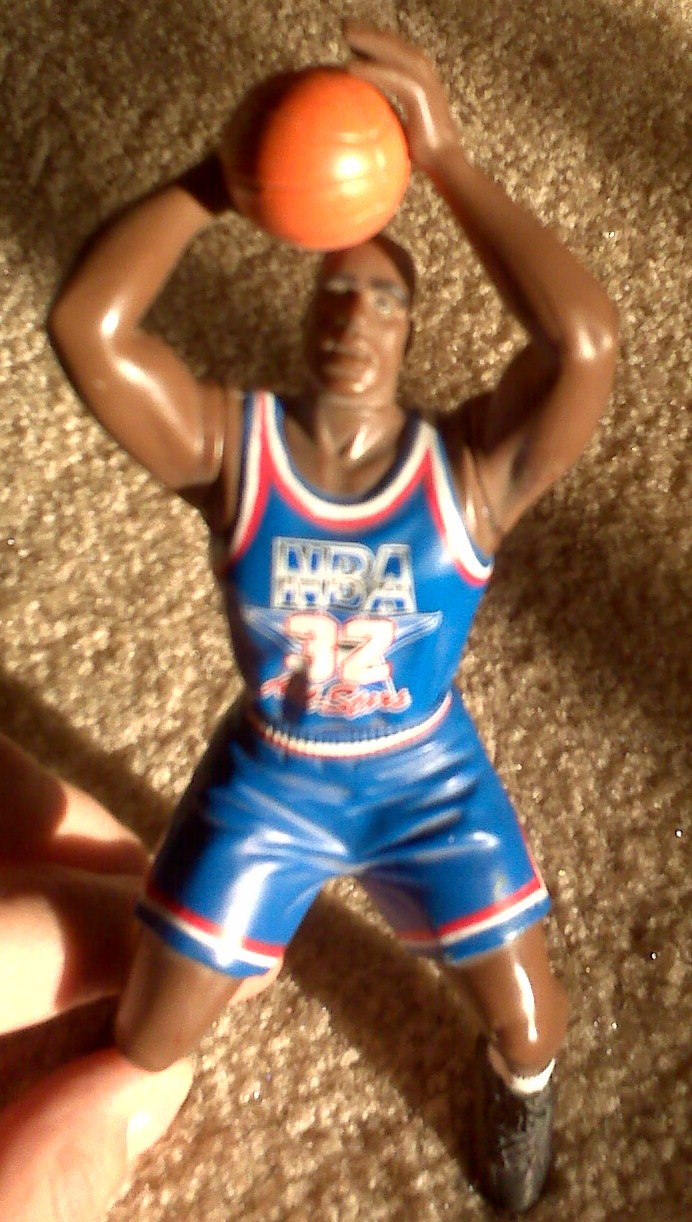


And a Shaq basketball (the signature is not real). I remember taking this ball outside and playing with it once. Then a voice inside my head said, "What the fuck are you doing, Joe? You're going to want this to be in good condition so you can look at it when you're older." Foresight.


This is a Shaq rookie card in which he yams on Alonzo Mourning. Mourning probably got away with the foul.


Also making an appearance: Ol' Jud Buechler from the back-lookin' Tom Tolbert.



Remember me? I was the bald white guy that used to annoy the shit out of you during halftime before Jon Barry. Suck it, Jon. You'd be unemployable if it wasn't for me.

Shaq rookie card equipped with shiny, silver encasement. I thought this one would be worth at least 50 bucks. I saw it on eBay for as low as $1.25.

            
Shaq should be a controversial figure. Instead, he endeared himself to the media early and kept fans wrapped around his finger. Shaq was great at deflecting his own personal shortcomings into funny quips. He was also a hell of a basketball player, and a cultural icon. We'll remember him mostly for the latter two, and it's probably better that way.

Monday, March 7, 2011

A Good Cry


The Miami Heat taught us all a valuable lesson yesterday. Actually, a few valuable lessons. Firstly, about professional basketball, and secondly, their competitive spirit. The fun part of course is that we probably weren't meant to learn any of this.
Heat coach Erik Spoelstra's admission that a few Miami Heat players were crying in the locker room after their 87-86 loss to the Bulls set off yet another firestorm that the franchise has grown so accustomed to dealing with this year. Spoelstra's comments were meant to exhibit how badly the team wanted to win. Instead, most people used the comments to argue that the Heat were a mentally soft team, a viewpoint they probably already held, and were looking to confirm. And so goes the double standard...
There's a long-held view about the NBA, propagated mostly by the over-50 crowd that the players don't care. They're content earning a paycheck and being friends with each other. Basically, winning is the least of their worries.
The NBA naysayers point to the college game as a true model of how players should carry themselves. In this year's March Madness tournament, the camera will surely focus on a lone player on the bench, head down, crying into his towel. This will probably be a senior, and the best player on a lowly-ranked Cinderella team.
"Look at how passionate he is," the NBA naysayer will say. "Now that's a player who gave it his all, came up short, and couldn't hold his emotions in any longer. I've never seen an NBA player care that much."
So thank you Erik Spoelstra for revealing that your players were crying. Thank you Dwight Howard for going on The Dan Patrick Show and telling him that you cried numerous times after losses your rookie season, and also after losing the 2009 NBA Finals to the Lakers.
When college players cry it's because they care so much about the game, when professional players cry it's because they're pussies. NBA players care, maybe not all of them, but most do. The question should be, why are they crucified for caring?
There's some revisionist history at work regarding the 2010 Summer free-agency period. Most people now will say "The Decision" and the premature celebration parade the Heat threw before even filling out the roster were their main gripes. Lies, all lies.
The problem, in most people's eyes, was that LeBron and Wade, two of the best, if not the two best players in basketball were playing together. This was supposed to mark the end of competitiveness as we knew it. How could LeBron and Wade want to play together? Didn't they have a competitive bone in their body?
The Heat were looked at as a team that wanted to coast to a Championship. A team that would be able to put an end to all competition. Hell, even the Heat players themselves believed this. It hasn't worked out that way. The Heat are the third best team in the East. They're 1-9 against elite teams and have looked absolutely clueless on offense at times. It hasn't been easy, and it isn't going to be easy.
Now we're seeing the Heat's true colors. They realize they can't coast through the season. They're putting forth maximum effort, but guess what? They're just not that good. Not Championship-level good, at least.
I wrote a few weeks ago that teaming up may have been the most competitive thing the Heat could have done. The competition instead would come from within. Playing with elite teammates would in fact push them to greater heights, more so than playing against elite opponents ever could. Turns out I, and many others underrated their outside competition.
The Heat crying in the locker room tells me they've accepted a challenge and want to win. They may not win anything significant but it won't be because they're afraid of a little competition. At the end of the day, that's all I want. I want to feel like athletes give as much of a fuck as I do. And I believe the Heat do.
Some things are meant to stay in house. I'm glad this little crying incident didn't.

Friday, March 4, 2011

This Old Jersey

Somewhere in the back of my closet is an Allen Iverson blue Sixers road jersey, circa 2003. While I can't imagine a situation where I'd ever wear it again, I also can't fathom throwing it away. You see, that jersey is the only remnant I have left from the Allen Iverson era. Were Iverson's prime years worthy of being an era's namesake? Probably not, but I tend to think so.
In the year 2000, the Bulls were coming off an Eastern Conference worst 17-65 record and were unable to attract any of that offseason's premier free agents. Clearly, they were no good and weren't going to be any good for a long time.
I was in eighth grade an used to a winning basketball team. I grew up with Championships and really didn't appreciate how difficult they were to come by. I decided to invest my rooting interest into Allen Iverson and the 76ers that year. It helped that the 76ers were Championship contenders, but more importantly, Iverson's game was the most intriguing of anyone in the NBA at the time.
He was usually the smallest player on the floor, yet was the most athletic. He was a poor outside shooter, yet led the league in scoring five times. He may have been the most inefficient player of his era, and also one of the greatest. Now that's saying something.
In eighth grade we didn't speak of inefficiency. We preferred a more scathing term: "ball hog." Allen Iverson was a ball hog. I heard that for the entire 20-minute lunch period everytime I wore my Iverson jersey. I began to think my classmates were more enraged with Iverson attempting 30 shots a game than anything else. It didn't matter whether he made 8 or 17 of them. Thirty shots was too many, especially for someone as disliked as Iverson.
His somewhat deserved reputation as a chucker is one of the only aspects about his game people remember. He's more known for one/some or all of the following: cornrows, tattoos, being the main target of the NBA dress code, a high school bowling alley brawl, refusing to accept a bench role towards the end of his career, a homophobic rap song, and of course, "PRACTICE, WE TALKIN' ABOUT PRACTICE, NOT A GAME, NOT A GAME, NOT A GAME, BUT PRACTICE."
Translation: thug, trouble-maker, selfish, bigot, and lazy.
If those are lenses which you choose to view Iverson then that's on you. Many have tried to defend him and are usually unsuccessful because he is such a polarizing figure. If you have an opinion on Allen Iverson, you most likely aren't changing it now.
The point of this post was not to reflect on Iverson's basketball legacy or the legitimacy of the negativity surrounding him. I simply wanted to relate how I remember him, and one image sticks out above the rest.
Game 7 in Philadelphia of the Eastern Conference Finals. The Sixers defeated the Bucks 108-91 to advance to the 2001 NBA Finals. If someone asked me to show them a video that summed up Allen Iverson I wouldn't show them the infamous "Practice" video, or the overrated 1996 Jordan crossover, or one of his 11 career 50-point games. I'd show them Game 7, or as I call it, the perfect actualization of an Iverson-led team.
Iverson poured in 44 points on 17 of 33 shooting, including 4 of 6 from behind the arc. He was only a career 42 percent shooter,  31 percent from three, yet made a variety of difficult outside shots that game. He took is customary plus 30 attempts, but did so efficiently.
In my opinion, the best description of Iverson's game was written by FreeDarko founding member Bethlehem Shoals:

 No player before or since has so sincerely believed in one-on-one basketball as a means to victory, imagining it fully while others had been unwittingly dragged into it by their egos. Iverson wanted the ball in his hands until the last possible second and seemed resistant to the idea that anyone else on his team could implement his plan for a possession.

The 2001 76ers were structured around allowing Iverson to take full control of the offense. Every other player fulfilled their role, which rarely included any input on the offensive end. Aaron McKie guarded the bigger guard, in this case Ray Allen, and fed Iverson the ball coming off screens. McKie finished with 13 assists. Tyrone Hill crashed the boards and scored garbage points. He finished with 11 and 10. Dikembe Mutombo was the heart and soul of the Sixers defense. He owned the paint, grabbed rebounds at will and rejected shots. Mutombo had the game of his life: 23 points, 19 rebounds, and 7 blocks. If you were to draw up a perfect game for a Iverson-led team, this would be it.
With a 18 point lead and just under 40 seconds left, Sixers coach Larry Brown took Iverson out:      


Iverson ran across the court with his hand to his ear, imploring the crowd to raise their decibel level. That's the image I will always remember. At that moment, Iverson was embraced by his teammates, coaches, and the basketball world. A player who was never supposed to sustain any level of team success finally did. The Sixers would go on to shock the Lakers in Game 1 of the Finals, Los Angeles' only loss of the playoffs, but Iverson's Game 7 exit will always be the most memorable moment of his career for me.
When I hear things nowadays that Iverson is broke, gambled away all his money, and watching the All-Star Game alone at the bar, none of it surprises me. People revel in the supposed downfall of former athletes, especially controversial ones like Iverson.
It just seems wrong that Iverson is watching an All-Star Game. He surely would have been voted in again this year. I watched ten minutes of his inaugural game in Turkey and he looked like another average player, trying to make a living playing overseas. I had to turn the game off -- it was that bad.
Allen Iverson's NBA career is over but in those who could appreciate his unorthodox approach to the game, he'll live on. Iverson's impact may get tossed aside, but like my jersey gathering dust, it will always be there -- and that's the important thing.

Tuesday, March 1, 2011

Big, Imposing Question Marks

Minding my own business a few days ago, I noticed a retweet from someone I was following which read something like this: "1) Rose wins MVP 2) Tibs wins COY 3) Bulls get 1 seed 4) Bulls win finals." The tweet, typed in earnest, was retweeted to mock Bulls fans and their tendency to be "a little" delusional.
But looking at that list, all of those things are possible, right? I've prided myself in remaining, or at least trying to remain rational throughout this season. The last thing I want to do is fall off the wagon now.
Either way, the tweet got me to thinking about the percent chance of each scenario occurring. These numbers are not based on any higher formula, just a simple high or low number used to signify likelihood.
Tom Thibodeau wins Coach of the Year --> 90 Percent. The COY trend is well known by now: give the award to the coach of the league's most improved team. Fresh off of two straight 41 win seasons and low playoff seeds, the Bulls are now in line to secure a Top 3 seed and a win total in the upper-50s. Most people expected the Bulls to improve, but not to the degree they have. A 4 seed and 50 wins seemed about right in preseason, and that was assuming the team would be healthy. Thibs has preached defense since day one and it shows. The Bulls are winning games on the defensive end.
Gregg Popovich is another candidate, but is often overlooked for the honor because the Spurs have been consistently good for so long. I'm not sure a 68 win season would even win him the award this year.
A wild card is first-year 76ers coach Doug Collins. Collins not only has Philadelphia in the playoff hunt, but challenging the Knicks for the sixth spot. In reality, the 76ers are probably the biggest surprise team of the NBA thus far. But a potential sixth seed doesn't compete with a possible one seed and legitimate Finals hopes.
Derrick Rose wins MVP --> 75 Percent. I've been going back and forth with this number. A few days ago I thought it was just right. Today, I feel it might be a little high. For the last month or so the MVP race seemed to be between D. Rose and LeBron. LeBron had the disadvantage of the whole Decision/playing with other superstars thing. Also, like the Spurs, he's so consistently good, we tend to overlook him. Rose seemed to be cast as the anti-LeBron and benefited from the misconception that Chicago would be a 20-win team without him.
But now Dwight Howard has entered the equation. If you're voting for the MVP based on numbers alone, then Howard deserves the award. Since the trade, he's averaging 25 points, 15 rebounds, and 2 blocks a game. All while shooting 61 percent from the field. Even "video-game numbers" would be an inappropriate way to describe that beautiful stat line. Not to mention, Howard has a bigger impact on the defensive end than any other NBA player and is the sole reason Orlando has been a Top 5 defensive team for so long.
That's great, but isn't the MVP a reflection of his team's success to an extent? Orlando is no slouch, they're 38-22. However, here's something I've found interesting. In almost every Boston, Miami, or Chicago playoff article I've read, the writer has mentioned how important it is for BOS/MIA/CHI to secure the one seed, so they don't have to meet up with either BOS/MIA/CHI in the second round. As if Orlando would be an easy out in round 2. They're being completely overlooked and that has to count for something. The MVP is a regular season award, and the MVP should be on an elite team. Even after the trades, no one is buying that Orlando is an elite team.
Bulls win NBA Finals --> 20 Percent. This number is based off of my opinion that there are five legitimate title contenders: San Antonio, LA, Boston, Miami, and Chicago. I have no idea which team to pick. I think all five are equally capable of tearing through the playoffs, and being exploited. 20 percent is my way of saying the Bulls are one of five teams, and I don't think any team is the favorite.
The Bulls are 5-3 against these teams, with a losing record only against Boston (1-2). They have the size to match up with Boston and LA, the athleticism to hang with Miami, and the defensive prowess to contain San Antonio. It would help though, if they could win this upcoming game against Miami, and secure at least one road win against an elite team.
Bulls earn the 1 Seed --> 15 percent. If the Bulls were to procure the number one seed in the East, they'd need two things to happen:
1) Boston to lose in Chicago and Miami, in addition to blowing a few "gimme" road games. The Celtics have the fifth highest road winning percentage in the NBA.
2) Miami needs to continue their futility against good teams and lose at least half of their next ten games.
Here's the breakdown:

CELTICS 43-15
12 of 24 remaining games against playoff teams
13 Road Games
@Chicago, @Miami

HEAT 43-17
13 of 22 remaining games against playoff teams
9 Road Games
vs. Chicago, vs. Boston

BULLS 41-17
12 of 24 remaining games against playoff teams
13 Road Games
@Miami, vs. Boston

The Heat have the most intriguing race to the 1 seed. Their next ten games are against playoff teams. They have a combined 6-6 record against those teams, plus two meetings with San Antonio, who they haven't played yet. This ten game stretch will make or break their chances of grabbing the top seed. They play 8 of these 10 games at home. If the Heat can come away with 7 or 8 wins in that stretch, they should set themselves up nicely for a push towards the one seed.
The Celtics currently hold a one game advantage over Miami, and two games over Chicago. While they have Jeff Green and Nenad Krstic to incorporate into the system, the core of their team has been together for the last four years. They're a veteran team and, I hate this cliche but, know what it takes to win.
Here's something else the Boston Celtics know: the Chicago Bulls are the only Eastern Conference team that can beat them in a seven game series. I believe wholeheartedly that they're terrified of facing the Bulls in the playoffs. That will be motivation enough to focus on the top spot and hope the Heat can knock the Bulls off. If they have to play the Bulls in the EC Finals, they do so knowing they have home court advantage against a team with limited postseason experience that has played poorly on the road this year.
The Celtics know this is probably their last stand. No way I see them loosening the reins and letting the one seed slip away.
I'm still concerned about the Bulls' propensity to lose on the road and play down to inferior competition. The good news is that they finally have their full team healthy. Perhaps having everyone back will instill a focus in them. Regardless, the Bulls are the dark horse to grab the one seed, and whether they do or not, will likely have the most momentum heading into the playoffs.
A few months from now, we'll have the answers to all of these questions. I'm 100 percent sure of that.

Sunday, February 6, 2011

The Rise And Fall Of Converse

Converse has become somewhat of an afterthought in today's NBA, but the impact the shoe has had on the game is undeniable. The marriage between Converse and basketball was a product of good timing and geographic proximity. In 1908, founder Marquis M. Converse started his business in Malden, Massachusetts. By 1915, Converse was designing shoes for the newly popular game of basketball, invented in the southwest city of Springfield less than 25 years earlier. Malden was within Springfield's sphere of influence, and no doubt, their proximity played a large role in Converse's pioneering decision to create a market for basketball shoes.
Converse of course had some help, in the form of professional basketball player Charles H. "Chuck" Taylor, the eventual namesake of the Converse Chuck Taylor All Stars. Taylor was first introduced to the shoe in 1918, while playing professional basketball in Ohio. In 1921, he began endorsing Converse, promoting the shoe while conducting basketball clinics across the country. As the nation's interest in basketball began to take off in the 1930s, Converse became the standard issue basketball shoes for numerous high school and college teams across the country. Leading to many players of my generation to ponder: how could they possibly have played in those things?
Julius Erving was the fist superstar who endorsed Converse, wearing the shoe through out his exhilarating ABA days and into the NBA in the early 1980s. Despite Erving's marketability, ABA basketball, and even the NBA in the early 80s failed to capture a national audience. The arrival of Larry Bird and Magic Johnson would change everything, including Converse's marketing campaign.
In honor of the Super Bowl bonanza surrounding their commercials, here's one of the most popular NBA commercials ever: Larry and Magic team up to promote the multi-colored shoe called The Weapon, in Converse's "Choose Your Weapon" campaign.


The commercial emphasized the perceived differences between the two. Bird, playing alone in his rural Indiana hometown is approached by the flashy Johnson, who arrived in a limousine. Talking on the set, the two found out they were more similar than they could have ever imagined. Both grew up poor, in blue collar families who preached hard work. Both approached basketball and leadership with the same unwavering intensity.
Johnson and Bird were originally opposed to the idea of appearing in a commercial together. The Lakers and Celtics were mortal enemies, a predisposition that extended to the players of each team. Lakers players were especially perturbed that Magic was fraternizing with the reigning MVP of the league, who had defeated them in the NBA Finals the year before.
Magic and Larry's new found relationship off the court, as you can imagine, didn't spill over into the games. They remained as competitive as ever. In fact, Magic got his revenge the next year when the Lakers defeated the Celtics in six games to win the title.
This commercial was crucial not only from a marketing standpoint, but for forging a relationship between two competitors who mutually respected each other's game but were otherwise very distant. The "Choose Your Weapon" ad also spawned the commercial below, so take the bad with the good.


Converse went on to further their success with Larry's Johnson's "Grandmama" ads of the 90s, and then fail miserably with Latrell Sprewell. They paved the way for marketing basketball players. Their efforts would eventually lead to their demise. Nike signed Michael Jordan and have been firmly in control of the basketball shoe market since.
The story ends predictably, Converse was bought out by Nike in 2003. But Converse's Chuck Taylor All Stars and basketball tradition remain intact.

Thursday, January 20, 2011

San Antonio's 70 Win Pace

I usually don't start paying attention to the NBA standings until after the All-Star break. Playoff positioning is usually determined in the last two months, as teams either cement their standing or make a deal to try and move up. But what the Spurs are doing this regular season so far deserves special attention.
Now I knew the Spurs were rolling, obviously, but I wasn't aware of the waters they're currently treading. When the Western Conference standings scrolled across my TV screen a few nights ago and I saw: 1) San Antonio Spurs - 35-6 (the Spurs beat the Raptors yesterday and are now 36-6), I had to do a double take. 35-6!? I did some quick math. That's 41 games, the midway point of the NBA season. I did some more math. They're on pace for 70 wins. That's dangerously close to the 1996 Bulls' record setting 72 win season.
It's not like I pop bottles after the the last team loses their 11th game every year. In fact, I don't think about the record at all. I always kind of assumed it would never be broken. It takes a steady combination of luck, health, motivation, and talent to even approach 70 wins. It's rare to see these four factors working in unison in today's NBA.
Still, three teams in recent history have come close: The 2007 Mavericks (67 wins), 2008 Celtics (66 wins), and 2009 Cavaliers (66 wins). All three teams have two things in common:
1) The core of each team was in the primes of their career.
2) A huge motivating factor (I'll explain them next) occurred the year before. This factor inspired them so much that they returned the next year and took the league by storm.

2007 MAVERICKS   
Ages of Core Players: Dirk Nowitzki (28), Josh Howard (26), Jason Terry (29).
Motivating Factor: Up 2-0 in the 2006 NBA Finals, the Mavericks held a 13 point lead in Game 3 with just over 6 minutes left in the game. The Mavs were outplayed in the first half but had put together an excellent defensive 3rd quarter, outscoring the Heat 34-16 and took that momentum into the 4th. The Heat mounted a furious comeback behind Wade's 42 points (and 18 free throw attempts) to edge out the Mavs 98-96. It should be noted that Nowitzki had an opportunity to tie the game with one second on the clock, but missed his second free throw.
The Mavs went on to lose the next three games, completing one of the most epic collapses in NBA history. Motivated by how they went out the year before, the Mavs dominated regular season competition all year. But we all remember what happened next. They choked again. This time in the first round against 8th seeded Golden State. Can you think of a worse way to lose in two consecutive years?

2008 CELTICS
Ages of Core Players: Kevin Garnett (31), Paul Pierce (30), Ray Allen (32)
Motivating Factor: The Celtics had won 24 games the year before and had been slowly wasting the prime years of Pierce's career. Then Boston GM Danny Ainge got bold and dealt for veteran future Hall of Famers Garnett and Allen. Despite already decorated careers, neither of the three had won a Championship. Ainge's message was clear: Championship or bust.
The Celtics terrorized the league, starting the season 27-3. It was obvious that this team was taking nothing for granted and came to play every night. Add to that a weak division, and the Celtics were practically unbeatable in the regular season. At this time, Rajon Rondo was looked at as a possible liability.
Despite their struggles in the first two rounds, the Celtics went on to defeat the Lakers in the Finals and vindicate the careers of the Big Three.

2009 CAVALIERS
Age of Core Players: LeBron James (24), Mo Williams (26). Who was the third wheel on this team? Was there even a third wheel? I think that speaks to how good LeBron was playing.
Motivating Factor: Two year prior the Cavs (or should I say LeBron) made an improbable run to the NBA Finals. They capitalized off a weak Eastern Conference and the spectacular individual play of James. Their run was cut short by who else but the San Antonio Spurs in the Finals.
The following year, the Cavs were pitted against the newly formed Boston team in the second round. They lost but took Boston to seven games and looked like a team on the verge. The Celtics also showed signs of weakness that year, as they went 0-6 on the road in the first two rounds. The Cavs were poised to takeover the East, and LeBron -- the league.
The Cavs steamrolled through the first two rounds sweeping both Detroit and Atlanta. While LeBron averaged 38.5 points a game in the EC Finals, it wasn't enough to take down a Magic team that was firing on all cylinders and feeding off the confidence of defeating Boston the round before.

Now for a look at the Spurs. Here's what they've done in the regular season the last 10 years. Their playoff seed is in parentheses next to their win total.
2001 - 58 (1), Lost WC Finals
2002 - 58 (2), Lost in Semifinal
2003 - 60 (1), Won Championship
2004 - 57 (3), Lost in Semifinal
2005 - 59 (2), Won Championship
2006 - 63 (1), Lost in Semifinal
2007 - 58 (3), Won Championship
2008 - 56 (3), Lost in WC Finals
2009 - 54 (3), Lost in First Round
2010 - 50 (7), Lost in Semifinal

And here are some offseason playoff seed predictions for the Spurs:
Basketball-Reference - 3rd
CBSSports.com - 3rd
SI.com - 4th
ESPN.com - 5th
Sporting News - 8th

It's safe to say that no one expected the Spurs to perform the way they have up to this point. But why? Perhaps they set the bar too high . From 2000-08 they averaged 59 wins a season and won three Championships. The last two years they've averaged 52 wins (we're going to pretend like that's a bad thing) and were eliminated in the first round in 2008, and swept out of the second round in 2009. In other words, it appeared like the dynasty was about to crumble.
But let's not forget that in 2008 Ginobili missed half the season and the playoffs. In 2009, the Spurs struggled to incorporate Richard Jefferson into the offense and made an effort to get younger. Needless to say, it was going to take a year to adjust. But when you're an aging team and get swept by the uptempo Suns' offense, the easy explanation is that you are too old to contend anymore.
What intrigues me the most about the Spurs is they defy the two categories of a 70-win challenger I layed out earlier. Duncan (34) and Ginobili (33), while still effective players, are past their prime. They haven't made any huge additions, and no Tiago Splitter doesn't count. Not yet, at least. (Interesting sidenote: The sites that predicted the Spurs would finish in the Top 3 did so with the assumption that Splitter would be more of a contributor than he has been this year).
So what is their motivating factor? It has been three years since they were serious Championship contenders. I have three theories.
1) They've finally developed the chemistry with Jefferson and the younger players they expected last year. Duncan and Ginobili don't have to play as many minutes, which is a huge bonus.
2) We were so blinded by the Lakers and Thunder in the offseason that we forgot there were other teams in the West capable of making it to the Finals. Everyone (myself included) basically gave the West to the Lakers, and another, smaller contingent bought into the Scoring Title/Team USA hype surrounding Durant. Our obsessions with those teams probably led us to forget how good the Spurs have been and still are.
3) The Spurs want badly to beat the Lakers. The Lakers eliminated the Spurs from the 2001, 2002, 2004, and 2008 playoffs. That's four years out of a possible seven! The Spurs did get some revenge in 2003 when they defeated the Lakers in the Conference Semifinals en route to the Championship. There would be no better way than to take down the Lakers when everybody crowned them champs in the offseason and viewed the Spurs as an afterthought.
Or maybe the Spurs are just underappreciated and have been for the last decade? Yeah. I like that one the best.