Showing posts with label Shaquille O'Neal. Show all posts

Monday, January 9, 2012

The Inevitable Tandems


Superstars change teams. A year and a half ago, following The Decision, 'pundits' tried to convince us otherwise. The most popular and definitive of statements to come from the mess: "Micheal Jordan never would have done that." 'That' being the most vile and disgusting atrocity one man could commit against another, verbalized in an all-too-serious tone. LeBron James' arrival in Miami was supposed to signify the end of competitive balance in the NBA and usher in an era were the league's superstars placed money (even though James took a pay cut), a desirable place to live, and playing alongside friends above winning. Winning, supposedly a player's sole concern in the good ol' days, is an easy concept to trumpet when players aren't making as much money or afforded the same less-restrictive free agent policies. These buzzword-driven discussions in the summer of 2010 didn't mean much. They all became different ways to say, I DON'T WANT THE BEST PLAYERS IN THE LEAGUE PLAYING FOR THE SAME TEAM, unless these players happen to collude their way on to the team I root for, in which case, I'm all for it.

Carmelo Anthony was last year's high profile player attempting to switch teams. Rather than wait for free agency, he sped the process up. He demanded a sign-and-trade because he could make more money signing the Nuggets' extension than signing as a free agent with the Knicks under the new CBA. Despite his selfish motives, I still thought he was doing the kind thing. He made it be known he wasn't going to resign with the Nuggets so they could get something in return for him. Denver did acquire a nice haul and to this day, various people on Twitter brings up how successful the Nuggets have been since they traded Carmelo. Cleveland was left with Antawn Jamison and no 2010 draft picks when LeBron left. Anthony to the Knicks was viewed as another instance of superstars teaming up.

Chris Paul was this year's Carmelo. He never explicitly stated where he wanted to go, but made it known he wasn't resigning with the Hornets. When news broke he was heading to the Lakers, the same outrage directed towards LeBron and Carmelo was not there. Part of this was probably due to the fact Kobe was no longer in his prime. David Stern, by vetoing the trade, also took plenty of heat and discussion away what the Lakers team would have actually looked like. When the Paul deal with the Clippers was finalized, the reactions were anything but disappointment. People were excited. LOB CITY! This excitement, no doubt, was motivated by the potential to see exciting basketball. But why not the same complaints of superstars teaming up? Is Blake Griffin not viewed as a superstar, or did the Clippers franchise, the NBA's model of futility, ease the burden? They're the Clippers, how much of a threat could they possibly be?

Dwight Howard has always been a popular target for criticism. He smiles too much. He's too nice. He can't control his temper. He's too mean. He doesn't have a post game. His entire persona is contrived, in the same way Shaq's was. He's bolting to LA to follow in Shaq's footsteps. Like Shaq, despite dominating the league, we'll speak of Howard in terms of what he could have been. Well, Howard developed a post game. He's curbed his on-court temper. For what it's worth (nothing), he's not smiling as much anymore. Unlike LeBron, Howard and Paul have been absolved of the blame surrounding their team's shortcomings. Where LeBron is typically accused of not getting it done with a good enough bunch, Howard and Paul are victims of incompetent front offices. For this reason, in addition to the general public's desensitization to superstar movement, Howard isn't being killed for wanting to switch teams.

I can't help but laugh at the talk surrounding Howard, though. No one is mad about Howard wanting to switch teams, but they are mad about which teams he wants to go to. His wish list is reportedly limited to the Nets, Lakers, and Mavericks. In IDEAL-NBA, where winning is everything, Chicago seems like a no-brainer. The Bulls have tradeable assets, including a center to replace Howard in Orlando. They have the best point guard in the league to complete a duo that makes more basketball sense than any of the other superstar pairings. But Howard doesn't want to go to Chicago. Speculation ranging from Howard's ego to Adidas' secret motives to Rose's disinterest in recruiting have all been used to explain away Howard's 'faulty' decision-making. We're back to square one. People cannot comprehend that a basketball player could be motivated by something beyond winning a championship immediately.

Save for his free throw shooting, there is very little observers can criticize about Howard's game anymore. He's developed the low post game his fans and detractors have been clamoring for. His mere presence practically guarantees a Top-5 defense. He is the NBA's best rebounder and at times its most dominant player. All that is left to bitch about are his team choices, which feels funny looking back to the negative feelings surrounding superstar movement only two summers ago. It seems that fans of the sport have accepted that superstars will change teams to play with other superstars. Then question becomes, how entertaining will these partnerships be for me, the fan? Fans, I think are no longer falling for 'good ol' days' sentiments that were never true to begin with. They feel superstars teaming up in desirable markets is almost inevitable, and just ask that these tandems make basketball sense.

Wednesday, June 1, 2011

A Wolf In Genie's Clothing

The day has finally arrived. Shaquille O'Neal has decided to retire and I'm overcome with the sentiment I always thought I would be: It's about time. Shaq's beaten and bloated body checked out three years ago. His media personality -- the attention-seeking egomaniac that cunningly masqueraded as a charming quote machine has run its course. At age 39, Shaq finally retired and don't think for a second that his timing -- a Wednesday, on the day off between NBA Finals games -- was not strategic. He wanted the spotlight all to himself, and the media will undoubtedly comply. It's the least they could do, really, for someone who provided week's worth of headlines and talking points during his 19-year career.

I'm probably being too harsh on Shaq. For all of his perceived character flaws, he was a tremendous player. Probably the most physically dominant basketball player I've ever seen. My appreciation for Shaq's offensive prowess divvies up nicely into three parts, which coincide with his stints in Orlando, Los Angeles, and Miami.

I was five years old when the Magic selected O'Neal with the first overall pick in the 1992 Draft. Growing up, I remember hearing about the physically imposing presence that Shaq was. He unabashedly dunked on his opponents, he brought down backboards, and did so because he was so much bigger and stronger than everyone he went up against. According to the people around me, Shaq was basically a brute. He dominated more because of his strength, almost in opposition to a fruitful set of basketball skills. This partly accurate understanding seems to have stuck.

When Shaq joined the Lakers in 1996, I was mostly preoccupied with the Bulls. Shaq's turn-of-the-decade championship years were when I really started to pay attention. I was intrigued by Shaq because he was still the most physically dominant player in the League -- capable of 30 and 15 every time out -- but possessed skills that I rarely heard people talk about. Sure, many if not most of his points were catches within five feet that he easily threw down. But I remember Shaq's footwork in the post being much more advanced than I would have thought for someone his size. I also thought he was never properly credited for his excellent touch around the basket. This was also around the time when team's began employing the "Hack-a-Shaq" philosophy. Shaq will always be remembered for his poor free throw shooting, mainly because sending him to the line in the early 2000s was the only chance you had at containing him.

Shaq joined the Heat in 2004 with plenty left in the tank. He almost won the MVP after his first year in Miami and was rewarded with a 100 million dollar contract. He began to break down the following year and was never truly the same. Shaq could no longer play major minutes and had lost some of the underrated athleticism that made him more than just a dunker. Forced to contribute in other ways, Shaq became a great passer, particularly out of double-teams in the post, and was a huge reason the Heat won the title in 2006.

O'Neal's last three years have rubbed me the wrong way. He was dealt to Phoenix and made some disparaging remarks about his teammates and coach in Miami on the way out. This was Shaq's specialty through out his career: he burned bridges everywhere he played, and disregarded the efforts and importance of the star player that played alongside him; and even non-teammates such as Yao Ming and Dwight Howard who threatened to take his spot as the next big thing at the center position. He blatantly chased championships during the last two years of his career in Cleveland and Boston. All of this has been swept under the rug though because he's Shaq. And the good-natured, 7-foot goofball couldn't possibly be in it for any other reason than to dunk a few basketballs and share a few laughs.

* * *

It's time to open up "The Box." "The Box" is a white, 16 x 25 cardboard box that weighs roughly 15 pounds and sits atop my bookshelf. It is filled with basketball memorabilia I collected during my childhood, mostly between 1993-2003. I start digging around inside whenever I feel the urge, or something like Shaq's retirement happens. I found a few interesting Shaq artifacts.

Here are a couple of cards from Shaq's Lakers days. Notice the way the back of both cards focus on his size and strength. Click on all of these pictures to enlarge.


The only player with a 40-20 in each of the first two games of a Playoff series. When you accomplish something having to do with points and rebounds that Wilt Chamberlain didn't, you're other-worldly.


In 2000-01, O'Neal scored 974 more points than any other center. By contrast, Dwight Howard led the League in scoring amongst centers in 2010-11. He scored 111 more points than Brook Lopez.


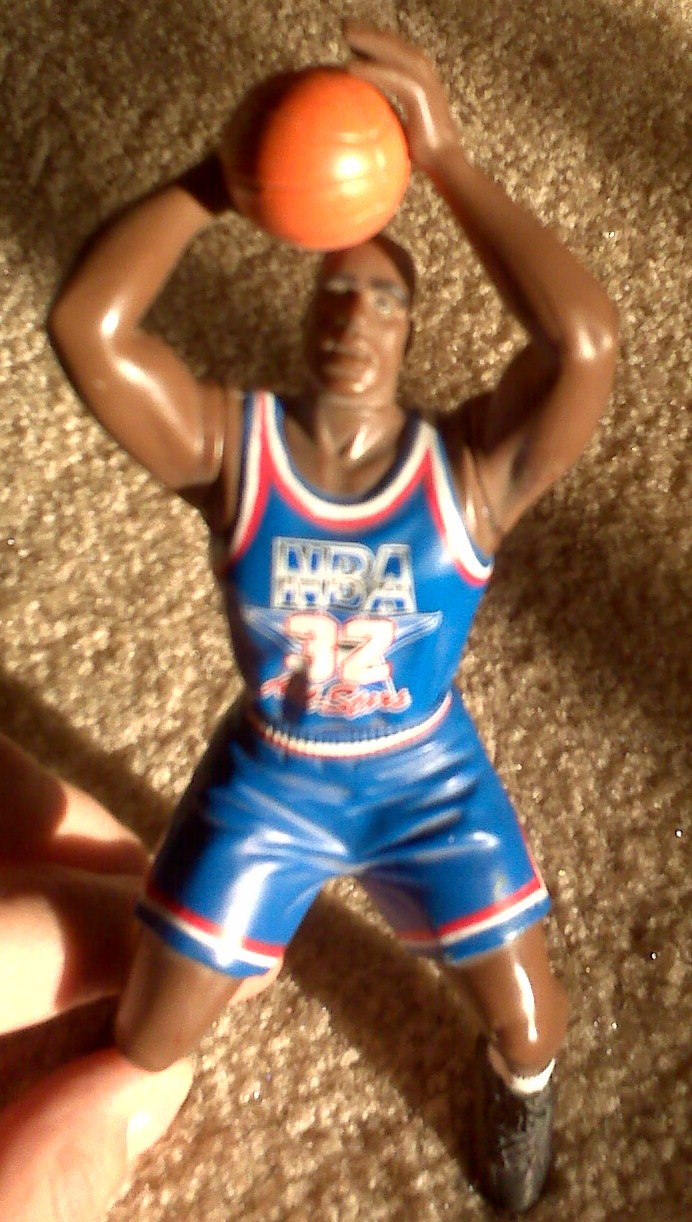
Here's a Shaq action figure. He's donning his 1993 NBA All-Star jersey. This once belonged to my brother. Hopefully he's not still looking for it.


And a Shaq basketball (the signature is not real). I remember taking this ball outside and playing with it once. Then a voice inside my head said, "What the fuck are you doing, Joe? You're going to want this to be in good condition so you can look at it when you're older." Foresight.


This is a Shaq rookie card in which he yams on Alonzo Mourning. Mourning probably got away with the foul.


Also making an appearance: Ol' Jud Buechler from the back-lookin' Tom Tolbert.


Remember me? I was the bald white guy that used to annoy the shit out of you during halftime before Jon Barry. Suck it, Jon. You'd be unemployable if it wasn't for me.

Shaq rookie card equipped with shiny, silver encasement. I thought this one would be worth at least 50 bucks. I saw it on eBay for as low as $1.25.

            
Shaq should be a controversial figure. Instead, he endeared himself to the media early and kept fans wrapped around his finger. Shaq was great at deflecting his own personal shortcomings into funny quips. He was also a hell of a basketball player, and a cultural icon. We'll remember him mostly for the latter two, and it's probably better that way.

Tuesday, March 8, 2011

Throw It Down, Big Man!

Here is a list of the Top 10 things I miss the most about the NBA:

1. Michael Jordan
2. The NBA on NBC theme song
3. Bill Walton (The Commentator)
4. High Top Fades
5. Broken Backboard Dunks
6. Lil' Penny Commercials
7. The Washington Bullets Logo
8. Detlef Schrempf
9. The Charlotte Hornets
10. The 2000-01 Sacramento Kings (RIP Sacramento, by the way)

In all seriousness, the Top 5 are very dear to me. Their loss has been a little easier to cope with because every few years, one of the Top 5 threatens to make a comeback. Jordan already came back once and is practicing with the Bobcats again. Bill Walton occasionally calls Celtics and Kings games. Brandon Jennings reintroduced the NBA to the high top fade for a short time last year. The NBA on NBC is never coming back, but the NBA on ESPN/ABC theme song is flying under the radar. It's no NBC, but pretty good nonetheless. The current group of youngsters will look back fondly on the ESPN/ABC theme like we do the NBC.
The age of broken backboards however, isn't coming back. I suppose that's a good thing. Raining glass can be pretty dangerous. The NBA also saves time and money -- two of the League's biggest assets at this point.
We all know that the rims and backboards are made sturdier nowadays, but how exactly do they work? Arthur Ehrat is credited with the invention of the breakaway rim as we know it today. Not a fan of basketball himself, Ehrat was contacted by his nephew, an assistant basketball coach at St. Louis University in 1975, about creating a rim that could withstand forceful slams. After a couple failed attempts, Ehrat struck gold -- in the form of a John Deere cultivator. He found that the spring was strong enough to not only withstand missed shots, but dunks as well.
Ehrat's new rim debuted in the 1978 Final Four. Dunking had been illegal since 1967 in the college game, but recently reinstated in 1976, due in large part to the popularity of Dr. J and the rest of the ABA's high-risers.
The NBA followed suit, introducing the breakaway rim in 1979 as a response to Darryl Dawkins, who shattered two backboards that year. While the new rim proved to be more successful than its predecessor, players were still bringing backboards down.
That changed in the early 1990s. NBA rims are now attached directly to the arm extending beyond the backboard. The arm, coupled with the springs on the breakaway rim absorb the force that the glass backboard used to. The video below contains a nice visual of this process, in addition to a disheartening experiment for those still hoping to see another broken NBA backboard in their lifetime. 


In 1992, Shaq became the last player to shatter a backboard in an NBA game. The once famous trend lasted for 46 years but will never be seen again, at least in the NBA anyway. In memoriam, I conclude with this: