I skipped Days 7-9 of the Daily NBA Blog because I visited my brother at college this weekend and didn't have time to write as a result. Who knew that simply stepping foot back on a college campus unleashed in me the three habits I'd since kicked so well: too much pizza, beer, and irregular sleep patterns. I still managed to catch large chunks, if not every game in its entirety and came away with a few thoughts that I forgot to write down. So much for that.
Maybe it was the Guinness, but Zach Randolph dancing to DJ Khaled's "All I Do Is Win," after Memphis notched a 91-88 win to take a 2-1 series lead over San Antonio, was the weekend's most memorable NBA moment. Why? Because of the improbability of the scene. If you would have told me before the playoffs that Chris Paul would hop in his time machine, single-handedly will his team to two victories over the best team in the NBA, and, in a matter of days, convince NBA observers that he was still the best point guard in the NBA, I would have believed you. If you would have told me that Brandon Roy would make four clutch shots IN A ROW, with the game on the line, to even up the series in Portland, I would have believed you. If you would have told me the Knicks would struggle, LeBron would miss a game winner, and Dwight Howard would put up 30 and 15 despite showing very little interest in the games, I would have believed all that too. But Randolph, dancing at midcourt, soaking in an adoring crowd's attention? Not for a second.
Zach Randolph is the type of athlete who hometown fans are skeptical of embracing (see: Portland, New York, LA). The fact of the matter is that Randolph as been a remarkably consistent model of productivity in his ten years in the league. He's long figured out the on court stuff (to an extent, but let's not get into that). His off-the-court behavior is what garners him the most attention and why, even after putting together his fourth 20-10 season in the last five years, he is not mentioned with the game's elite players. Why would Memphis fans, knowing Randolph is due for a screw-up, let their guard down and become emotionally invested in him? Here's one big reason:
After the game, the Spurs exited the floor, and Memphis fans stood and applauded Randolph as he danced, seemingly in slow motion, as he always does, to the beat of his own drum. He had signed a 4-year 71 million extension with the Grizzlies just days prior. Since coming to Memphis, Randolph has stayed out of trouble and played well. He deserved this moment, and I was happy for him and the Grizzlies franchise on their first home playoff win.
The Grizzlies and Pacers agreed upon a trade the day of the February 24th trade deadline that reportedly was going to send OJ Mayo to Indiana in exchange for Josh McRoberts and a 1st round pick. The trade was voided because it didn't meet the 3 PM deadline. Both sides tried to blame the other for the mix-up, but this fact remains: both teams, at least for their first round series', are better without the trade.
Mayo has been the most valuable player off a Memphis bench that has outplayed San Antonio's bench this series. Not only can he come off the bench and provide an offensive spark for the second unit like he did in Games 3 and 4, but can play major minutes if Memphis needs his three-point shooting, like they did in Game 1. McRoberts has been one of the centerpieces of Indiana's physical play. Along with Foster, he has come off the bench and not only offered hard fouls, but been aggressive on the boards. Both of these areas have given the Bulls trouble. If the Mayo-McRoberts trade goes through, I don't think either Indiana or Memphis is as successful in their respective series' as they have been up to this point.
Much of the talk after Game 4 centered around the end of the Spurs dynasty. First of all, the series isn't over. I don't think anyone would be surprised if San Antonio could mount a comeback. But even if they can pull off a miracle and advance, they're not beating Oklahoma City. All dynasties must crumble, but the Spurs have done so in such surprising fashion. They've compromised some of the defensive end and have preferred to rest Duncan more and try and outscore teams. Their biggest advantage during the regular season was their superior three-pointing shooting; tops in the league. Through the first two games in which they went 1-1, they shot 40.6 percent from behind the arc. Since then, 0-2 and 21.2 percent in Games 3 and 4.
Tim Duncan was routinely stripped when the Grizzlies doubled him. He also had a difficult time trying to pass out of the double team. Tony Parker played well, but his counterpart Mike Conley, as he has all series, kept up with him. Conley mid-range game was surprisingly effective and he only turned the ball over once. Spurs fans had been begging for Tiago Splitter to make an appearance and he finally did. Splitter provided a spark, hitting 5 of his 9 shots, but his production was negated by the collective effort of the Grizzlies' bench. Every player but one on Memphis' roster scored in Game 4. That stat says it all.
If this is in fact the end of the Spurs, then perhaps we should reflect on their remarkable regular season. Most teams gradually fade into obscurity, slowing dipping in the Playoff standings before missing the Playoffs all together and dismantling the roster. The Spurs finished one game off the NBA's best record and were 46-10 at the All-Star break. They weren't always the most entertaining team, but they always managed to surprise us in one way or another.
Tuesday, April 26, 2011
Thursday, April 21, 2011
Day 6: Bulls-Pacers (Game 3)
The Pacers played Game 3 like a team who knew they were overmatched. They tried every trick in the book. Flopping, hard fouls and screens, and sticking their legs out on contested threes and passes, among other things. I'm not about to criticize Indiana for anything they did. In a Playoff series, adjustments are the key. The Pacers outplayed the Bulls in different facets of Game One and Two (some may say the entire games themselves) and still came up empty. They had to do something. Sure, flopping and cheap shots are dirty and dishonest, but what were they supposed to do? Roll over? If anything, the Pacers' style of play in Game 3 was a testament to how good the Bulls are at pulling out victories, even when they don't play well.
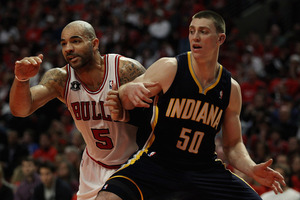
Indiana's physical play was the story of this game. Stacey King and Scottie Pippen were ready to suit up and give a hard foul to who ever was closest. Jeff Foster and Josh McRoberts came off the bench took turns clobbering the Bulls, trying to outdo the other each time. Foster in particular drew the ire of Chicago fans when he deliberately came down on Rose's face, prompting a reaction from Rose. Not much later, he swung a blatant elbow to Deng's head, which put him to floor. That's what Foster does. He's in the league for two reasons: to get rebounds and try to get under his opponent's skin.
Some people, King and Pippen included, were quick to criticize the Bulls for failing to retaliate. I think the opposite. Let Indiana try to play their bully brand of basketball. The second Chicago tries to make this in to a shoving match is the second Indiana can take advantage of them. The Bulls are a more talented BASKETBALL team. Playing basketball is what they do best. If Indiana can get Chicago thinking about fouls and how to retaliate, they've got them off their game plan, which is exactly what they want.
I'm starting to sound like a broken record, but the bench was awful for a third straight game. The Pacers' bench has outscored the Bulls' bench 27-25 in Game One, 43-22 in Game Two (that number is a bit inflated because of Collison's injury), and 32-20 in Game Three. I maintain that the bench goes as Brewer goes, and Thibs has been weary of playing Brewer. Although he did come up with two clutch free throws and a couple big rebounds to end the game as something positive to build on.
Kyle Korver has really saved the Bulls. 13 points, 4-4 threes in Game One, 5 points and one huge three in Game Two, and 12 points and three threes in Game Three. The Pacers have been trapping Rose as he crosses half court, usually forcing him to give the ball up to Noah at the top of the key. Indiana's defense was really active today and deflected a bunch of interior passes that the Bulls normally execute. Anyway, with the trap on late in the 4th quarter, Korver will get some open looks. As strange as it is to say, he's been just as valuable as Rose in closing games this series.
The Pacers have given it a valiant effort but are probably going to be swept. Things have looked picture perfect for them at times, but ultimately they're going to fall well short. Kind of like this Jeff Foster jumper.
Day 5: Nuggets-Thunder (Game 2)
The NBA regular season is a long, sometimes predictable grind. The good teams will almost always beat the bad teams. Guys won't be playing as hard as they do in the Playoffs, and JaVale McGee will make you wish he was on your team and then quickly rescind that wish in a span of two minutes. To break the monotony, NBA followers and writers alike latch on to the exciting and unpredictable. What will Blake Griffin do next? Can the Spurs keep up their pace after the All-Star break? Anything having to do with the Miami Heat. These were all intriguing questions/issues because there were so many different ways to tell each story. They were consistent NBA stories, made better because of the thought that the way we felt about them could change drastically at any moment.
Then there was the Thunder -- a team that had a spectacular year, but fell short of the preseason hype surrounding them. Oklahoma City pushed the Lakers to their limit in last year's first round, and Kevin Durant led Team USA to Gold over the Summer in the FIBA World Championship. The Thunder were supposed to challenge for the top seed in the West and Durant was supposed to be the runaway MVP. That would have been a great, somewhat predictable, but ultimately intriguing storyline. A young, gifted player joins the ranks of the game's elite. He takes his team from an 8 to a 1 seed in the matter of one year and wins the MVP while doing so. Sound familiar? That was Derrick Rose and the Bulls. Chicago had the season Oklahoma City was expected to have.
Perhaps the bar was set to high. The Thunder did improve after all. They went from a 50-32 8-seed, to a 55-27 4-seed. Here are Durant's numbers this year compared to last:
2010-11: 27.7 ppg, 6.8 rpg, 2.7 apg, 46% FG, 23.7 PER
2009-10: 30.1 ppg, 7.6 rpg, 2.8 apg, 47% FG, 26.2 PER
His numbers were slightly lower, but not enough of a drop off to become an MVP afterthought like he was this year. The Playoffs are the great equalizer. In an ever-alternating Western Conference, the race to the Finals is wide open. The Thunder were one of many well-written drafts this year. Now they're a favorite to become the story.
What is wrong with Wilson Chandler? Denver's tattooed and scruffy small forward has contributed next to nothing on the offensive end. He scored nine points on just 4-10 shooting in Game One, and added only four points without converting a field goal in Game Two. The problem runs far deeper than shot selection. Chandler has always taken bad shots -- he just normally makes more of them. Chasing around Kevin Durant thirty minutes a game seems to be getting to him. Chandler likes to take his man off the dribble, begin to drive, then inexplicably step back for a fade away 18-footer. His legs aren't there for that shot, and unfortunately for Denver, they need more offense out of him to win.
James Harden's beard (and Harden too!) went off for 18 points in Game Two. Harden has to be one of the most frustrating players to watch in the NBA. He has the skills to be great. He can shoot from anywhere in the building, take his man off the dribble, finish in traffic, and defend when he wants to. Yet, the 4th overall selection in 2009 has reveled in mediocrity up to this point. I realize this is only his second year, but you never know what you're going to get on a night-to-night basis. Charles Barkley made a great point (shocking, I know) about Harden. He stated that Harden would be starting now, but his head coach Scott Brooks wants to bring him off the bench to provide a spark, similar to how the Spurs used to use Manu Ginobili.
Harden provided that spark in Game Two, showcasing all of the talents that I wish he could lay out on his kitchen table and super glue together. If the Thunder are going to contend, they need a reliable third scorer to take the pressure off Durant and Westbrook. They can't be expected to combine for 65 every night, let alone the 72 they posted in Game One. Harden is the only Thunder player capable of playing the third wheel. It's going to be difficult for anyone to beat them if Harden can efficiently give them 16-18 a night.
The Nuggets have become a fan favorite after the Melo trade. They dealt their big name/distraction that didn't want to be there and became a better team. All while the Knicks made little to no improvement after supposedly receiving the prize of the transaction. But sure enough, the Nuggets miss Carmelo Anthony. Not for the entire game, but they miss Carmelo Anthony in crunch time.
The Nuggets were the highest scoring team in the NBA. After trading Melo, they were off to the races, literally. Their uptempo style ran teams out of the gym. The Nuggets have a remarkable EIGHT players that averaged double figures for them this year. But that's part of the problem. The new-look Nuggets have not been in many close games during the season, but in games decided by 8 points or less, including Game One, they are 3-6.
The Nuggets right now are a bullpen filled with guys that can throw 95 mph with movement, but none of them have a defined role. We've seen the Closer-By-Committee fail countless times in baseball and Denver's basketball version is doing the same. They don't have anyone they can count on to win a game for them in the closing seconds. Playoff games, or at least 4 out of 7 in a series are typically close. The Nuggets' success was fun because of what they represented, but they could really use a player like the one they dealt away.
Wednesday, April 20, 2011
Day 4: Magic vs. Hawks (Game 2)
I think of Dwight Howard as an aggressive driver. He has a vision of where he wants to go but is constantly impeded by basketball's version of "No Left Turn" signs, slow drivers, and radar-gun-toting police officers. Howard wants to take his sweet ass time on the free throw line. He wants to swing the ball over his head but a defender's cheek bone is always in the way. He wants to run the floor and establish quick low-post position, but there's always a smaller, inferior player waiting to flop into the third row. Howard recognizes the game's expansiveness but is unable to adapt to the traffic cones scattered across the court.
Worse yet, Howard doesn't trust the police...er....referees. He believes they are out to get him. Watch how LeBron, Wade, or 2011 Derrick Rose operate. They're confident that when the time comes, they can force the referee to rule in their favor. Howard operates with the knowledge that it's him against the world. He'll receive a blow to the ribs or a slap across the face and can do nothing but flash that incredulous stare. He knows that the slightest, well, slight of the referee's hand will get him T'd up, and still is unable to contain himself.
But make no mistake, Howard has been contained. It could be his personality or it could be his wavering confidence in the ref's ability to protect him, but we're not seeing Howard fully realized. He's arguably the most dominant player in the game and there is not one NBA observer who thinks he couldn't be more dominant. Will Howard learn to suppress his aggressiveness just enough to avoid the squad car nestled within the bushes? Can he recognize where the squad cars typically hide? Or will he be content as the driver of a Maserati, going 45 miles per hour along with the Camrys?
The Magic will always be about Howard. At least until he bolts to LA, anyway. His teammates can sometimes be nothing more than scenery. Dwight could morph into 1962 Wilt Chamberlain, average 50 and 25 a night (not as much of a stretch as it seems playing 48 minutes a night), and the Magic would still lose. Howard does his thing, but Orlando is still viewed as a team that lives and dies at the three-point line. Howard's defense and offensive numbers are constant but it is Orlando's three-point shooting that puts them over the top.
How then, did they win Game 2 after draining only five of their 23 three-pointers? Unexpected contributions from Howard, of course. Forget about Dwight's numbers, Atlanta has defended him masterfully in this series so far. They've refused to double team him, allowing the four-headed monster (Jason Collins, Etan Thomas, Josh Powell, and Zaza Pachulia) to go one-on-one. All four have enough size and strength (and six fouls) to hang with Howard for the required five to twenty minutes. Collins in particular has done a great job of stripping the ball from Howard in the post. Dwight already has 15 turnovers in two games, in large part due to Collins' active hands.
The Hack-A-Howard strategy backfired on Atlanta in Game Two. Howard, who shot 59 percent from the line this year, went 15-19 from the line. Sure, Jason Richardson's three to put Orlando up seven with just over a minute to play was the biggest shot of the game. Al Horford's early foul trouble and subsequent inability to get into the flow of the game was huge. The fact that Howard only attempted 12 shots is a painful reminder that even he can disappear during crucial stretches of a game. But ultimately, Howard's free throw shooting was the difference. That's probably not what Orlando wants to rely on to win a game.
Howard has sat out TWO minutes through the first TWO games. The Magic barely came out with a win from their home court advantage. Exactly how many of his teammates can Howard pile into that Maserati? It is on the verge of breaking down.
Monday, April 18, 2011
Day 3: Bulls-Pacers (Game 2)
Free-throw disparity was one of the hot button issues from the first game. The Bulls out shot the Pacers 32-17 from the line. Derrick Rose himself shot four more free throws in Game One than Indiana's entire team. Whenever one player, and a superstar player at that, out shoots an entire team from line, questions are sure to arise. Is said player receiving superstar treatment? Is (in Indiana's case) the underdog getting the raw end of the deal? To simply look at free throw disparity and assume the Bulls were getting the majority of the calls is lazy thinking. Rose went to the line 21 times because he drove to the basket practically every possession in the second half and forced the referees to blow the whistle. The Pacers, on the other hand, were content to settle for perimeter jumpers. Chicago frequently doubled the post in Game One and left open outside shooters.
Game Two was played differently, and what do you know, the free throw attempts were more evenly dispersed. Chicago still out shot Indiana 34-27, but the higher number of Pacer free throws were the result of less open perimeter shots and consequently more fouls in the paint.
I'm worried about Ronnie Brewer. Brewer sprained his thumb against New York and missed the final game of the regular season against New Jersey. He's playing through the pain and has looked uncomfortable doing so. It has flown under the radar, but Ronnie Brewer has been a non-factor in the first two games. If the NBA compiled an All-NBA Bench Team (which they really should), Brewer would have been the two-guard. He was the defensive spark that ignited this year's most effective bench.
Brewer so far has looked awkward with his shot and entry passes. He's also appeared more passive on the defensive end, which limits the second unit immensely. The second unit as a whole have been ineffective so far this series and Thibs has chopped their minutes as a result. The biggest reason for this, in my opinion, is Brewer's passive play. Hopefully this is a passing phase and not a potential problem heading into the tougher rounds.
The Boozer-Hansbrough match-up has been fascinating to watch. Hansbrough hung 22 on Boozer in Game One, consistently knocking down his mid-range shots when Boozer helped off him. The Bulls pounded the ball in to Boozer in the first half of Game Two this time he had his way with Hansbrough. The two also earned double technicals with three minutes remaining in the game.
Hansbrough and Boozer are prototypical "Make 'Em Mad" players. Boozer because of bobbling head, demonstrativeness, and incessant yelling. Hansbrough because of his Ritalin-like focus, whiteness, and pesky play. Basically, both are annoying as shit. Especially if you have to play against one of them in the playoffs. They've been prodding at each other in both games, like a kid poking a rabid dog with a stick. Eventually the leash will break. The leash will probably be Game Three.
The Pacers held the Bulls to 54.5 percent shooting in the paint. Incredibly, they shot the same number of shots and an identical field goal percentage in the paint in Game One. But the Pacers were tougher around the rim in Game Two. They fouled rather than give up easy buckets. Even the majority of Chicago's made shots were highly contested. Indiana has made Chicago earn it at the line. And they have. The Bulls as a team have shot 80 percent from the line this series (53-66). Derrick Rose has done the bulk of the damage (31-34, 91 percent).
Sunday, April 17, 2011
Day 2: Celtics-Knicks (Game 1)
A Celtics-Knicks first round match up wasn't supposed to happen. Then trades happened. The Celtics were the top team in the East and expected to reach the NBA Finals for a second straight year. Hours before the trade deadline they traded center Kendrick Perkins, who many considered the anchor of their very good defense. The Celtics went into a tailspin, finished the season 15-12 and dropped to the 3-seed in the Eastern Conference. Perkins had missed most of the season when the Celtics were playing well, so he hardly was the sole reason for their collapse. But his departure certainly became the easy answer. Undoubtedly, the close-knit Celtics were at least damaged emotionally by the unexpected trade.
Three days prior to Boston's deal, the Knicks acquired their year-long target, Carmelo Anthony. The much scrutinized Knicks finished the season 14-14 with Melo and were accused of giving up too much for him. What often goes overlooked is that New York was only 28-26 before the Melo deal, so record-wise, they weren't much worse. The new look Nuggets finished the season 18-7 and improved to a 5-seed, fueling much of the criticism the Knicks received. Both limped unexpectedly into the playoffs and created for themselves an unlikely match up.
Jermiane O'Neal, yes that Jermaine O'Neal, could be the key to the series. Jermaine was supposed to back-up the bigger, more famous O'Neal, but 350-pound 39 year-olds generally have a difficult time getting back into basketball shape. Shaq's expected presence was one of the big reasons the Celtics felt they could trade Perkins. He didn't play in Game One and it is unclear when or if he will ever play again. So naturally the other O'Neal went 6-6 from the field, provided Boston's only shot-blocking presence (something they badly needed), and took a couple of crucial charges that quelled New York's third quarter runs. Forget his offense, if O'Neal plays defense like he did today all series, Boston will easily control the paint. Remember, that wasn't a given coming into this series.
Rajon Rondo has a jumpshot only his mother could love. Just look at that thing. Does Ray Allen politely suggest that he keep his elbow in? How can Rondo's shot possibly be this bad when he has one of the greatest shooters in NBA history as a teammate and possible mentor? The Knicks didn't respect Rondo's shot either. Doc Rivers said they left Rondo wide open in practice to simulate what the games were going to be like. How about that for a confidence booster. Maybe not so surprisingly, it worked. Rondo knocked down three of his six mid-range attempts. He got to the basket at will even though his defenders were playing three feet off of him. If he makes that shot even 40 percent of the time, how can you defend him? I don't think there's a way.
Once upon a time, Bill Walker resided at the end of the Celtics' bench during the 2008-09 season. He never got in the game but was the typical overbearingly excited and supportive 12th man. He's familiar with this Boston team. When Carmelo Anthony picked up two quick fouls, Walker entered the game as his replacement. He immediately got in Rondo's face. Then he got tangled up with O'Neal, and jawed with Pierce. It's always fascinating to watch a guy play against his old team. More often than not, he plays with a greater intensity level and is more effective because of it. Walker won't play enough minutes to have an enormous impact in this series, but couldn't he be used to get in Boston's head? The last thing the Celtics will put up with is a former bench-warmer trying to show them up. This could become an interesting subplot.
I should probably conclude with Melo's shooting woes, broken down by quarter. He didn't attempt a shot in the 1st quarter. He made 4 of his 7 attempts in the 2nd quarter, including two threes. He went 1 of 7 in the 3rd quarter. He finished 0-3 in the 4th quarter, including a stupid long three to end the game with six seconds remaining on the clock. That's 5-18 for the game and if you take away the one good quarter: 1-11. Expect a big Game 2 from Carmelo.
Saturday, April 16, 2011
Day 1: Bulls-Pacers (Game 1)
Due to his slightly over exaggerated comments about the Bulls, Danny Granger became the story of Game One even before the game started. When asked whether he would prefer to face the Bulls or Celtics in the Playoffs, Granger said Chicago. "Chicago, they go as Derrick Rose goes," he stated. "If you can make a concerted effort to stop Derrick Rose, you have a better chance of beating them."
To be fair, Granger didn't say anything inflammatory, or even ridiculous. Many people feel Boston, because of their playoff experience, will be a tougher out. And the Bulls do tend to lean heavily on Rose for their offense.
Part of the lore surrounding Rose during his 2011 MVP campaign is the Jordan-esque memory he seems to have developed regarding past performances. Jordan was the master of self-motivation. He scoured the Earth for anything that could be perceived as a slight against him or his team. Rose is the same way. It has been no coincidence that some of his most dominant performances have come against teams that beat the Bulls earlier in the season. The Bulls' 115-108 overtime loss against Indiana the last time the two met, coupled with Granger's comments, figured to fuel Rose to a monster performance. Much of the onus then fell on Granger's shoulders, as many looked to see if he could back his words up in Game One.
While Granger is Indiana's best player, I felt Tyler Hansbrough was going to be the key to this game. He torched the Bulls for 29 points on 10-19 shooting in their last meeting against the Boozer-less Bulls. I thought he'd be able to exploit Boozer on the offensive end and he did. Hansbrough provided the usual hustle plays, crazy eyes, and ability to knock down that damn mid-range jumper that Boozer gave him all game. Granger's 18 points in the second half (including the first eight to start to half) fueled the Pacers, but he won't go off like that from behind the arc all series. Hansbrough is the disconcerting match up because he can do what he did today every game.
I'm not normally one to harp for too long on stats, but today I will make the necessary exception. The Bulls are the best team in the NBA at defending the three-point line. They held teams to 32.6 percent shooting during the regular season, best in the league, and gave up less threes than anyone this year. The Pacers went 10-18 from three-point line. That's an unacceptable 55.6 percent.
The Bulls are also the best rebounding team in the NBA. They out rebounded Indiana 49-34 (21-13 on the offensive glass) but were outscored 9-8 on second chance points. They gave up 10.1 offensive rebounds a game during the regular season. With a rebounding advantage as sizable as the Bulls' was today, there's no excuse for being outscored in second chance points. Three-point shooting and second chance points were what kept Indiana in the game. If the Bulls performed even remotely close to what they normally do in these areas, this is a double digit victory.
The Bulls closed out the game on a 16-1 run. After two Deng free throws, Rose scored or assisted on 12 of the Bulls' last 14 points. I'm not sure there is any other player I would want on my team at this point to close a game. Rose adjusted during crunch time. His shot wasn't falling (he went 0-9 from three) so he attacked the basket, as he did all game. He attacked the basket with reckless abandon, hammered home an "And 1," spun into the lane to finish off a 7-foot floater, made two more free throws and set up a wide-open Korver three with his penetration.
Watching the end of this game, it's easy to see why Chicago's critics think the Bulls are too dependent on one player. But look at the shots Deng and Korver knocked down this game. Those two, along with Boozer will have to pick up the slack when the ball is inevitably forced out of Rose's hands. Deng and Korver stepped up today. I'm not buying that this game somehow exposes an offensively flawed team. Team defense and rebounding were the two biggest issues today. Bigger than anything that happened on the offensive end.
Subscribe to:
Posts (Atom)