Wednesday, July 27, 2011
My Cat Is Getting Old
My cat, Kringle, turned ten years old today. According to Calculator Cat, that would make him 57 in cat years. July 27, 2001 is not his real birthday. When our family picked him up from the shelter on December 27th, they had him listed as a 5-month old kitten. We stuck with the 27th, subtracted five months, and decided to use July 27th as his birthday. I could also tell you about the elaborate back-story my brother and I created for him. About how he lived with Fidel Castro while growing up in Cuba, and preached revolution in his previous lives. Or how he batted leadoff and played centerfield for his shelter baseball team. Or even the eight illegitimate children he fathered with two different women. But all of that would bore you.
Kringle's backstory was very important to us as young teenagers, and was instrumental in the development of my love for storytelling. But more than anything, creating a narrative for Kringle was necessary because cats are just plain boring. They sit, they sleep, they eat, and if you're lucky, they provide a change of pace and lick their ass for a few seconds. You can only play with a cat for the first year or two of their life and then they start to become bored. Really, you're going to make me chase around that feather again? I'm too old and wise for this shit.
Talking about Kringle's past exploits allowed us to create some excitement when there wasn't any. None of it was true, but I'll be damned if I didn't start to believe in it. Yesterday night, Kringle tip-toed into my room and began sniffing around. My bedroom windows were open, and a glimpse of the outside world for a house cat is what reality TV is to humans. My windowsill is about three feet high. In his younger days, Kringle jumped up there with no problem. Despite the two-inch width, he would always manage to measure up the height and time his jump perfectly to land on the windowsill with ease. Nowadays, he's more hesitant.
Kringle looked up at the now Goliath-sized windowsill. He stared for a minute, poked is head around, checked out the other windowsill, and realized he couldn't make the jump. He hasn't been able to make that jump for some years now, so he's taken to jumping on my desk and then stepping on to the windowsill. My desk is about two and half feet high. I've never seen him have a problem with jumping up to the desk.
As usual, my desk was a mess -- empty water bottles, empty beer bottles, laptop, obnoxiously large books, keys, wallet, glasses case, etc. I pushed most of the crap to back in an attempt to clear out some space for him to jump up. Kringle sniffed around some more and surveyed the now-open space. He stretched out on his hind legs, and batted his paws at the top of the desk. I interpreted this as a way to psyche himself up. Kind of like when a boxer jumps around in his corner during introductions and punches himself in the face before the fight is about to start. Kringle did the super-stretch a few more times before settling in. He crouched down real low in preparation for his jump. Glued to my desk chair, I stared. I was riveted. He looked at me, and before I could react, he jumped up to my lap, jumped on to the desk, and stepped on to the windowsill in the span of two seconds. The once one-step process turned two-step process, is now a three-step process ten years later.
I guess that is what getting old is about. There's no easy way to do anything anymore. I'd be lying if I said I didn't have a flashback of the times we coaxed him into jumping five feet in the air to track down a noise-making ball. Or of the times I had convinced myself he made diving catches in the outfield. The reality is: he's ten years old and has lost his athleticism. And some of that athleticism was imagined to begin with.
As Kringle lay on the windowsill and stared into the blank night, I decided I would blog about this. I hadn't posted anything in a month and figured my five loyal readers were probably wondering if I was still alive. So I disappeared into another room to find a camera. I was going to take this visceral, even symbolic picture of Kringle staring into the black vastness of the world and use it for the top of this post. Camera in hand, I made it back into my room. As I steadied the camera and just about took the picture, Kringle turned around and jumped off the windowsill. The photo above is what I was left with. The perfect, fleeting picture I burned into my memory morphed into the picture I actually took.
I can't help but to think that too is what getting old is about.
Thursday, July 7, 2011
Stumped
The three men arrived in their rusting white van. Armed with an arsenal of destruction weapons, they would eventually begin hacking at the tree. First, the youngest and most fit man climbed to the top of the tree. He wore special tree-climbing boots and was supported by a rope tied around his waist and to the sturdiest branch. He had with him his chainsaw and used it to saw the weakest, most thin branches. By the time he was done, he had created the world's largest bird's nest beneath him. The oldest of the three men took it from there. He gathered up a pile of branches and took them to the wood chipper, and repeated this single step until all of the branches were destroyed. The man on the tree had it pretty easy from there -- a few semi-developed dead branches and then the main event -- the trunk. You watched it all from your bedroom window.
The three men were hired to take down your tree and three of your neighbor's trees. An insect outbreak most likely got a hold of them and were killing off a bunch of trees in the neighborhood. After the workers took down the trunk of your tree, the third man used a heavy machine to grind away the stump. He looked happy doing it, knowing he had a place in the world. You're outside now and you give him a head nod up to acknowledge his good work.
The man finishes with the machine and covers the hole with what looks like a grassy soil mixture. The area is a bit uneven, and takes on a yellow hue. A passer-by might think a dog pissed all over the area, but never that a tree used to live there.
You reenter your house, walk upstairs back into your room, and notice the unobstructed view. Gone is the tree and everything becomes so clear to you. Your eyes focus to the left: Chris' pool. You remember the time -- about six years ago -- when Chris, your younger brother, and yourself were able to convince Brittany and Sarah to come swimming with the three of you. Sarah possessed the good upper body, Brittany the good lower body, and both of their faces were decent enough. You decide on Brittany even though there is nothing spectacular about her. Sarah had been flirting with Chris and you're not about to encroach on his territory. Sarah is the better looking one. Son of a bitch.
While in the pool, Brittany suggest you play a game. The name of the game now escapes you. One of the girls opens her legs and one of the guys is to swim through them. In the event of a successful pass, the girl is to put her legs a little closer together. You lose when the girl's legs are so close together that you crash into them before you are able to get through. This is a great game because losing is really like winning.
In the pool you try to put moves on Brittany. You get close to her and say things you think will impress her. She laughs you off and is more interested in your younger brother. He could care less about her. Chris is not able to close Sarah. Everyone gets out of the pool, dries off, and leaves unhappy.
Your eyes move gradually to the right and fix on the Rizvi's shed. Behind the shed is where Chris and you had your first egg-throwing experience. It was a warm summer night and the two of you were a couple of bored suburban middle-schoolers looking for something to do. "Hey, why don't we egg a house," you say. "Sure," Chris replies. "Have you ever done it before?" you ask. "Sure. Lots of times." "You're a liar."
The two of you agree on 12:30 in the morning. The perfect time. Everyone should be asleep and it's not like cops come through your neighborhood anyway. You are able to sneak out the back door with no problem. Your parents have work in the morning and go to sleep early regardless. Chris is not so lucky.
His parents are asleep but he has to pass by their room to make his way down the stairs and out the door. Chris' mom has the ear of an owl. The slightest creak of the stairs would wake her. Chris decides not to chance it. He places his house key in his pocket, opens his bedroom window, and removes the screen. He climbs out the window and on to the roof. From there, he is able to grab ahold of the basketball rim and drop down to his driveway.
You brought four eggs with you and hand two to Chris. You're afraid of the streetlights giving you away so you hide behind the Rizvi's shed and Chris follows you. "We can throw them from here," Chris says. "A few houses down they have a sliding door in the back. We can peg the shit out of it from here. It's not that far." You look over to the sliding door. It seems pretty far to you. You've never thrown an egg but you have thrown a baseball before. Chris has a better arm than you and you want him to go first.
Chris cocks his arm back and lets it fly. You gaze at the magnificent flying egg until you lose it in the darkness. Splat! A direct hit. "Holy shit," you say as you get ready to throw. You release. Splat! Another hit, just below where Chris connected. You become so excited and you body fills with adrenaline. You don't wait for Chris' turn. You throw again. This time with all your might. Splat! That one almost hit the roof! Splat! Chris had flung his last egg.
"We should get out of here," Chris says. "I'll see you tomorrow." Chris jumps back into his yard as you jump the Rizvi's fence and head across to your house. Your first act of petty vandalism and it feels so good.
Staring out your window and your eyes move to the Rizvi's front lawn. The Rizvi's didn't always live there. Before they bought the house, it had gone unsold for many months and the original owners had already moved out. No problem. You and the rest of the neighborhood kids adopted the house as your own. You played on the giant tire in the backyard and swung on the swings. Occasionally, each kid would bring food from home and you'd eat together on the patio. When basketball became boring, and it hardly ever did, you would play tackle football in the Rizvi's yard. It was the only house that wasn't fenced in -- plenty of room for a mock football field. The neighborhood kids don't play basketball or football nowadays. It's all about hockey. You can't drive anywhere without having to wait for a kid on roller blades to pull his net to the curb.
When the Rizvi's moved in you were devastated. The house you ate and played at, and took so much care of now belonged to someone else. At your age, you didn't know the first thing about home ownership but it felt like your house was being taken from you. This was supposed to be the house nobody wanted. Shortly after assuming ownership, the Rizvi's had a fence built. Your football field became but a distant memory.
The three men packed up their demolition tools and drove off. They left four piss-colored patches of grass in four different yards. Your once obstructed bedroom view is now a mirror to your past. That tree used to scare you as a kid. As you tried to sleep, its branches looked like monster's claws waiting to break though your window. You don't even sleep in this room anymore.
Why did it take the removal of a dead tree to help you remember? Why did you push these memories aside in the first place? You're sure of one thing: with loss comes recollection.
Tuesday, July 5, 2011
Some Satchel Paige Stories
I normally stick to producing original content around here, but at this point in the year would require me to write about the Cubs. It's the middle of summer. The sun is shining. I don't hate myself, and thus, am not going to devote time to something that is just going to piss me off. My old college roommate used to say, "All Cubs fans are masochists." He was absolutely right.
Instead, I have some Satchel Paige stories from the book I just finished, Invisible Men: Life in Baseball's Negro Leagues by Donn Rogosin. The Hall of Fame pitcher is probably the most well-known Negro League player (excluding players such as Jackie Robinson and Hank Aaron who spent the majority of their careers in MLB). The pages devoted to him were the most entertaining. It's a shame Paige's career didn't sync up with the Internet era. Twitter would have loved him.
All passages are in italics and quoted directly from Rogosin's book.
On his pinpoint control...
It was in the Southern Negro League that Paige began to emphasize his precise control by disdaining a regular home plate and placing a gum wrapper down instead. "This is my base," he'd chortle, or he'd place two bats about six inches apart and zap the ball between them into the catcher's mitt (45).
As the definition of confidence...
The greatest single episode of Paige's lengthy career occurred in Forbes Field on July 21, 1942, when Paige had his penultimate showdown with Josh Gibson. That hot July day Paige knew he really had his stuff and he baffled and teased the Grays through six innings. With a 4-0 lead, he was a picture of nonchalance, as he put the first two men out in the seventh. Then lead-off man Jerry Benjamin tripled.
Satchel motioned for first baseman John "Buck" O'Neil, the Monarchs' captain, to approach the mound. "Hey, Nancy," yelled Paige, using the nickname he gave O'Neil, "I'm gonna put Howard Esterling on base; I'm gonna put Buck Leonard on base; I'm gonna pitch to Josh!"
"Oh, Satchel, you got to be crazy," moaned O'Neil, who was accustomed to Satchel's antics.
Behind the scene was this story. When both Satchel and Josh had been rising young stars with the Pittsburgh Crawfords years before, Paige had told Josh, "Some day we're gonna meet up. You're the greatest hitter in Negro baseball, and I'm the greatest pitcher, and we're gonna see who's best."
So on that day in 1942, Paige walked Howard Esterling so that Buck Leonard entered the batter's box and Gibson reached the on-deck circle. "Hey, Josh, you remember that time when I told you about this," roared Paige as he began deliberately to walk Leonard. "Now is the time."
"Okay, Satchel, okay," cackled Gibson in his high-pitched voice. In repartee, Gibson was not ready to challenge the voluble Paige.
"I'm gonna put Buck on. I'm gonna put him on, and pitch to you. I want this to happen," Satchel told Josh.
Now the fans began to realize just what was happening. They stood and cheered. And then, as Leonard hustled to first, loading the bases, they turned oddly silent.
"Now I'm gonna throw you a fastball, but I'm not gonna trick you, I'll tell you what, I'm gonna give you a good fastball," said Paige as Gibson stepped in.
Boom! It was a knee-high fastball. Josh didn't swing. Strike one.
"Now I'm gonna throw you another fastball, but I'm not gonna try and trick you. Only it's gonna be a little faster than the other one," teased Satchel.
Boom! Again, Josh didn't swing the bat. Strike two.
"Now Josh, that's two strikes," laughed Paige. "Now I'm not gonna try to trick you. I'm not gonna throw any smoke around your yoke. I'm gonna throw a pea on your knee, only it's gonna be faster than the last one."
Boom! It was a fastball, knee high on the outside corner, and Josh didn't swing. Strike three.
As Paige walked off the mound even the Grays' fans cheered. "I told you, I was the greatest in the world... (97-98)"
Again teetering the line between confidence and cockiness, and durability to boot...
Wendell Smith argued Satchel Paige's greatest days came in July of 1934. Pitching for the Pittsburgh Crawfords, Paige mowed through the Homestead Grays' lineup at Forbes Field. Paige had such extraordinary stuff that day, he'd shout to the batter, "You'll get nothing today," while an appreciative crowd howled with laughter. Finally Buck Leonard, to slow Paige up, complained that Paige was tampering with the ball, and in an unusual concession, several were thrown from the game. Paige scornfully approached Leonard and yelled, "You might as well throw them all out, 'cause they're all jumping today." Then after his victory, the incredible Paige hopped into his roadster and drove straight to Chicago; there he outdueled the American Giant ace Ted Trent 1-0 in a twelve inning ballgame (78-79)!
The time his team's owner threw him into a Dominican jail...
The Negro League players, loyal only to their wallets, watched amused as the Dominican factions used baseball as the arena for their power struggles. One day Chet Brewer, who was playing for Santiago, went hunting for Satchel Paige, who was playing for Trujillo City, to invite him to have a beer with him. Unfortunately, Brewer couldn't find Paige. Then as Brewer recalled, "A little kid (they know all the business), he said, 'En la carcel,' that's 'jail' in Spanish. Trujillo had put them in [protective custody] before they were gonna play us. So they wouldn't 'rouse around. He was gonna have it (167).
With the top down screaming out, "Money ain't a thang..."
Stories of irreverence toward segregation became staples of Negro league lore. Satchel Paige, who loved fast cars and had a tongue as sharp as his fastball, was legendary for getting "one up" on the white man. Double Duty Radcliffe relates that once Paige got a speeding ticket while zooming through a small Kansas town in his new Lincoln. A policeman escorted him to the local judge, who fined him forty dollars and asked if he had anything to say for himself. According to Radcliffe, "Paige pulled eighty dollars from his wallet and said, 'Here you go judge, 'cause I'm coming back tomorrow (132-33).'"
You are so dumb. You are really dumb...
While playing for the Pittsburgh Crawfords he loaded the bases with Philadelphia Stars. Third baseman Judy Johnson called for the ball, and while rubbing it up, informed Paige that "the fellows were kinda hoping you'd get in this spot." "They did, did they?" questioned Paige. "Yeah they did," answered Johnson. "They said you were such a pop off." Paige fulminated a couple of minutes and then struck out the side on nine pitches. Quickly he walked toward the Stars dugout and boasted, "Now go back to Philadelphia and tell that (99)!"
Wednesday, June 29, 2011
Would You Name Your Child After This Man?
Tony Campana has looked uncomfortable at the plate all season. He's batted .262 in 33 games, including two doubles, but generally doesn't offer much but a threat to bunt. Campana did enough in Monday's 7-3 win over Colorado, singling in the 3rd, and working his at-bat long enough in the 4th to allow Geovany Soto to score on a wild pitch.
In center field, however, is where Tony shines. Not because he's a particularly good fielder, although his speed does allow him to cover a bit of ground, but because he's not alone. Tony has friends, and plenty of them in center field.
This is nothing new. The bleacher bums love embracing their outfielders, especially the undersized, overachieving ones that have "Career Minor-Leaguer" written all over them. Tony was drafted by the Cubs in the 13th round of the 2008 Draft. He's stolen 144 bases in his minor league career, and carries a cumulative average of .303. Not bad, but he's still 5'8 and doesn't hit for any power, and has been told countless times he'd never make it. Adversity! That's the ticket.
I presume, it's difficult to boo him because of the adversity he's overcome. Even if his on base percentage continues to hover around .300 (from the 2-hole), Tony is well aware of his get-out-of-jail free card. One has to look no further than the different ways Soriano and Campana interact with the fans to witness the sort of privilege Campana enjoys.
Soriano and the left-field bleachers play a little game. "How many outs Sori," the fans yell, and Soriano more often that not obliges. He waves his index to indicate one out, and his index and pinky to indicate two. Sometimes he'll turn around and watch the crowd. His willingness to engage is usually determinate on his performance. It's unclear, to me at least, the purpose of the "How many outs" game. I've sensed the left-field bleachers feel Soriano will likely forget the number of outs, and are just trying to keep his head in the game. Or maybe they're seeking the thrill of a celebrity response. Can I get a retweet?
Beyond the number of outs, Soriano is generally disinterested in what the fans have to say. He carries himself as if he's heard it all before, probably because he's heard it all before. Or he doesn't understand English too well. I don't know. He seems to get the most joy out of tossing the third out into the crowd. He waits for everyone to stand up and get frantic and teases a few people before pointing to the lucky winner. I suspect he enjoys imposing his will on the game within the game. And tossing a ball is easier than hitting a 1-2 slider in the dirt out of the park.
Thirty-three games later and Campana is still reveling in his new found celebrity. Fans in left center and right center (mostly in right) shout things that I cannot make out. Tony seems to hear them just fine. He's the type of celebrity that takes all autograph requests. It doesn't matter if his reservation is in five minutes, there's people that came to see him, and these people need things signed. Tony flashes his boyish smile as if a female fan offered to blow him after the game. She might have, I can't hear what they're saying, remember. And then he does the cutest thing. He waves at a young fan. Not with his free hand, but with his glove. That big bird's nest of a thing. He'll do this a number of times and the 25-year old will look thirteen doing it. He can hit .150 and you still can't boo him. You just can't.
A drunk woman stands up and makes slaughterhouse-appropriate sounds. Tony smiles at her too. Jesus, this kid is a saint. "Tony," a guy yells. "I'm naming my first-born son after you." Tony laughs and is probably blushing. He has the best job in the world and now will be the namesake of someone's child.
Rockies catcher Chris Iannetta hits a high fly to short center field. Campana camps under it and records the final out of the game. Right center begins chanting Tony's name. The Cubs won and a bunch of people would rather cheer for him. Take your time getting healthy, Marlon. Tony could use a few hundred more friends.
Friday, June 24, 2011
Jimmy Butler and the Heroic Journey
David Stern stepped to the podium. With the 30th overall pick the Bulls select Marquette senior Jimmy Butler. Before mentioning physical attributes, collegiate accomplishments, or anything basketball-related, the ESPN analysts tripped over themselves to peddle "The Jimmy Butler Story: Great Kid, Great Story." Butler's childhood adversity, happy ending and inimitable spirit were the talking points. Similar to Derrick Rose during his MVP campaign, Butler's demeanor will probably take on a life of its own. Chad Ford even took the time to recommend Butler's story to all of his Twitter followers -- the story he wrote.
At first glance, Butler's transition from homeless, to adopted family member, to professional athlete seems like the basketball version of The Blind Side. But look closer and you'll find the elements of Joseph Campbell's monomyth, often referred to as the "Hero's Journey."
In his seminal 1949 work, The Hero with a Thousand Faces, Campbell argued that all cultural myths share the same fundamental structure. The monomyth also holds up when applied to contemporary works of fiction. Campbell describes three sections of a hero's journey: Departure, Initiation, and Return. Each section includes a number of stages that need to be completed in order to move on to the next section.
| http://www.whatmyworldslike.com/ |
We're currently at the end of the "Departure" section of Jimmy Butler's journey. The lumps he takes against NBA-caliber talent will serve as his "Initiation" stage. Employing Maricopa Community Colleges' nice summary of Campbell's "Departure" section, here's how Butler's life parallels the Hero's Journey.
DEPARTURE
1. The Call to Adventure: The call to adventure is the point in a person's life when they are first given notice that everything is going to change, whether they know it or not.
Butler's mother kicks him out of the house at age 13. A hero's journey cannot truly begin until he or she is separated from their comfort zone, which in most cases, is family.
2. Refusal of the Call: Often when the call is given, the future hero refuses to heed it. This may be from a sense of duty or obligation, fear, insecurity, a sense of inadequacy, or any of a range of reasons that work to hold the person in his or her current circumstances.
Butler initially has trouble finding a home to harness his abilities. He bounces around from friend to friend. Extraordinarily, to his credit, Butler's refusal of the call is not due to his own fears or insecurities, but of those around him.
3. Supernatural Aid: Once the hero has committed to the quest, consciously or unconsciously, his or her guide and magical helper appears, or becomes known.
Butler meets Jordan Leslie and develops a friendship with him. After much hesitation, Leslie's mother decides to take Butler in. With a roof over his head, support system, and structure in his life, Butler is afforded enough stability to harness his basketball talents. Depending on your perspective, Leslie or his mother could be the supernatural aid, or both.
4. The Crossing of the First Threshold: This is the point where the person actually crosses into the field of adventure, leaving the known limits of his or her world and venturing into an unknown and dangerous realm where the rules and limits are not known.
Butler leaves behind the high school and Juco scrubs and heads to Marquette University. He finds it isn't as easy to score at the next level. He struggles to find playing time and his coach Buzz Williams is harder on him than any coach he had ever played for. Butler wants to come back home.
5. The Belly of the Whale: The belly of the whale represents the final separation from the hero's known world and self. It is sometimes described as the person's lowest point, but it is actually the point when the person is between or transitioning between worlds and selves...By entering this stage, the person shows their willingness to undergo a metamorphosis...
The transition from amateur to professional basketball. Butler's possible rookie struggles will likely serve as the "low point," and continue into the "Initiation" section. His metamorphosis is from an orphaned teenager to a solid NBA player.
* * *
Butler spoke to reporters about his defense after the draft, "I'm going to guard. I think that's where I'm going to make my mark in this league. I'm going to put in that work to be able to guard LeBron and Dwyane Wade." A heroic endeavor indeed.
Tuesday, June 7, 2011
Big Z's Burden
Carlos Zambrano breaks bat over powerful left leg; sends chunks of wood flying.
Zambrano isn't the first or only baseball player to break a bat over his leg, but the act is most commonly associated with him. Pure, unbridled rage is how some choose to view this act, and really, Z's career up to this point. Similar to how Dennis Rodman used to take off his jersey and whip it into the stands after being ejected, Zambrano's bat-breaking takes on the same measure of unpredictability. Rodman could fling his jersey into the stands one hundred times without incident, but that 101st time could very well be the day he chooses to manufacture his jersey into a self-made noose and ring the neck of the nearest fan. Zambrano breaks his bat into two even pieces and does nothing more than bang them together as if to call his dog in for supper. But would anyone be surprised if he tossed them at an unsuspecting spectator, or even threatened to attack Houston pitcher Jordan Lyles with the sharp side?
This is what many of the media types would like for you to believe. That Zambrano is uncontrollable, and an inherent ball of rage. His spats with Michael Barrett and Derrek Lee, his demolition of the Gatorade machine, and his other scattered tirades over the last 11 years serve no greater purpose. They're simply who he is.
Wrong.
Consider Zambrano's most recent bat-breaking incident: May 31st against Houston. Zambrano had given up 5 hits through the first 5 innings, including a solo homer in the 4th to Brett Wallace; the only run on the board at this point. Surely, he senses this might be one of those solid performances wasted because of lack of run support.
Blak DeWitt leads off the bottom of the fifth with a double. Tony Campana sacrifices him to third. Geovany Soto strikes out with one out and a man on third. With the pitcher batting next, the RBI was Soto's responsibility and he failed. But Carlos Zambrano doesn't view it that way. After working the count to 2-2, Zambrano stuck out on the fifth pitch of the at-bat. His anger and subsequent bat-breaking were most likely directed at himself for not getting the run home. Even though that RBI should have been taken care of by Soto. Such is Big Z's burden.
National League pitchers aren't expected to hit. They are expected to pitch well and then be able to lay down a sacrifice bunt when the situation arises. This is why so many of us can become flummoxed when we see Zambrano put so much pressure on himself to succeed at the plate. We don't expect pitchers to hit, and therefore, pitchers shouldn't expect to get a hit either. But Zambarno prides himself on being a complete player because, by nature, he's accustomed to placing the burden on himself.
Not to rail on Sammy Sosa, but Sosa was content with going 1-5 with four strikeouts, a home run, and a fielding error. He recognized his role as an entertainer, and as long as he hit long balls, he was doing his job. Hitting a home run is an individual accomplishment. It helps when people are on base, and pitchers definitely change their approach (i.e. more or less hittable pitches) based on the merits of the rest of the lineup, but a teammate cannot hit a home run for their teammate.
Carlos Zambrano cannot win a game without the help of his teammates. They need to make the routine defensive plays and an occasional spectacular one, and they need to provide a decent amount of runs. Players like Zambrano, who look to assert themselves in every way they can, are uncomfortable with the amount of control afforded to them. I'm not suggesting that Zambrano doesn't trust his teammates, but that he places an unbelievable, even unrealistic burden on himself to succeed. When he doesn't see the rest of his teammates do the same, it frustrates him.
Here are a few quotes from ESPN's "Zambrano Apology" article to illustrate my point. These comments came a day after Zambrano's now infamous rant in which he criticized Marmol's pitch selection and said the Cubs were playing like a Triple-A team.
"I really feel for this team. I think sometimes I care too much. I just want this team to do good. I don't like to be in this position where we keep losing and keep losing, and we don't do nothing about it. I just want to win with this team and do the best I can."
Zambrano speaks like a man who takes the Cubs' failures personally, even though he's been one of the lone brights spots this season. Also notice the apparent disconnect between him and his teammates, "I think sometimes I care too much." As opposed to his teammates, who don't seem to be as bothered by losing as him. I can't help but read "I think sometimes I care too much" and feel like Zambrano is condemning himself. As if being passionate about winning is a bad thing.
"I have a mission here. I've said it since I've been in the big leagues, and that mission is to win with the Cubs. Anything can happen in the big leagues. Anything can happen in the next two months. The previous two months we didn't play well, we didn't pitch good."
Say what you want about Zambrano, but he's been intensely loyal his entire career. It's rare in today's athletics to see an athlete intent on winning with a particular franchise.
"It's not over yet. Believe me guys, it's not over for the Cubs."
Even the most optimistic of Cubs fans don't feel this way.
Zambrano hasn't always handled things well. The less-mature Zambrano probably would have strangled either Ramirez, Marmol, Lopez, or all three, after the game. He instead took the more diplomatic route, going to the press, and was blasted for that as well. While Zambrano probably didn't need to call out Marmol by name, his comments were veracious and necessary. Some folks haven't come to Zambrano's defense, I suspect because they mistake his anger for selfishness, rather than an unparalleled will to win.
Imagine making it your life mission to win with a franchise that is best known for finding every conceivable way to lose. That is the self-imposed burden Zambrano walks around with all day. Live like this for eleven years. How even-keeled would you be?
Wednesday, June 1, 2011
A Wolf In Genie's Clothing
The day has finally arrived. Shaquille O'Neal has decided to retire and I'm overcome with the sentiment I always thought I would be: It's about time. Shaq's beaten and bloated body checked out three years ago. His media personality -- the attention-seeking egomaniac that cunningly masqueraded as a charming quote machine has run its course. At age 39, Shaq finally retired and don't think for a second that his timing -- a Wednesday, on the day off between NBA Finals games -- was not strategic. He wanted the spotlight all to himself, and the media will undoubtedly comply. It's the least they could do, really, for someone who provided week's worth of headlines and talking points during his 19-year career.
I'm probably being too harsh on Shaq. For all of his perceived character flaws, he was a tremendous player. Probably the most physically dominant basketball player I've ever seen. My appreciation for Shaq's offensive prowess divvies up nicely into three parts, which coincide with his stints in Orlando, Los Angeles, and Miami.
I was five years old when the Magic selected O'Neal with the first overall pick in the 1992 Draft. Growing up, I remember hearing about the physically imposing presence that Shaq was. He unabashedly dunked on his opponents, he brought down backboards, and did so because he was so much bigger and stronger than everyone he went up against. According to the people around me, Shaq was basically a brute. He dominated more because of his strength, almost in opposition to a fruitful set of basketball skills. This partly accurate understanding seems to have stuck.
When Shaq joined the Lakers in 1996, I was mostly preoccupied with the Bulls. Shaq's turn-of-the-decade championship years were when I really started to pay attention. I was intrigued by Shaq because he was still the most physically dominant player in the League -- capable of 30 and 15 every time out -- but possessed skills that I rarely heard people talk about. Sure, many if not most of his points were catches within five feet that he easily threw down. But I remember Shaq's footwork in the post being much more advanced than I would have thought for someone his size. I also thought he was never properly credited for his excellent touch around the basket. This was also around the time when team's began employing the "Hack-a-Shaq" philosophy. Shaq will always be remembered for his poor free throw shooting, mainly because sending him to the line in the early 2000s was the only chance you had at containing him.
Shaq joined the Heat in 2004 with plenty left in the tank. He almost won the MVP after his first year in Miami and was rewarded with a 100 million dollar contract. He began to break down the following year and was never truly the same. Shaq could no longer play major minutes and had lost some of the underrated athleticism that made him more than just a dunker. Forced to contribute in other ways, Shaq became a great passer, particularly out of double-teams in the post, and was a huge reason the Heat won the title in 2006.
O'Neal's last three years have rubbed me the wrong way. He was dealt to Phoenix and made some disparaging remarks about his teammates and coach in Miami on the way out. This was Shaq's specialty through out his career: he burned bridges everywhere he played, and disregarded the efforts and importance of the star player that played alongside him; and even non-teammates such as Yao Ming and Dwight Howard who threatened to take his spot as the next big thing at the center position. He blatantly chased championships during the last two years of his career in Cleveland and Boston. All of this has been swept under the rug though because he's Shaq. And the good-natured, 7-foot goofball couldn't possibly be in it for any other reason than to dunk a few basketballs and share a few laughs.
It's time to open up "The Box." "The Box" is a white, 16 x 25 cardboard box that weighs roughly 15 pounds and sits atop my bookshelf. It is filled with basketball memorabilia I collected during my childhood, mostly between 1993-2003. I start digging around inside whenever I feel the urge, or something like Shaq's retirement happens. I found a few interesting Shaq artifacts.
Here are a couple of cards from Shaq's Lakers days. Notice the way the back of both cards focus on his size and strength. Click on all of these pictures to enlarge.
The only player with a 40-20 in each of the first two games of a Playoff series. When you accomplish something having to do with points and rebounds that Wilt Chamberlain didn't, you're other-worldly.
In 2000-01, O'Neal scored 974 more points than any other center. By contrast, Dwight Howard led the League in scoring amongst centers in 2010-11. He scored 111 more points than Brook Lopez.
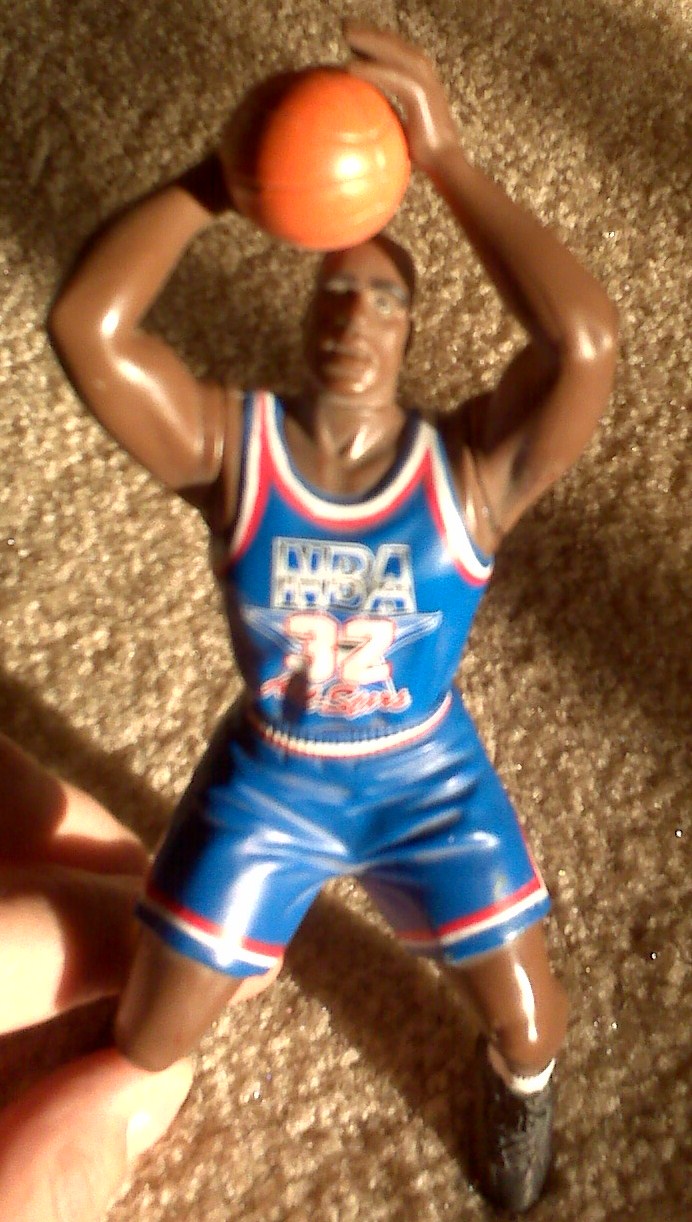
Here's a Shaq action figure. He's donning his 1993 NBA All-Star jersey. This once belonged to my brother. Hopefully he's not still looking for it.
And a Shaq basketball (the signature is not real). I remember taking this ball outside and playing with it once. Then a voice inside my head said, "What the fuck are you doing, Joe? You're going to want this to be in good condition so you can look at it when you're older." Foresight.
This is a Shaq rookie card in which he yams on Alonzo Mourning. Mourning probably got away with the foul.
Also making an appearance: Ol' Jud Buechler from the back-lookin' Tom Tolbert.
Remember me? I was the bald white guy that used to annoy the shit out of you during halftime before Jon Barry. Suck it, Jon. You'd be unemployable if it wasn't for me.
Shaq rookie card equipped with shiny, silver encasement. I thought this one would be worth at least 50 bucks. I saw it on eBay for as low as $1.25.
Shaq should be a controversial figure. Instead, he endeared himself to the media early and kept fans wrapped around his finger. Shaq was great at deflecting his own personal shortcomings into funny quips. He was also a hell of a basketball player, and a cultural icon. We'll remember him mostly for the latter two, and it's probably better that way.
I'm probably being too harsh on Shaq. For all of his perceived character flaws, he was a tremendous player. Probably the most physically dominant basketball player I've ever seen. My appreciation for Shaq's offensive prowess divvies up nicely into three parts, which coincide with his stints in Orlando, Los Angeles, and Miami.
I was five years old when the Magic selected O'Neal with the first overall pick in the 1992 Draft. Growing up, I remember hearing about the physically imposing presence that Shaq was. He unabashedly dunked on his opponents, he brought down backboards, and did so because he was so much bigger and stronger than everyone he went up against. According to the people around me, Shaq was basically a brute. He dominated more because of his strength, almost in opposition to a fruitful set of basketball skills. This partly accurate understanding seems to have stuck.
When Shaq joined the Lakers in 1996, I was mostly preoccupied with the Bulls. Shaq's turn-of-the-decade championship years were when I really started to pay attention. I was intrigued by Shaq because he was still the most physically dominant player in the League -- capable of 30 and 15 every time out -- but possessed skills that I rarely heard people talk about. Sure, many if not most of his points were catches within five feet that he easily threw down. But I remember Shaq's footwork in the post being much more advanced than I would have thought for someone his size. I also thought he was never properly credited for his excellent touch around the basket. This was also around the time when team's began employing the "Hack-a-Shaq" philosophy. Shaq will always be remembered for his poor free throw shooting, mainly because sending him to the line in the early 2000s was the only chance you had at containing him.
Shaq joined the Heat in 2004 with plenty left in the tank. He almost won the MVP after his first year in Miami and was rewarded with a 100 million dollar contract. He began to break down the following year and was never truly the same. Shaq could no longer play major minutes and had lost some of the underrated athleticism that made him more than just a dunker. Forced to contribute in other ways, Shaq became a great passer, particularly out of double-teams in the post, and was a huge reason the Heat won the title in 2006.
O'Neal's last three years have rubbed me the wrong way. He was dealt to Phoenix and made some disparaging remarks about his teammates and coach in Miami on the way out. This was Shaq's specialty through out his career: he burned bridges everywhere he played, and disregarded the efforts and importance of the star player that played alongside him; and even non-teammates such as Yao Ming and Dwight Howard who threatened to take his spot as the next big thing at the center position. He blatantly chased championships during the last two years of his career in Cleveland and Boston. All of this has been swept under the rug though because he's Shaq. And the good-natured, 7-foot goofball couldn't possibly be in it for any other reason than to dunk a few basketballs and share a few laughs.
* * *
It's time to open up "The Box." "The Box" is a white, 16 x 25 cardboard box that weighs roughly 15 pounds and sits atop my bookshelf. It is filled with basketball memorabilia I collected during my childhood, mostly between 1993-2003. I start digging around inside whenever I feel the urge, or something like Shaq's retirement happens. I found a few interesting Shaq artifacts.
Here are a couple of cards from Shaq's Lakers days. Notice the way the back of both cards focus on his size and strength. Click on all of these pictures to enlarge.
The only player with a 40-20 in each of the first two games of a Playoff series. When you accomplish something having to do with points and rebounds that Wilt Chamberlain didn't, you're other-worldly.
In 2000-01, O'Neal scored 974 more points than any other center. By contrast, Dwight Howard led the League in scoring amongst centers in 2010-11. He scored 111 more points than Brook Lopez.
Here's a Shaq action figure. He's donning his 1993 NBA All-Star jersey. This once belonged to my brother. Hopefully he's not still looking for it.
And a Shaq basketball (the signature is not real). I remember taking this ball outside and playing with it once. Then a voice inside my head said, "What the fuck are you doing, Joe? You're going to want this to be in good condition so you can look at it when you're older." Foresight.
This is a Shaq rookie card in which he yams on Alonzo Mourning. Mourning probably got away with the foul.
Also making an appearance: Ol' Jud Buechler from the back-lookin' Tom Tolbert.
Remember me? I was the bald white guy that used to annoy the shit out of you during halftime before Jon Barry. Suck it, Jon. You'd be unemployable if it wasn't for me.
Shaq rookie card equipped with shiny, silver encasement. I thought this one would be worth at least 50 bucks. I saw it on eBay for as low as $1.25.
Shaq should be a controversial figure. Instead, he endeared himself to the media early and kept fans wrapped around his finger. Shaq was great at deflecting his own personal shortcomings into funny quips. He was also a hell of a basketball player, and a cultural icon. We'll remember him mostly for the latter two, and it's probably better that way.
Subscribe to:
Posts (Atom)